



|
RCBJ-Audible (Listen For Free)
 |

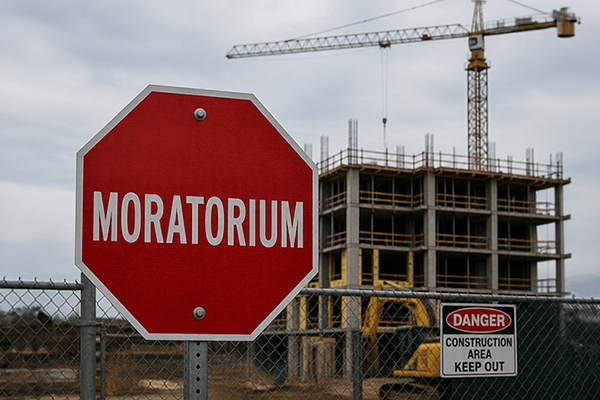
Clarkstown Town Board Considers 6-Month Development Moratorium; Saying It Needs Time To Write New Zoning Regulations
The Clarkstown Town Board on Tuesday will hold a public hearing and vote on a six-month development moratorium impacting several pending development projects.
The local law is billed as a stopgap or interim measure to temporarily “suspend the approval of multi-family development, large scale subdivisions and commercial/industrial development” throughout Clarkstown, with a number of exemptions and carve-outs.
Clarkstown officials have been subject to withering criticism over a bevy of proposed developments, including the 561,000 square foot Cedar Corners warehouse project on 41 acres in Congers, and high-rise multi-family housing projects proposed for both North & South Main Streets in New City.
The moratorium, first proposed at a town board meeting in August, is not an original idea.
CUPON (Citizens United To Protect Our Neighborhood) had urged the Town to consider a building moratorium during the most recent revisions to the town’s Comprehensive Plan. The town demurred.
And Eugene Bondar, the Democratic candidate for Clarkstown Town Supervisor in November’s election, previously proposed a 12-month moratorium, saying six months is inadequate to undertake the changes to the town code necessary to protect the town from overdevelopment. Bondar has called the moratorium a political stunt.
“A six-month moratorium is long enough to look busy before Election Day and not nearly long enough to actually rewrite a zoning code,” said Bondar. If elected, the candidate says he plans to “conduct a full review of the 2023 and 2025 hamlet center rezonings that permitted high-rise buildings before anything is adopted.” Bondar is referring to the changes in the New City Hamlet zones that allows large residential projects on North and South Main Street.
The proposed moratorium would allow one six-month extension by resolution of the town board.
On September 2, the Rockland County Department of Planning found the moratorium “would have no significant county-wide or inter-community impact under New York State General Municipal Law § 239; and therefore, the action is a local decision.”
The moratorium does not affect development in Upper Nyack, whose land-use boards are reviewing a proposal to convert the former Alliance Theological Seminary into a yeshiva for boys at 350 North Highland Avenue.
The moratorium also exempts site plans or special permit approvals for commercial/industrial projects of 5,000 square feet or less; subdivisions containing no more than five lots; and site plans containing no more that five dwelling units.
The moratorium would also exempt subdivisions, site plans, and special permit applications that had either received a negative declaration under SEQRA (State Environmental Quality Review Act) or where written findings were made by the town pursuant to submission of a Final Environmental Impact Statement.
It is unclear whether the moratorium would impact New City Center/Shoprite redevelopment project, which received a negative declaration from the Clarkstown Planning Board in May. That project entails the construction of a 137,686 square-foot five-story, mixed-use building containing approximately 103 residential units together with structured parking, retail uses, a proposed quick-service restaurant.
Litigation is pending in Rockland County Supreme Court to annul the negative declaration based on the Planning Board’s failure to comply with its obligations under SEQRA.
The redevelopment on Camp Champion into senior housing at 175 West Clarkstown Road would likely also be exempt as it received a negative SEQRA declaration, according to the town.
The two developments for residential towers around DeCiccos Market on South Main Street in New City would be subject to the moratorium.
Also exempt would be the approval of any site plan, subdivision, or special permit in the town’s Nanuet Transit Oriented Development zones, including the Nanuet Hamlet Center. The land in the Nanuet TOD zones has sat fallow since the creation of the TOD zones in 2019.
The moratorium would provide a mechanism to relieve property owners from its dictates if the property owner can show by clear and convincing evidence, including a financial analysis that an owner could not make any reasonable use of its property with any of the uses permitted in the relevant zoning district, that the moratorium causes irreparable injury to the applicant, and that it would be unreasonable and unjust not to grant relief from the moratorium.
In August, the Town of Orangetown officially adopted a Local Law placing a temporary 6-month town-wide moratorium on new data storage facilities and battery energy storage systems after engaging expert to review and study the implications of the moratorium.