









|
RCBJ-Audible (Listen For Free)
 |

Environmental Impact and Quality of Life Issues Top List of Concerns Among More than 200 Residents Who Turned Out To Protest Vanta’s Application to Build Three Warehouses on 41 Acres of Wooded Land in Congers
By Tina Traster
A public hearing on a massive warehouse proposal turned into a combination of politicking and small-town theater on Wednesday but that did not take away from the genuine concern scores of Clarkstown residents expressed about the project.
While Democrats used the issue to galvanize support to fight overdevelopment in the Town of Clarkstown, Republican officials took to the government’s Facebook page to tamp down opposition to the Cedar Corners project in Congers while the Planning Board resorted to the unusual step of reading that preamble on the status of the project at the start of the meeting. The statements were designed to slow down panic over a project that residents overwhelmingly oppose because of its significant environmental impact on a 41-acre wooded expanse that includes a significant stripping of trees, adding more trucks to the beleaguered Route 303, air and noise pollution associated with idling trucks, and a host of issues that turned out a large crowd.
Although the issue has been before the Planning Board for more than two years, Democrats running in the November election, along with former Clarkstown Town Board Councilman Peter Bradley, drummed up attention over the application in recent weeks, turning it into a lightning rod for political jockeying.
Prior to the town board meeting, citizen activists along with Democrats running for Town Supervisor and town council, staged a rally to oppose the project, which includes the merging of 16 lots subdivided into three parcels to build three warehouses totaling nearly 600,000 square-feet, along with a fast-food restaurant. Nyack’s Mayor Joe Rand, the Democrat running to unseat Republican State Senator Bill Weber, said to a crowd of roughly 30 people outside town hall “Another warehouse doesn’t generate jobs or economic activity.” He said Clarkstown needs to balance quality of life with responsible development.

Politicking aside, a room filled with more than 200 residents made passionate pleas to the Planning Board to reject the application, particularly many who’ve lived in Congers for decades but also 20-somethings who beseeched board members to factor in climate change, the collateral damage of overdevelopment and the degradation of quality of life.
“Allowing this project to proceed would undo all the work the government has put in to make Clarkstown a better place to live, work, and raise a family,” said Peter Grafstein, a 21-year-old who said his family put down roots in Clarkstown for the abundance of natural green space. “Warehouses are not going to provide any material benefit for the people of Clarkstown, much less for the residents of Congers who will have to deal with the mess of noise, light and traffic on a daily basis. You are selling the town out from under us if you allow this to move forward.”
Brooklyn-based Vanta Developers, the developer of Cedar Corners, briefly presented its Supplemental Draft Environmental Impact Statement (DEIS) for public review, comments and questions. Vanta last appeared before the Clarkstown Planning Board in June, where it presented the Supplemental DEIS, triggering the public hearing to review the update.

After the DEIS is accepted, the Planning Board as lead agency is responsible for gathering comments and prepares the Final EIS. It must adopt a formal, written set of findings, evidencing that the Board took a “hard look” at environmental consequences, balanced social and economic factors, and chose an action that minimizes environmental harm to the maximum extent practical.
Once findings are adopted, the Board can officially approve, deny, or place conditions on the project permits, concluding the SEQR review process.
The property is located on more than 40 acres of CO, COS and LS zoned land on the west side of NYS Route 303, bordered by the CSX railroad to the west and an existing shopping center and several dwellings off Meola Road in Congers. It is designated by New York State as a “significant natural community,” populated with oak and tulip forests, and is part of a 175-acre contiguous habitat for wildlife. The site also has 5.56 acres of wetlands as well as wetlands contiguous to adjacent sites.
In one of the most heart-stopping moments at the meeting, Meghan Raquet said she was born and raised in Congers and is one of Rockland County’s wildlife rehabilitators.
“I have seen firsthand, again and again, the detrimental effects of overdevelopment in our county,” said Raquet. “When land is developed, the animals don’t just disappear into thin air. They end up in my hands and the hands of my colleagues. The deer that get hit on the road, the babies orphaned when trees are cut down, the birds that hit windows, the residents concerned when they see bears and coyotes in their neighborhoods, the rodents caught in traps or poisoned because they are moving into towns. You haven’t watched an animal suffer, because of overdevelopment. I have. And I wouldn’t wish it on anyone.”
Residents gave the board an idea of what it’s been like to live in a community that has been encroached by warehouse development, impacted by brush fires on the CSX train lines, and subject to the disruptions along Route 9W because of the CHPE pipeline project. Many residents talked about the untenable conditions along Route 303, from poor road surfaces to the steady stream of trucks and commercial vehicles.
“I live on Route 303,” said Mary Araneo. “This project is expected to add 342 trucks a day, 24 hours a day. That’s 14 more trucks per hour. No one living on the route will have a quality of life.”
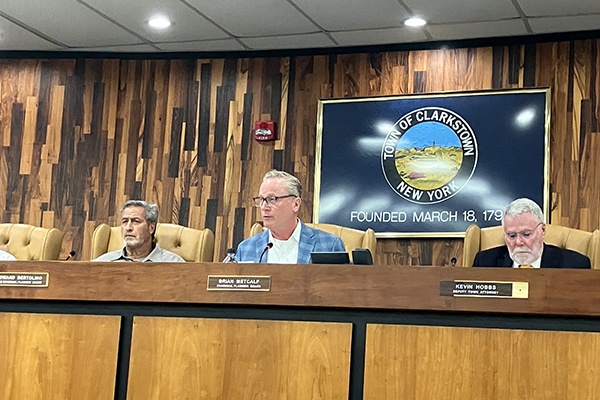
If past is prelude, pleas to the Planning Board to protect the county from environmental impacts will not be heeded. Sometimes the board calls upon the applicant to mitigate traffic or tree loss but rarely is an as-of-right commercial application scrapped. Board Chairman Brian Metcalf told the room the project is zoning compliant and the applicants have the right to build what they are proposing. However, the board is guided by SEQRA (State Environmental Quality Review Act), which requires local and state agencies to weigh environmental, social, and economic impacts before approving projects.






Congers resident Barbara Pfingst said the project, which calls for 561,520 square feet of warehouse space and office space, a 1,500 square foot fast food restaurant, 627 parking spaces and 72 loading berths, would cover “an area of roughly ten football fields.”
“The project would require the removal of more than 1,600 trees and the clearing of a substantial portion of the site’s forested land. This tree canopy provides wildlife habitat, captures and stores carbon, filters air pollutants, reduces surface temperatures, absorbs rainfall, supports natural drainage and helps buffer neighboring properties from noise and industrial activity.
She pointed out that project like these create “heat islands” at a time when climate change is wreaking havoc with hard rains and flooding and said the Cedars Corner project does not exist in isolation.
“It should be evaluated in conjunction with the Valley Cottage Warehouse (the Lincoln Equities 225,000 square-foot warehouse in Executive Park that was widely but unsuccessfully fought and is partly vacant), other existing and proposed industrial developments throughout Clarkstown, and the cumulative transformation on the Route 303 corridor.”
Several speakers urged the board to use its discretion to deny the applicant its request to merge 16 lots. While the board has discretion when it comes to approving lot mergers, blocking the merger could subject the town to litigation.
Halfway through the hearing, while the meeting was paused for a break, Eugene Bondar, the Democrat running to unseat Republican Supervisor George Hoehmann and Town Clerk Lauren Marie Wohl, who is also the Vice Chair of the Rockland County Republican Committee, got into a heated argument over a $138,000 donation given to the Republican Committee last January.
Bondar had publicly said that the donor owned one of the parcels, but public records show the donor owns an adjacent 2.61 acre parcel on Orchard Lane. In an interview with RCBJ on Thursday, Jack Goldenberg, the owner of the parcel said, “I am not involved in any way or shape with the project,” adding that there is a paper road that gives him access to his land.
Another point of contention arose over the applicant’s efforts to secure nearly $6 million in tax breaks from the Rockland County Industrial Development Agency (IDA). When the issue was raised, Planning Board Attorney Kevin Hobbs said there was no such endeavor to seek a tax break, and the applicant nodded in agreement. But Hobbs backpedaled when it was brought to his attention that the application to the IDA was made in the name of GK Congers LLC.
The confusion continued when Hobbs said that tax breaks from the county would have no impact on Clarkstown. In fact, when an applicant receives IDA benefits, towns have the option to participate in PILOT (Payments In Lieu Of Taxes) agreements.
Residents also raised the issue about the lack of transparency about how the warehouses will be used, adding the town has a glut of empty warehouse space. The applicant has not revealed who the tenant or tenants might be for the warehouses, or the fast-food restaurant, including concerns that the fast-food restaurant would operated 24/7 serving truckers.