

|
RCBJ-Audible (Listen For Free)
 |

Clarkstown Struggles To Keep Up With Illegal Occupancies; Police Chief Says House Was Occupied By A Family and Three Room Rentals
By Tina Traster
Neighbors living near the house that burned down at 1 West Burda Place in New City say the dwelling had all the telltale signs of an illegal rental.
“We are very concerned that this is an illegal rental,” the neighbor said. “We don’t want to lose our neighborhood.”
One neighbor said we’ve been monitoring this house, and others, for a couple of years. While another neighbor, who spoke on the condition of anonymity, said, “We’ve been very aware that this is not a typical single family living in a quiet neighborhood.”
The neighbor described six or more cars parked in the driveway, explosive garbage on pickup days, cars coming and going all times of the day and night. He said neighbors witness people coming and going frequently – sometimes different people. They also hear “a lot of noise” coming from the front of the lawn and many different cars. “First it’s a white car, a blue one, then a green one, an orange one, a striped one.”
“We are very concerned that this is an illegal rental,” the neighbor said. “We don’t want to lose our neighborhood.”
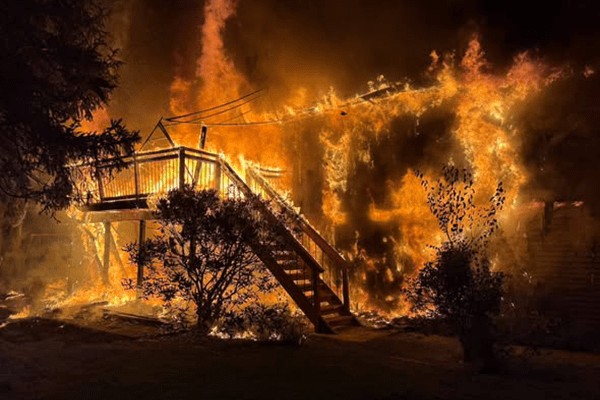
The tragic pre-dawn house fire that broke out around 4 am early Saturday morning destroyed the 1960s three-bedroom split ranch house and killed a dog. News 12 reported that 45 firefighters responded to the fire and the Red Cross was on site helping displaced residents relocate.
The Clarkstown Fire Inspector is investigating.
Police Chief James Fay confirmed on Sunday a police report filed with the department said that a husband, wife and child were living downstairs, while three adults were residing upstairs, “each apparently renting a room.”
Fay said the police officer has completed a Building Code Violation form and referred the situation to the Clarkstown Building Department.
But according to neighbors, Clarkstown was aware that the house was potentially being rented illegally.
“The town had been made aware of the situation in the last several weeks and the house was scheduled to be raided,” said a neighbor, though it is unclear what steps a Clarkstown building inspector or code enforcement officer had actually taken.

The 1,894-square foot, four-bedroom house was purchased from 1 W Burda LLC in April 2026 by Israel and Zissel Mering for $765,000. The buyers live in Brooklyn, according to the deed. The seller, 1 W Burda LLC, was managed by Malka Neiman.
Neiman also manages 47 W Burda LLC that owns 47 West Burda Place, according to public records. Neiman’s LLCs own other houses in Spring Valley, Suffern and Thiells. 47 West Burda Place has no connection to the fire or the alleged occupancy at 1 West Burda Place.
Fay said attempts to reach the landlord at the time of the report were unsuccessful. Police also reported that the tenants did not know the landlord’s name, but they had his phone number.
It is unclear whether the landlord had registered the house on Clarkstown’s rental registry or whether it had been inspected, in accordance to the town code.
In Clarkstown, a landlord is out of compliance if the single-family house is occupied by unrelated people
The scourge of illegal rentals in New City is happening in every town and village in Rockland County. “Investors” snap up vulnerable houses, often on the cheap, and rent them to large groups. In many cases, contractors or taxi company owners will rent the house and fill them with workers, sometimes undocumented immigrants. It’s not unusual to witness what appears to be a “family” living in a house like this because neighbors see the presence of young children or bikes strewn across the property. But the parade of incoming and outgoing mattresses and other furniture gives away the ruse of converting single-family homes into unregistered boarding houses.
Clarkstown is grappling with a slew of instances in which investor-landlords rent homes to home improvement contractors who fill the houses with workers, or illegal immigrants. The town’s code enforcement officer is charged with investigating neighbors’ complaints and bringing the cases to court.

In many of the most egregious cases, it doesn’t require excessive sleuthing to deduce that a single-family house has been converted to a boarding or “multi-family” house. The code enforcement officer’s easiest target is when a house has been carved up, and there is more than one kitchen. However, a dozen mattresses strewn across floors or a parade of cars coming and going day and night or mounds of garbage on pick-up day, is equally compelling evidence laws are being violated.
Typically, landlords participating in these illegal boarding house schemes tend to own more than one house.
In June 2024, Clarkstown Supervisor George Hoehmann, flanked by County Executive Ed Day and Congressman Mike Lawler, held a press conference to announce a crackdown on two landlords who were renting single-family houses in deplorable conditions to people who were clearly not family members. The two landlords, Simcha Schwartz and Wilson Bermeo, owned 17 houses, all illegally rented according to the Town, in deplorable condition with multiple building and fire code violations.
But in December 2024, the town struck a deal with both Schwartz and Bermeo. Both were ordered to permanently refrain from “using, maintaining, allowing, permitting or otherwise acquiescing in the use and occupancy” of the houses cited in the legal proceedings, to be used as anything other than a single-family residence. Under these agreements, the property owners were barred from using the house as a multi-family dwelling or a dormitory/boarding house.
The Stipulation and Consent Order also gave the town the right to inspect the houses at any time for compliance.
A year later, RCBJ reported on a neighbor of one of Simcha’s houses where the problems persisted.
Neighbors who live near illegally converted houses are at the mercy of code enforcement officers. There is little neighbors can do to cure the problem themselves, but residents can be the greatest asset to code enforcement officers. They are the eyes and ears, they have a front row seat, they know what’s going on, and they have the most to lose. When a house is converted to a boarding house, you lose a sense of continuity, safety, stability, on your street. Inevitably it will impact a neighborhood’s quality of life and home prices – when it becomes common knowledge that this kind of abuse is tolerated or goes unprosecuted by a town or village.
The experience of living near or adjacent to a boarding house becomes triggering, a Pavlovian response because you become tuned into the noise or excessive traffic going in and out of driveways. It’s easy to feel worked up as houses languish in disrepair and you wonder what that’s doing to your real estate value – even in a bull market. Neighbors who’ve lived along a quiet street for years tend to know their neighbors – but they don’t know who’s living in these rentals.
In Jan. 2026, Clarkstown passed more stringent code enforcement laws, hired three building inspectors, and created the position of Deputy Town Attorney for Code Enforcement. The law also increased fines for first time and repeat enforcement violations.
The Code Enforcement Hiring Act of 2026 also required one of the three hires to be fluent in Spanish.
RCBJ sought comment from Supervisor George Hoehmann but has not immediately received a response.
*Photo provided by Rockland Fire Coordinator