









|
RCBJ-Audible (Listen For Free)
 |

AARP’s Report Shines Dire Light On Soaring Energy Costs; State & Federal Officials Agree Something Must Be Done To Lower Rates & Produce Additional Energy
By Tina Traster
A new AARP New York survey reveals soaring utility costs are pushing older New Yorkers into financial distress, forcing them to make alarming sacrifices on essentials like food and medication, keeping homes at uncomfortable temperatures, and taking on debt to keep up with rising utility bills.
The report, “Energy Affordability Challenges in New York,” shows overwhelming concern among New Yorkers 50 and older as utility costs continue to climb.
In this election year, state and federal candidates are scrambling to take positions and posit solutions on the energy crisis, which will likely be exacerbated by the Trump administration’s war in Iran and the Middle East. The prolific building of data centers is also straining the system.
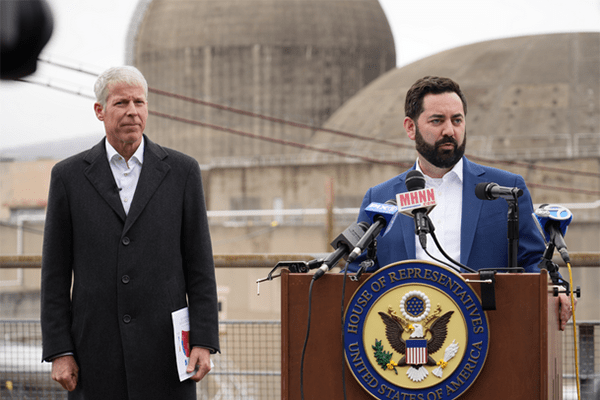
Congressman Mike Lawler (NY-17) on Friday, at a press conference alongside U.S. Department of Energy Secretary Chris Wright, called for the Indian Point power plant in Buchannan, to be rebuilt and reopened as part of a larger plan to lower energy costs and strengthen New York’s electric grid.
Indian Point once supplied nearly 25 percent of the region’s electricity but there is unlikely to be regional support to reopen the plant, which is in the process of being decommissioned.
“Let me be clear – because apparently I was not clear enough for Congressman Lawler and the Trump Administration: restarting the Indian Point nuclear power plant is not welcome in Westchester County,” said Westchester County Executive Ken Jenkins.
But Lawler believes reopening the plant is necessary.

“New Yorkers are now paying nearly 60 percent more for electricity than the national average, and prices have risen dramatically over the past several years,” said Lawler. “You cannot shut down nuclear plants, block natural gas pipelines, and impose costly mandates, and then act surprised when families are hit with some of the highest utility bills in America.”
Lawler says he backs an across-the-board strategy to relieve energy costs including approving critical infrastructure like natural gas pipelines, and clean energy.
The vulnerable congressman who is fighting to be re-elected in November, recently introduced the Economic Recovery for Nuclear-Affected Communities Act, legislation designed to provide economic relief to communities that lost jobs and tax revenue after nuclear plant closures but continue to store spent nuclear fuel onsite. Key provisions would provide financial assistance to communities impacted by nuclear plant closures to support economic recovery, introduce a tax credit for homebuyers to draw new residents and businesses to these areas, and establish compensation for proposals aimed at redeveloping former nuclear sites, facilitating their revitalization.
Officials at the county state and federal level agree that soaring energy prices are unsustainable. Gov. Kathy Hochul and Lawler both agree a comprehensive approach to bringing down energy costs is needed, and both support expansion of nuclear energy. While Lawler is rallying to reopen Indian Point, the Hochul has her sights on “small modular reactors” (SMRs) in upstate New York.
The 2025 State Energy Plan embraces an “all-of-the-above” strategy that leverages hydropower, wind, solar, and firm zero-emission resources like nuclear to anchor the grid as demand grows.

The Champlain Hudson Power Express (CHPE) is on track for completion in mid-2026 and will deliver 1,250 MW of Canadian hydropower directly to New York City. Once operational, the pipeline will deliver up to 20 percent of New York City’s energy, all of it clean.
Prior to the State of the State address this January, Hochul was calling for 1 gigawatt (GW) of new nuclear energy in New York. But in her address, she promoted developing 5 GW of new nuclear power in New York. The new generation small modular reactors (SMRs) typically have a power output ranging from 20 megawatts to 300 megawatts.
The governor recently introduced the NYS Affordable Utilities Omnibus Legislation, which includes measures to ramp up nuclear energy production. The Nuclear Reliability Backbone program directs state agencies to establish a pathway for additional advanced nuclear generation to support grid reliability.
Indian Point operated for six decades before closing in 2021, following years of public concern over the environment and safety risks. Communities waged long and tireless battles to shutter the nuclear reactor, and many doubt there’s an appetite to see the facility recommissioned.
“New York State already has access to a range of low-cost, environmentally responsible energy alternatives, including solar, wind, geothermal and hydropower,” said Jenkins. “We do not need – and we do not want – Indian Point back online. The health and safety of millions of residents in the Hudson Valley will always matter more than reopening a nuclear facility. That’s why I support Governor Kathy Hocul’s plan to expand nuclear energy capacity in New York State in appropriate locations, while excluding New York City, Long Island and the Hudson Valley from consideration.”
AARPs survey shows that among New Yorkers 50 and older who pay a utility bill, 84 percent say costs have increased and 88 percent are worried about costs continuing to rise. To cope with these bills, 56 percent kept their home thermostats at uncomfortably cold levels, 49 percent cut back on basic expenses including groceries, personal care and transportation, 22 percent borrowed money or took on debt and 27 percent paid other bills late. And, 17 percent cut back on medical expenses, including prescription medications.
“Utilities aren’t a luxury; they’re essential to living safely and with dignity,” said Beth Finkel, State Director of AARP New York. “No one should ever have to choose between paying a utility bill, buying medication, or putting food on the table. If we want New York to be truly affordable, we must confront this crisis now, especially how rates are set, to bring down costs for everyone.”
AARP is calling for the passage of several of the state’s proposals, including the creation of an independent utility advocate office to represent residential customers in energy rate cases, the assignment of an independent auditor to review a utility company’s operations and finances if regulators find that rates have become unaffordable, return ratepayer money if a utility earns more than the amount approved by the Public Service Commission (PSC) through bill credits and strengthen utility termination protections for tenants whose landlords fail to pay the building’s energy bills.
The organization is also asking for a temporary pause state taxes on utility bills to provide immediate relief particularly when supply and delivery costs are escalating, as well as return unused ratepayer money being held by the state.

“The results of AARP’s utility affordability survey, while deeply troubling, are unfortunately not surprising,” said State Senator Shelley Mayer, (D-37). “Across New York, rising utility bills burden everyone, including seniors, those on fixed incomes, and middle-class families as well. AARP’s data underscores what we have known for years, and what we have heard in greater numbers following rate increase proposals – New Yorkers are making immense sacrifices to pay their bills. They are cutting back on medical care and medications, taking on more debt, and sacrificing quality of life, and still not seeing real relief. This is untenable.”