










|
RCBJ-Audible (Listen For Free)
 |

What the original DEC restoration proposal involved, why it stalled, and why tidal marsh restoration still matters for fish, birds, and climate resilience along the Hudson
By Christine Toth
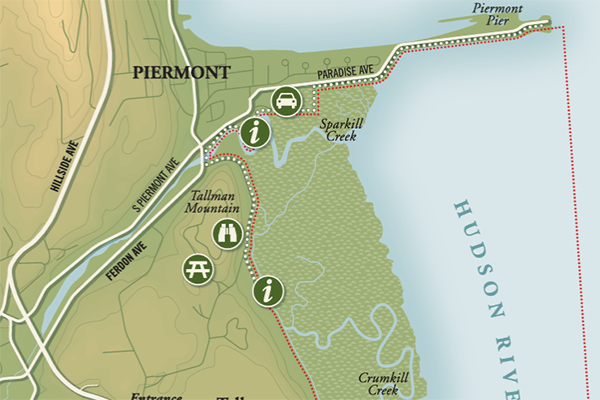
Heading out from the parking lot onto Piermont Pier, with the scent of salt in the air, the walk is lovely — but sometimes it feels oddly empty. On one side, housing units often appear dark and quiet, with few signs of activity: on the other, dense stands of invasive common reed (Phragmites australis). Small birds occasionally appear along the edges, but the layered plant diversity and habitat complexity of a healthy tidal marsh are notably missing.
Piermont Marsh, one of the largest remaining brackish tidal marshes in the Hudson River estuary, is a state-designated significant coastal fish and wildlife habitat. The tides bring in salty water from the Atlantic Ocean mixing freshwater and seawater. Like many northeastern marshes, Piermont Marsh has been degraded by Phragmites, a fast-growing species that crowds out native plants and disrupts wetland habitats. Nearby sites such as Jamaica Bay in Queens and Mill Creek Marsh in Secaucus have done large-scale Phragmites reductions and native marsh restorations, resulting in increased biodiversity— beautiful trails show off their new landscapes.
Amid the global biodiversity and climate crisis, Piermont Marsh offers potential to return to a thriving native tidal marsh — centered around smooth cordgrass (Spartina alterniflora) and other salt-tolerant grasses and rushes, supporting wading birds like herons and egrets, fish, crabs, muskrats, and other wildlife. Native marsh vegetation could increase these populations — expanding habitat for breeding birds, improving nursery grounds for fish and crabs, and strengthening the marsh’s overall resilience to sea level rise. Spartina marshes and Phragmites stands both store carbon and reduce wave energy. However, scientists generally consider Spartina-dominated marshes more resilient in the long term because they maintain tidal channels and support species diversity.

Restoring Piermont Marsh today would be challenging, requiring substantial resources, but there was a time in 2013 when this goal was within reach. The New York State Department of Environmental Conservation (DEC) planned to remove Phragmites and restore natives as part of the Cuomo Bridge’s mitigation plan. While several mitigation measures including oyster habitat restoration, construction controls to protect fish, and stormwater treatment were accomplished, the crucial wetland enhancement at Piermont Marsh was never carried out.
At the time, some residents questioned whether restoring the marsh made sense without addressing Sparkill Creek water quality issues — which they viewed as the underlying issue. The controversy blurred the distinction between marsh mitigation rules and watershed restoration.
New York State owns Piermont Marsh, and the DEC has a legal mandate to manage and restore tidal wetlands under its jurisdiction, including invasive species management. Because Sparkill Creek runs through multiple municipalities and is impacted by sewer infrastructure and stormwater systems, the primary responsibility is at the county and local levels.
In its February 20, 2018 resolution, the Village Board asked that the DEC’s draft be revised “to include funding to enhance the quality of Sparkill Creek storm water entering the marsh.” In a June 19 response letter, DEC declined that request. Ideally, the DEC’s proposed marsh restoration plan could have prompted county and municipal leaders to initiate a complementary effort to improve water quality in the watershed.

Manual removal of Phragmites works for small areas like less than a half-acre while larger scale infestations usually involve a more comprehensive plan. Some residents raised understandable concerns about potential herbicide use at the marsh. However, the proposed aquatic treatments would have been conducted by licensed applicators using formulations specifically approved for use in wetlands — applied in targeted, time-limited phases and subject to regulatory oversight. Alternatively, routine lawn fertilizers and pesticides applied throughout the Sparkill watershed — though legally permitted — are washed by rain into storm drains and waterways repeatedly and cumulatively, without site-specific monitoring or permitting during application.
Around 2017, the DEC discussed a scaled-back draft management plan that involved reduced overall acreage and a phased removal of Phragmites. Local concerns — particularly about herbicide use and the scope of proposed creek enhancements— persisted, and by 2021 the project had stalled. Looking back, the controversy brought to light just how important it is to have a trusted environmental voice ready to explain clearly what is being proposed — and why.
On Paradise Ave, while it’s plain to see that living right beside a state-owned tidal marsh offers stunning views, proximity to protected land should also mean that ecosystem management, including invasive species control, is part of its long-term stewardship plan. In many coastal communities, buffer zones are now standard practice to prevent these sorts of conflicts. In several states, including New Jersey and Maryland, marsh-adjacent buffers of 200–300 feet are commonly required to protect water quality and marsh function — particularly in sensitive tidal systems.
As the climate warms, plant species ranges will continue to adjust, and not every new arrival should automatically be considered problematic. But there is a difference between ecosystems evolving over geological time versus being overrun by one dominant species like Phragmites in few decades. Over hundreds of thousands of years, new species might adapt —birds, fish, mollusks might develop new relationships. But Piermont Marsh has not had that time.
We have lost 3 billion birds since 1970. Along Piermont Pier, well-intentioned, decorative birdhouses are the latest trend. But real birds need more than symbols. They need functioning marshes, native plants, insects, crustaceans and room to nest. It’s easier to celebrate nature when it’s cute and creative. It’s more challenging when it requires uncomfortable choices, intervention and tradeoffs.
Christine Toth is the Conservation Chair for the Rockland Audubon Society