





Working Families Party Jumps On De-Flock Wagon; Rally Planned In Spring Valley October 18
By Tina Traster
In parts of New York State, activists fighting surveillance technology such as Flock cameras, are gaining ground. Some towns have canceled contracts with ALPR (Automated License Plate Reader) vendors, while others are enacting laws that restrict data sharing and access.
There are nearly 3,500 ALPRs statewide.
“Our freedoms have been eroding since 9/11, since the Patriot Act,” said Matt Brockbank, the coordinator for DeFlock New York. “We’re constantly being surveilled.”
In Rockland County, where there are estimated to be somewhere between 160 and 200 cameras, often situated along the county’s border with New Jersey and along State Roads like Routes 303, 304, and 59, there has not been any material pushback to this technology, until now.
A faction of the Working Families Party is leading the effort with rallies to shed light on the concerns over ALPRs, including violations of privacy, the potential for abuse by law enforcement, and concerns over companies like the Georgia-based Flock Safety amassing data that tracks the movement of people 24/7 and stores it in national and international databases.
“We are pushing for statewide bans to cancel this technology,” said Henry Leeker, a member of Rockland’s Working Families Party. Leeker and his colleagues have piggybacked on the DeFlock movement, a national, decentralized advocacy group working to ban ALPR technology. The national group maintains an online map pinpointing where ALPR cameras, including Flock and other vendors are installed.
“The main concern is that the technology has been embedded over a couple of years without any public discussion, without guardrails, with a lack of transparency, and with (municipalities and sheriff’s departments) unwillingness to answer any questions.” Leeker said.
ALPRs are as prevalent as fast-food drive-thru restaurants, maybe even more so. Cameras on ALPRs, situated above or adjacent to public roadways, read and store license plate data. They read the make, model and the year of passing cars. Some read bumper stickers, vehicle damage, roof & bicycle racks, and driver and passenger images.
ALPRs photograph license plates of passing vehicles and upload the pictures onto a cloud server, along with time stamps, locations, and identifying information about the vehicle, such as make and color. Users share data, creating AI-powered law enforcement databases that allow police departments to look at billions of snapshots and track vehicles outside their jurisdictions.







Law enforcement says ALPR cameras are crimefighting tools that help track perpetrators. They say cameras are used to trace stolen vehicles, assist in missing persons investigations and develop leads. But the growing resistance movement, led by DeFlock, says the cameras are a risk to privacy and civil liberties.
Imagine if cameras are used to track people, such as what houses of faith they worship in, what political meetings they attend, what doctors they visit, activists warn.
The organization hosts a crowdsourced map of ALPRs.
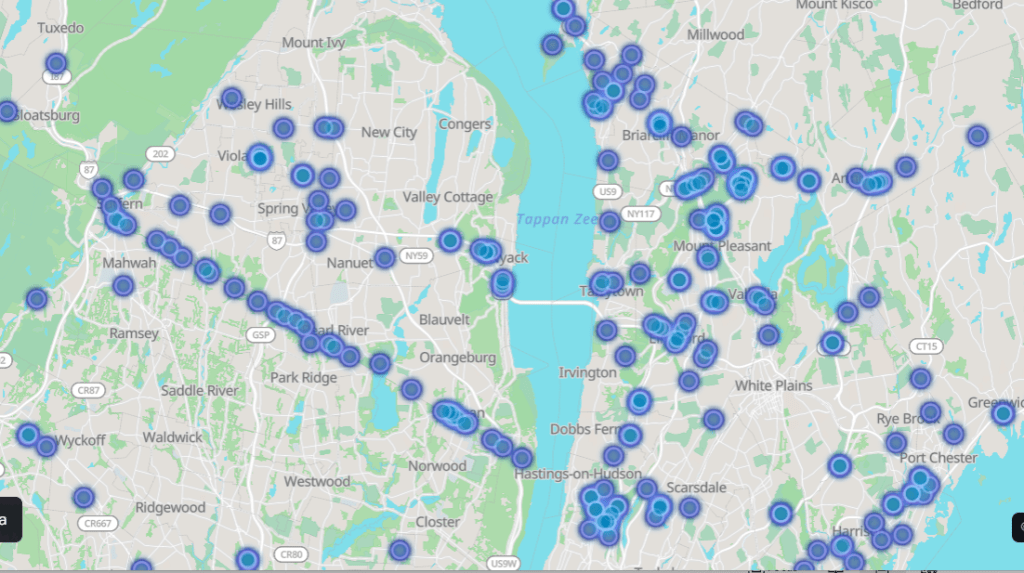
DeFlock says there have been instances in which police have been caught using Flock data to locate women seeking abortion services, stalking and harassment, monitoring protests and aiding ICE. In one instance, Kansas officers used ALPRs to pursue a man who wrote a critical op-ed about the police department, while a Colorado police officer wrongfully accused a woman of a theft.
“Our freedoms have been eroding since 9/11, since the Patriot Act,” said Matt Brockbank, the coordinator for DeFlock New York. “We’re constantly being surveilled.”
Brockbank, who believes this is a bipartisan issue much like the opposition to data centers, said his organization is working with county legislators and city councils to enact legislation to end the use of ALPRs.
Meanwhile, Rockland’s Working Families Party DeFlock group is planning a DeFlock Rockland Walk rally on Oct. 18th at 2 pm in Spring Valley. The group is hoping to walk the streets of Spring Valley and point out where the cameras are situated. They last protested the ALPRs at the Four Corners in Nanuet in August.
Spring Valley Mayor Schenley Vital did not return calls or texts seeking comment.






While Flock has become the household name for ALPR camera surveillance, companies such as Axon, Rekor, Leonardo, Motorola, and others sell similar technology. Rockland County’s Sheriff’s office contracts with Motorola for its ALPRs.
Flock has readers in more than 5,000 communities and 4,800 agencies nationwide. It allows agencies within the national network to store and share data up to 30 days.
Most of Rockland County’s ALPRs have been purchased by either the Town of Clarkstown or the Rockland County Sheriff’s office, RCBJ has learned through FOILs. The towns of Haverstraw and Stony Point do not have ALPRs. The Orangetown Police has fixed license plate readers, but not AI-powered ALPRs. Fixed license plate readers take snapshots of rear vehicle license plates at set points to flag stolen or wanted cars linked to active criminal investigations, whereas the newer generation of ALPR cameras track detailed vehicular characteristics.
The Ramapo Police Department in August cancelled a planned program with Axon to test ALPRs due to community push back over privacy and constitutional concerns.
“The Ramapo Police Department had discussed the possibility of looking at newer license plate reader technology reader technology at some point,” said Town Supervisor Michael Specht. “Axon offered to let us test equipment for a trial period at no cost to the town. Given recent nationwide discussion and controversy surrounding Flock Safety, which was not the system we were considering, we decided to pause exploring the new LPR technology at this time. That could change in the future.”
The Town of Clarkstown in March 2025 contracted with Flock Safety to install 14 cameras for three years for $126,000. The fee was covered by a New York Division of Criminal Justice Service Law Enforcement Technology grant. In June 2026, Clarkstown entered into a second contract for one year for one camera for the JCC in West Nyack, though the camera has not yet been installed.



Clarkstown is the only town that uses AI-driven Flock Safety systems, alongside older, legacy fixed automated license plate readers that are mounted on telephone poles or utility fixtures at intersections.
Among its 14 cameras, five are located on state roads: three on Route 59 near North and South Middletown roads, two on Route 303. There is also a camera on the entranceway at Route 59 and Mountainview Avenue in Valley Cottage and near the Palisades Mall. Many of these cameras are installed on private property in retail corridors, though property owners are not paid a fee. Installing cameras on private property along state roads eliminates the need for a town, like Clarkstown, to seek approval from the New York State Department of Transportation.
Residents worried about ALPRs want information about who can search license plates, how long records are maintained, which law enforcement departments have access to them and how the data is used when a community becomes part of a national or international network.
In the Clarkstown Police Department contract with Flock, it says, “the use of LPR technology is restricted to public safety related law enforcement assignments as authorized by the Chief or Police or his designated agency official.”
It also says, “LPR data can be used to recover stolen vehicles, locate missing persons, confirm a suspect’s alibi, or whereabouts at a particular date and time, and a host of other law enforcement purposes. Data may also be used for Intelligence-Led Policing and predictive purposes, such as to scan and record vehicular activity in high-risk crime locations or detect unusual patterns of traffic.”
Rockland County Sheriff Louis Falco said the sheriff’s department has 55 fixed Automated License Plate Reader (ALPR) sites and 13 ALPR mobile readers.
“Most of the fixed sites are at the ingress and egress points of the county and are part of a project approved by the Rockland County Legislature after the brutal antisemitic machete attack on December 28, 2019, in Monsey,” said Falco. “The suspect was apprehended in New York City using ALPR technology.”
“ALPR technology used in accordance with our policy provides timely, reliable data that enhances response and improves community protection, while responding to crimes in progress, attempting to locate missing persons, or locating a person experiencing an emotional crisis.”
While companies like Flock Safety are growing rapidly, some municipalities are canceling or curtailing the company’s contracts.
A group of Westchester and Putnam residents filed a lawsuit in Westchester County Supreme Court and asked the court to put a stop to the practice in Westchester, claiming it violates their civil rights and makes them subject to illegal surveillance. The plaintiffs, who are seeking class action status, also fear that the dossiers which are accessible to outside law enforcement entities will be misused, and cite cases where out-of-state and federal law enforcement used ALPR data to investigate a woman who obtained an abortion, to surveil protesters, and to support the Trump administration’s mass deportation operations through ICE and the US Customs & Border Patrol (CBP).
Westchester deploys at least 575 ALPR cameras across residential roads and major commuter highways.
In February, the ACLU filed an amicus brief in a Fourth Circuit case arguing that the use of ALPR systems gave the government unprecedented powers of surveillance that upset traditional expectations of privacy in violation of the Fourth Amendment.

In late July, Rockland County’s District Attorney Thomas Walsh issued a press release acknowledging that law enforcement agencies have at their disposal powerful technologies: “school bus cameras, Sky Eye helicopters, surveillance cameras, license plate readers, facial recognition systems, digital forensics, drones and artificial intelligence.”
He said, “These increasing ubiquitous tools help solve crimes, protect victims, locate missing persons and prevent wrongful convictions.” But added, “extraordinary technology requires transparency and accountability.”
RCBJ asked what prompted this press release but received a response that repeated the words in his release and did not offer an explanation.
Walsh mentions school bus cameras, referencing the BusPatrol program the county has contracted with to equip school buses with camera readers on the arms that extend when a bus stops to load and unload children. BusPatrol contracts with more than 400 school districts operating 40,000 cameras. Its original pitch was to keep children safe.
But now BusPatrol’s marketing admits, according to City and State, the company is looking to pitch a partnership with law enforcement. Its platform advertises access to live and historical bus location and video, integrated with real-time crime centers and 911/CAD systems, crash notifications and situational awareness for cases involving missing people. This level of surveillance raises the same kind of questions at ALPRs, only even more so because data collected captures the daily movements of America’s children, becoming tools of roving surveillance.