
|
RCBJ-Audible (Listen For Free)
 |
The Understory Provides Important Year-Round Habitat, Even After Deciduous Plants Have Dropped Their Leaves
By Christine Toth
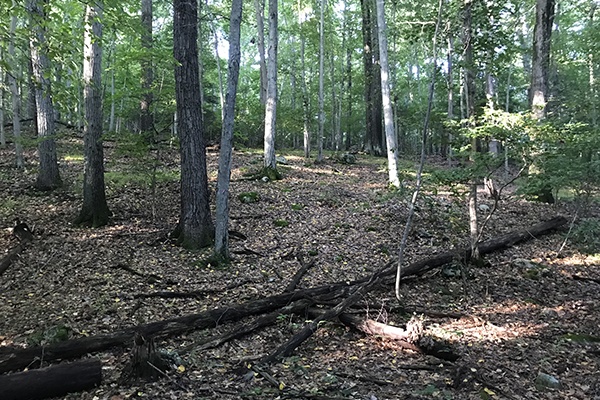
Riding along Seven Lakes Drive, the lush, green forest on either side of the road can be deceptively reassuring. A closer look reveals that, in some sections, a critical layer of a healthy forest—the understory—is noticeably missing.
Has the loss of dense forest understory and early-successional vegetation reduced Harriman’s suitability for birds that nest or forage near the ground?
The loss of forest understory, an issue rarely discussed, includes the decline of both the shrub layer and the wildflower ground cover that many birds and insects depend on for food, shelter and nesting. It also threatens the forest’s ability to regenerate.
With 31 lakes and reservoirs, 200 miles of hiking trails, and the Appalachian Trail running through it,
Harriman State Park is New York’s second-largest state park. Like many forests throughout the Northeast, Harriman has experienced a loss of biodiversity and plant regeneration associated with long-term over-browsing by white-tailed deer.
Historically, large predators such as mountain lions, also known as cougars, and gray wolves helped limit deer populations. European settlers gradually eliminated these predators from New York to protect livestock and settlements.
Suburban development in places such as Rockland County cleared extensive forests, leaving behind smaller wooded areas intermixed with parks, lawns, gardens, and golf courses. Over time, this created plenty of edge habitat, providing deer with an advantageous combination of forest cover and easily accessible food. Along with the disappearance of their primary nonhuman predators and other changes in the landscape, these conditions allowed deer populations to increase to levels that can severely damage forest understories.
Although we may imagine birds nesting high up in the tree canopy, some species depend far more heavily on the shrub layer or even the forest floor. Historical accounts document Nashville Warblers, Canada Warblers, and Hermit Thrushes breeding in Harriman’s high interior, including records from Island Pond, Surebridge Swamp, Pine Swamp, and Hogencamp Mountain. However, in New York’s most recent Breeding Bird Atlas, far less breeding evidence was recorded for these species in Harriman.
These records do not prove why that difference exists, but they raise an important question: Has the loss of dense forest understory and early-successional vegetation reduced Harriman’s suitability for birds that nest or forage near the ground?
The question is especially troubling for the Canada Warbler, whose population has declined sharply across its range. Birds arriving in Harriman during spring migration may now encounter far less dense understory than historical accounts suggest was once present. In comparison, Nashville Warbler and Hermit Thrush remain more secure across their ranges, making their apparent decline as Harriman breeders more suggestive of changes within the park itself.
The understory also provides important year-round habitat, even after deciduous plants have dropped their leaves. Although historically present in Bear Mountain–Harriman Park, the ground-dwelling Ruffed Grouse has not been recorded on the Rockland Audubon Christmas Bird Count since 2001, suggesting a substantial decline in the surrounding landscape.
Beyond the loss of wildlife habitat, the disappearance of the understory poses another serious threat. In a healthy forest, when mature trees fall during storms or perish from invasive insects or other reasons, young trees eventually grow to replace them. When deer repeatedly consume seedlings and saplings, however, the next generation of trees may be missing.
Northern Pennsylvania’s Allegheny Plateau serves as a wake-up call. In parts of this once mature, multilayered forest, heavy deer browsing, combined with logging and other disturbances, prevented many tree seedlings and understory plants from growing. Ferns that deer generally avoided expanded across the forest floor, creating areas sometimes described as “hay-scented fern savannas.” Once established, these fern communities can further hinder the regeneration of native trees and plants.
To begin addressing the loss of forest biodiversity and regeneration caused by long-term deer over-browsing, New York State Parks introduced a controlled deer-hunting program in Harriman during the 2025–26 season. For the 2026–27 season, the program is expanding hunting access by 2,300 acres northeast and southwest of Lake Welch. Parks is also offering 150 additional permits across the approximately 20,000-acre hunting area, bringing the total to 500 permits.
Sadly, the loss of forest understory extends beyond Harriman into other wooded areas of Rockland County. It is a far-reaching environmental problem that receives unusually little public attention.
At planning board meetings, we often hear how many trees will be removed from a project site: 1,600 trees, 117 trees, or some other number. Those figures are significant, but they do not tell the entire story. Native understory trees and shrubs—such as witch-hazel, mountain laurel, and young red oaks— may never appear in those totals because they are too small to meet the counting threshold.
The irony is that while these plants may not even be counted during the planning process, they are becoming increasingly valuable parts of our forests. Protecting a forest includes looking beneath its largest trees and noticing the layers there—the wildflowers, shrubs, seedlings, saplings, and ground-nesting wildlife upon which the forest’s ecological balance and its future depend.
Christine Toth is the Conservation Chair of the Rockland Audubon Society