








|
RCBJ-Audible (Listen For Free)
 |

Bird Window Collisions And What A Local Research Institution Is Doing About It
By Christine Toth
In the spring of 2025, I was invited to walk the Lamont-Doherty Earth Observatory campus in Palisades, NY to better understand a long-standing but largely unseen problem: bird–window collisions. As we moved around campus, staff pointed out a few birds that had perished days earlier. I had heard about bird collisions before — but then we turned a corner and came upon a bird still on the ground, its beautiful orange-red breast face up.
It was a freshly killed American Robin still warm to the touch.
Just above it, the impact mark was clearly visible on the glass — shocking in its clarity.
That moment made the issue real to me in a way statistics never had.
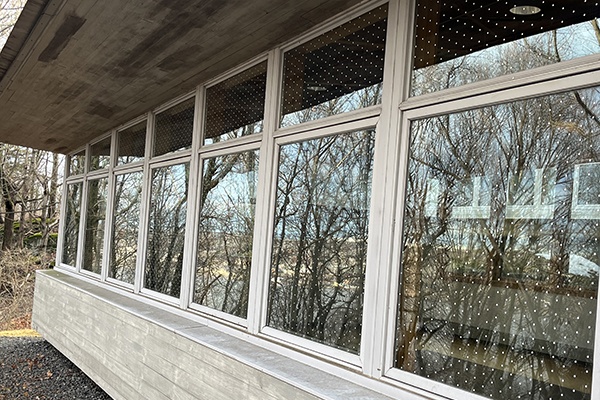
North American bird populations have experienced steep declines, with nearly three billion birds lost since 1970. Among the many pressures facing birds today are window collisions, predation by free-ranging domestic cats and habitat loss. Each year, an estimated one billion birds in the United States are killed after colliding with glass. Reflections of trees and sky can make windows appear like habitat to birds, particularly during migration seasons when birds are navigating unfamiliar landscapes. Although skyscrapers receive the most attention, homes and low-rise buildings account for the majority of bird-building collisions.
To help address this common but often overlooked conservation issue, Rockland Audubon Society partnered with Lamont-Doherty Earth Observatory, a globally-renowned research and education institution where Earth scientists and students seek fundamental knowledge about the origin, evolution and future of the natural world, on a bird-safe window pilot project at their campus.
“Once we realized the extent of the problem on campus, we had to do something,” said Lamont microbial oceanographer Sheean Haley. “With some research, we learned that there are already effective solutions for this problem, and some of these solutions can be applied quickly and at low cost. The partnership with Rockland Audubon made this possible. ”
The initial phase of the project, which was supported by the Lamont Ecosystems Impact & Stewardship Committee (LEISC), focused on sections of the Monell Building where window collisions had been reported. For portions of the building, uniformly patterned, closely spaced (typically 2” x 2”) dot decals from Feather Friendly® were applied to the window exterior to reduce collision risk. Treating windows with this widely-used and science-backed approach reduces bird window collisions often up to 95% while being unintrusive to humans, preserving natural light and building aesthetics. To complement the
Feather Friendly installation, LEISC members made and installed low-cost, do-it-yourself (DIY) paracord “curtains,” called Acopian Bird Savers on nearly all remaining windows of the Monell building. This project exemplifies one of the first large-scale bird-safe window retrofits in Rockland County, amplifying this research campus into an example of bird-safe infrastructure and public education.
This fall, as humans fall into the routine that comes with the start of a new school year, migratory birds will begin their own seasonal routine and follow the warmth and food south. Vast numbers of migrating birds travel along the heavily urbanized Atlantic Flyway during their challenging yearly bird migrations to locations as far away as the Caribbean, Mexico and Central and South America — some passing through the Hudson River corridor and along the Palisades on their journey. Undoubtedly, birds will face a host of potential dangers along their way, including habitat loss, extreme storms, light pollution, predators and sheer exhaustion. Monell, a cliffside building at Lamont, will be ready for them. The trees and sky that birds see will be real and not a dangerous reflection in glass — one more obstacle now removed from an already difficult journey.
Christine Toth is the Conservation Chair for the Rockland Audubon Society