









|
RCBJ-Audible (Listen For Free)
 |

Keynote Speaker Brian S. Cohen Says The Rule of Law Can Erode From Within
By Tina Traster
Under any circumstance, a Yom HaShoah commemoration is a solemn, meditative moment to reflect on those lost in the Holocaust and a calling upon Jews and their friends and neighbors to stay vigilant and engaged to prevent similar genocide of the Jewish people.
But this year’s 15th annual Yom HaShoah 2026 ceremony at the Rockland County Courthouse took on a deep sense of urgency and warning at a time when antisemitism is rising at an alarming pace at home and abroad, the Middle East is a tinderbox, and the rule of law in America is being tested.
“In years past, this commemoration has been largely symbolic,” said Paul Adler, a commercial real estate professional, philanthropist, and involved member of the Jewish community who leads the event annually. “Today I’m afraid this is a pressing issue. It is a warning. And that warning has never felt more urgent than it does right now.”
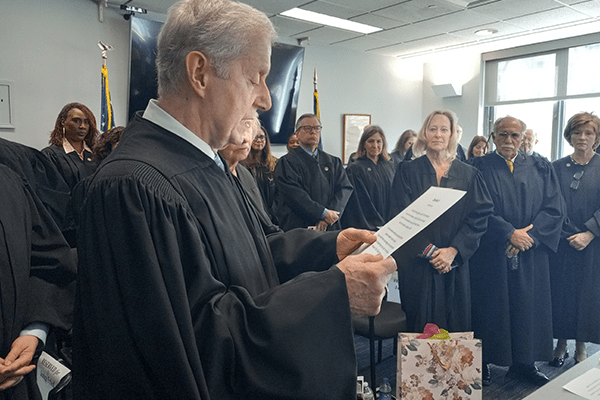
Nearly 300 people packed into the Juror’s Room in the Rockland County Courthouse Tuesday to share the moment. All the speakers’ remarks pointed to the breakdown of 1930s German society, and how it led ordinary men and women, including members of the judiciary, to normalize lawlessness and dehumanization. It was impossible to listen to these stories and history lessons without thinking about the mass roundup and inhumane treatment of immigrants playing out under the Trump administration, as well as measures taken against other marginalized groups in America today, including the transgender population.
Adler and others, including Justice Anne E. Minihan, Administrative Judge of the 9th Judicial District, and keynote speaker Brian S. Cohen of Lachtman Cohen & Belowich, who is President of the Westchester County Bar Association, anchored remarks in the palpable threat facing American democracy and The Constitution, though without citing specifics.
The event was co-sponsored by the Justice Brandeis Law Society 9th Judicial District, the Rockland County Bar Association, and the Holocaust Museum and Center for Tolerance and Education.
“Never Forget. Never Again” is the phrase Jews use to remind the world of an unthinkable tragedy in which six million Jews were murdered. Yom HaShoah, translated from Hebrew as “Holocaust Remembrance Day,” is an internationally recognized date that marks the anniversary of the Warsaw Ghetto Uprising in 1943.
We say those words every year,” said Adler. “We say them here, today. But you cannot repeat a slogan and believe the work is done.”

Adler said the words require us to “recognize the pattern.” He said, “systemic persecution does not arrive fully formed. It arrives in increments – in legal increments. In the Aryanization of commerce, the legalization of exclusion. In the bureaucratic designation of who belongs and who does not. In the slow erosion of an independent judiciary. In the moment when judges swear allegiance not to a constitution, but to a man.”
Though that reference might have been to Hitler, or any autocrat, it is clear America’s president is endeavoring to emulate world dictators, and that the rule of law has been bruised but not broken.
“When hatred is treated as just another opinion in the marketplace of ideas, truth begins to erode,” said Cohen, a tall and elegant silver-haired men who spoke with passion and purpose. “When language that calls for violence is normalized, excused, or dismissed as merely symbolic, it weakens the boundaries that protect civil society.”
Over the past decade, through political division and an uncivil tone boosted by the ease and carelessness of the Internet, civil society has been disintegrating. Politicians increasingly target and scapegoat to assume, amass and retain power. This has an uneasy echo of 1930s Germany, when Jews were disenfranchised, dehumanized and extinguished in European concentration camps.

“Today we’re hearing rhetoric in public life that, for many Jewish people, evokes fear,” said Cohen. “Phrases like ‘Globalize the Intifada’ and ‘we support Hamas’ have been chanted in public spaces and echoed in political discourse, he said. “For some it may sound like a slogan. But for Jews, it recalls years of terror attacks, bus bombings, and civilians targeted simply because they were Jewish.”
The Yom HaShoah commemoration takes place annually in the courthouse, and as Adler says, “that’s not by accident.” It’s an austere sight to see the robed judges together in one room taking part in a sober ceremony that has meaning beyond Judaism. The occasion is a reminder that the judiciary is democracy’s key line of defense.
“The rule of law can erode from within,” said Cohen. “It can be dismantled not only by violence, but by statute. Not only by force, but by decree. And once the rule of law gives way, rights give way with it.”
Cohen said history doesn’t repeat itself in identical form but it “depends on vigilance, separation of powers, and on courts that remain independent.”
His words reverberated at a moment in our history when the First Amendment is under attack, due process is routinely denied, the courts are abused for political retribution, and the separation of church and state is becoming increasingly blurred.
Minihan referred to the Holocaust as a “darkness that defies description,” but used a parable told to the writer Anne Lamott, who borrowed it from a pastor.
She recounted the story of a little sparrow on its back with its spindly legs up in the air. A warhorse comes by and asks him what he’s doing. The sparrow says he’s trying to hold up the sky, which is falling. The horse points out he only weighs an ounce and wonders what impact could he possibly have. And the sparrow says it’s up to everyone to do their part.
“No one has to hold the sky by itself,” she added, adding the Holocaust was a time when darkness crept in and people watched in horror. She urged everyone to do some small part, because “every day now the sky seems darker.”