











|
RCBJ-Audible (Listen For Free)
 |

Clarkstown Proposes Six-Month Moratorium On New Multi-Family Developments and Large Scale Industrial Projects
The Clarkstown Town Board has proposed a local law that would impose a six-month moratorium on new applications for the approval of multifamily developments, large scale subdivisions, and commercial/industrial developments. The moratorium, short on details, would include data center applications.
Clarkstown officials have been subject to withering criticism over some larger proposed developments, including the 561,000 square foot Cedar Corners warehouse project on 41 acres in Congers, and a raft of high-rise multi-family housing projects proposed for both North & South Main Streets in New City.
The moratorium would not impact these projects.
According to the town, smaller subdivisions, individual residential projects, commercial or industrial projects under 5,000 square feet, and developments within the Nanuet Hamlet Center would be exempt.
The basis for the moratorium, according to the town, is tied to potential zoning changes based on findings from the Routes 303 and 304 Safety & Sustainability Study, the town-wide traffic signalization study, and recommendations of the Clarkstown Community Preservation Board. The latter is a newly formed board that will oversee and make recommendations on land conservation.
The town also cited recent changes to the State Environmental Quality Review Act (SEQRA), which impacts the town’s role in environmental review of multi-family housing developments, saying it wants more time to study the impacts.
The town was recently granted approval from Gov. Kathy Hochul for the Clarkstown Community Preservation Act, which requires a town-wide referendum to become local law. The Governor signed the Act on July 31. Clarkstown missed the Aug. 3 deadline to put the referendum on the Nov. 3 ballot. (See story below.) It is unclear when the referendum will be scheduled and whether the moratorium will stay in place until it is.
The proposed moratorium was not published on the agenda in advance of the meeting; it added at the last minute. And the town meeting, normally broadcast on public access TV, was not live Tuesday evening.
The proposed law was referred to the Town Planning Board for a review and non-binding recommendations. Under the GML, the moratorium must also be reviewed by the County Planning Department.
Supervisor George Hoehmann said the moratorium, is “an opportunity to refine our vision for responsible growth while preserving open space, protecting our environment, and ensuring that our infrastructure and community services can support the development that takes place in Clarkstown.”
A public hearing on the proposed moratorium is scheduled for Sept. 15 at 6:30 p.m. at Clarkstown Town Hall, provided the reviews are completed in time by the County and Clarkstown Planning Board. This date seems highly unlikely given that both the Clarkstown Planning Board and the County Planning Board need to complete their reviews and recommendations.
In Orangetown, a public hearing will be held August 25 at 7:05 pm, for a proposed local law establishing a temporary moratorium on approval, construction and installation of Battery Energy Storage Systems and Data Centers. The moratorium only impacts new applications.

Clarkstown Misses Deadline To Have Its Community Preservation Act On This November’s Ballot
The Clarkstown Community Preservation Act (CCPA), if approved by voters in a mandatory town-wide referendum, would impose a one-time .75 percent transfer tax on real estate sales paid by home and commercial building buyers in Clarkstown.
New York State imposes a .40 percent tax on real estate transfers.
The referendum on the law, signed by Governor Kathy Hochul on July 31, will not appear on the November 3rd ballot because Clarkstown missed the August 3rd deadline for inclusion on the ballot.
According to the Rockland County Board of Elections, which confirmed the missed deadline, the Town could either hold a special election in the future or wait until November 2027 to hold the referendum. With even-year elections going forward, turnout on odd-year elections would likely draw out fewer voters.
The town says, the “landmark legislation” will serve as “an essential tool to preserve open space, land, natural resources, historic landmarks, critical agriculture and water resources, and much more in the Town of Clarkstown.”
According to real estate data platforms, the added transfer tax on a median priced single-family home in Clarkstown would be about $5,000. The town assessor’s office estimates the transfer tax will generate nearly $5 million a year for the town to purchase land for qualifying purposes.
Critics of the CCPA say adding a tax on the purchase of a home will serve to make it harder for buyers, especially first-time buyers, to afford a home. The New York State Association of Realtors says, “New York is in the midst of a housing supply and affordability crisis. The state’s housing inventory continues to remain stagnant.” The organization says the legislation makes it “even harder to buy a home.”
Other critics say that CCPA will siphon equity from home-sellers because property values will be impacted by the amount of tax the buyers pay.
“It is nothing more than an exit tax on everyone who has built equity in their homes and downsizes or moves out of Clarkstown,” said a local resident, who asked not to be identified.
Town officials in a press release say other methods of securing funds for preservation “such as massive bond issuances or the creation of a new conservation-taxing district would impose a permanent or near permanent annual tax on every property taxpayer in the town. The Clarkstown Community Preservation Act avoids that while providing protected and guaranteed funding.”






UOVO Plans Warehouse Expansion At Existing Kings Highway Location
UOVO, a fine art service company with locations in Orangetown, Brooklyn, and Long Island City has an expansion plan for its arts storage facility at 33 Kings Highway in Orangeburg. To facilitate the expansion, it has asked the Orangetown Town Board to change the zoning on its Kings Highway property to LIO (Light Industrial Office). The parcel is currently split between R-40 (residential) and LIO.
The plan includes the addition of 54,657 square feet of art storage warehousing to the existing 94,000 square foot facility on the 12-acre site. The southeastern 3.00-acre portion of the site is in the R-40 zoning district, where a fire access road will be constructed. A variance is required for expansion of its nonconforming use.
The LIO district permits, among other uses, business/professional offices by right, light manufacturing facilities as a conditional use, and storage of goods or equipment only as an accessory use. Warehouses are not permitted as a principal use in the LIO zoning district, though other warehouses currently exist in Orangetown’s LIO districts.
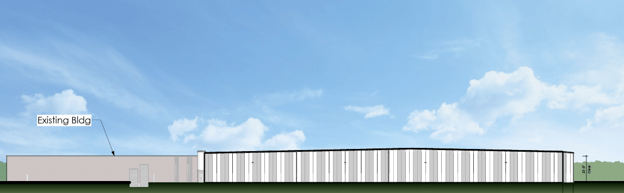
The Orangetown Comprehensive Plan, adopted in 2023, includes a chapter on Current and Future Land Use, Zoning, and Design which recommends that warehouses continue to be permitted only in the LI zoning district.
UOVO also operates a 140,000 square foot climate- and temperature-controlled storage facility at 100 Bradley Parkway in Blauvelt.
UOVO offers a full range of services including climate-controlled storage, digital inventory management, secure transportation, packing and crating, archiving solutions, private viewing galleries, and art installation.
A public hearing is scheduled for September 8, before the Orangetown Town Board on the proposed zone change.




adrotate banner=”169″]