










|
RCBJ-Audible (Listen For Free)
 |

Property Owner Adjacent To Shoprite Redevelopment Charges Inadequate Review Of Contamination On And Adjacent To Brownfield Site
A lawsuit filed yesterday in Rockland County Supreme Court against the Town of Clarkstown, its Planning Board, the New York State Department of Health, the New York State Department of Environmental Conservation, and the developer of New City Center alleges that Clarkstown greenlit the redevelopment project without adequately studying its potential environmental impacts as required by New York State’s Environmental Quality Review Act (SEQRA).
The redevelopment of New City Center, also known as the Shoprite Plaza, on North Main Street in New City entails the construction of a 137,686 square-foot five-story, mixed-use building containing approximately 103 residential units together with structured parking, retail uses, a proposed quick-service restaurant, roadway modifications, grading and excavation activities, stormwater infrastructure, retaining walls, utility work, and extensive site disturbance activities.
Last month, the developer cleared a major hurdle, convincing members of the Clarkstown planning board that issues related to an environmental easement put in place by the DEC would not pose a significant adverse environmental impact to the project. The easement stemmed from the cleanup of onsite contamination left by a dry cleaner that closed its doors two decades ago.
Petitioner Ricardo Fijor owns property at 11 East Evergreen Road where his elderly mother resides. The property is adjacent to and essentially surrounded by the proposed redevelopment of the shopping center.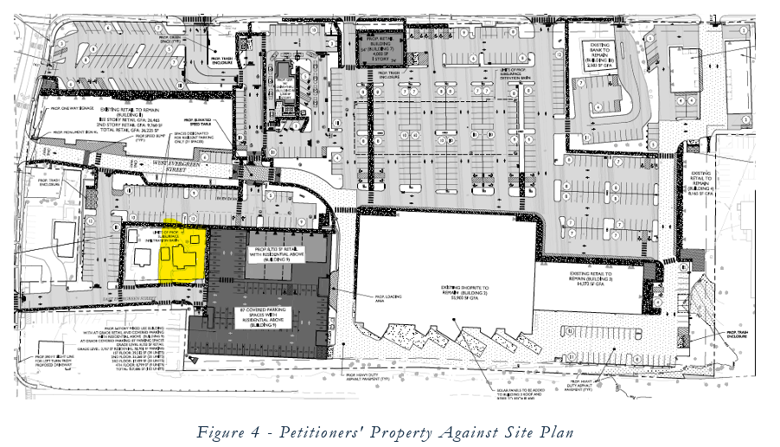
In March, Fijor’s attorney Robert Zitt called on the planning board to take a deeper dive into ongoing environmental impacts of contaminants left behind by the shuttered dry cleaner, even though the site was remediated back in December of 2015. He was concerned that the contaminants, including tetrachloroethene (PCE), and to a lesser extent PCE breakdown products, may still be traveling underground in the groundwater, outside the area of the original contamination.

An environmental easement limits the use of the areas in the Brownfield Cleanup Program (BCP) boundaries to “commercial” and “industrial” uses as defined by the DEC. It does not allow for “residential” use. The residential component of the proposed redevelopment project lies outside the BCP easement limits.
Shoprite Plaza covers more than 14 acres, but the contamination from the dry-cleaning operation affected only 1.14 acres of the site, primarily around the buildings housing retail on the southern portion of the site, and fanning out toward North Main Street and encompassing West Evergreen.
The shopping center is part of the New York State Department of Environmental Conservation’s Brownfield Cleanup Program. An eight-year clean-up was completed in March 2015. The cleanup showed that the soil, groundwater, and soil vapor were contaminated with tetrachloroethene (PCE), and to a lesser extent, PCE breakdown products. The contaminants have been contained but the state requires the property owner to monitor the property and file reports.
On May 20, the planning board issued a Negative Declaration under SEQRA and gave preliminary approval to the developer’s plans.
SEQRA requires agencies to identify relevant areas of environmental concern, take a “hard look” at those concerns, and provide a reasoned elaboration for their determinations.
Fijor charges that the Planning Board failed to take the requisite “hard look” at numerous substantial environmental concerns associated with the redevelopment, including the “historical expansion of the contamination plume beyond the original Brownfield Cleanup Program boundary.” That failure to take a “hard look” violated SEQRA.
The petition says an Environmental Impact Statement should have been prepared enabling a meaningful study of the potential harms, necessary mitigation measures, and alternatives to the current plans.
Fijor says the Planning Board “approved an extraordinarily intensive mixed-use residential redevelopment involving long-term residential occupancy directly adjacent to and, upon information and belief, within areas historically associated with plume migration, groundwater contamination, and vapor intrusion concerns” and that that approval was arbitrary, capricious and illegal.
In a nutshell, the petition says the record before the planning board demonstrated the existence of numerous potentially significant adverse environmental impacts associated with the redevelopment. Unresolved environmental concerns remain about the Brownfield contamination and how it may impact new and existing residents living in proximity to the original contamination. The migration of the contaminants beneath the site into the residential areas is a potential significant environmental impact that needs to the evaluated, not overlooked.
In addition to SEQRA violations, Fijor also charges various zoning violations that he says the planning board also overlooked. He is concerned about the impact the project will have on his property which is essentially surrounded by the redevelopment and sits in the shadow of the proposed residential structure.
In the Article 78 filing, Fijor asked the court to annul the Planning Board’s preliminary approval of the shopping center’s redevelopment plan, annul its Negative Declaration under SEQRA, and restrain the town from advancing the project pending further order from the Court.
The Court entered a Temporary Restraining Order stopping the project’s further advancement and set a court conference for Monday afternoon at 2:00pm.