










|
RCBJ-Audible (Listen For Free)
 |

New York Attorney General Objects To Knights’ Scheme To Change Its Status, Which Would Give Knights Free Rein To Sell Building Without AG or Court Permission
By Tina Traster
A lawyer representing the New York Attorney General’s Office in court this week said there appears to be “insider goings on” in the case concerning the Knights of Columbus, and the future of its building.
The Attorney General, which is urging a Rockland County Supreme Court justice to reject the Town of Haverstraw’s effort to enter into a 25-year lease with the Knights of Columbus, told Justice David Fried that the Knights are not a party to the court case but should be, the holding company (that holds title to the building for the benefit of the Knights) can’t be separated from the Knights of Columbus because their mission is the same, and that the terms of the lease are egregiously unfair to 250 members of the fraternal order who seemingly did not get to vote to lease the building.
Further, Sandra Giorno-Tocco, who is representing the Attorney General’s Charity Bureau, raised concerns about a potentially biased property valuation report paid for and prepared for the town instead of the Knights.
The June 16 hearing had been set for the Knights’ attorneys to argue its petition on behalf of 56 West Broad Street Angels Holding Inc, which is asking the court for permission to change its status from a charitable to a non-charitable, nonprofit corporation. However, last week, Girvin and Ferlazzo, an Albany-based law firm representing the Knights’ holding company, asked the court to hold a conference to discuss amending its petition after receiving the Attorney General’s objections.
After a 40-minute discussion, Fried granted the holding company 45 days to send a “proposed” amended petition to the Attorney General. The Attorney General has 45 days to object to the amendment. If the AG’s office accepts the amendment, the case starts anew. Accepting the amendment does not equate with AG approval of the transaction.

The holding company’s attorneys, who were selected by and are being paid by the Town of Haverstraw, indicated a willingness to add the Knights of Columbus to the petition but gave no indication to the court how else it might amend its requests or potentially change the terms of the lease contract. The Town of Haverstraw has been using taxpayer money to fund the legal costs for the case, and for its previous legal efforts to seek permission from the AG’s office to allow the Knights holding company to donate its building at 56 West Broad Street to the town.
For more than two years, Haverstraw Town Supervisor Howard Phillips, who was present in court this week, has led an effort to take hold of the Knights’ building in the Village of Haverstraw. A plan for the Knights to sell its building to an affordable housing developer for $2.4 million in 2024 was scuttled after Phillips persuaded a couple of newly sworn-in members of the Knights’ board to donate the building to the town. That plan went sideways when the Knights recognized it would not receive AG approval, and the Town and the Knights withdrew the effort and cooked up a new scheme for a long-term lease.
However, the provisions of the lease, and the way in which the 56 West Broad Street Angels have pursued the necessary approvals needed for a charity to change its structure, have presented one obstacle after another.
Fried is being asked to decide on two matters: whether 56 West Broad Street Angels can change its charitable status and whether the lease arrangement is equitable for the fraternal order.
The Attorney General objects to both.

The greater issue looks at whether the holding company can simply change its charitable status to be free of AG scrutiny. The AG’s counsel argues the request constitutes an impermissible and fundamental change of the organization’s “charitable character and purpose.”
In its written response to the petition, the AG writes: “it is apparent that this proposed change is not a clarification of an existing status, but rather a fundamental redesignation of the entity’s corporate type and purpose. The OAG takes the position that the organization established as, and continued to function as, a charitable entity as defined by New York law.”
In court, she said the AG’s review of how the holding company functions shows that it sends its income to the charity. “Any income it acquires flows back to the Knights of Columbus, which is reported on its IRS Form 990.” The 990 is similar to a tax return for non-profits.
The Knights are “seeking an amendment as first relief,” she said, to eliminate the need for AG approval for the transaction.
Fried responded, “So it removes the court from the transaction?”
The AG’s attorney agreed.
Arguing against the petition, the AG’s office in its papers said the “transaction may not constitute a bona fide lease arrangement but instead may operate as a de facto transfer of charitable assets for below market consideration.”
In addition to its philosophical and legal opposition, the AG also says that the proposed lease is both unfavorable to the Knights and that the “lease transaction does not appear to have been properly authorized.”

While Girvin and Ferlazzo’s attorney Christopher Langloir tried in court to characterize the Knights as an organization that needs bailing out, the AG’s attorney pushed back saying the organization has 250 members. “This is not an organization that is dying on the vine. They’re not limping along. They’re not in dire straits.”
The AG reminded the court that one of the criteria for its assessment is considering whether a transaction is “fair and reasonable”
If you really dig in and read the terms, the KOC are getting very little. They lose control. It shifts to the town. The entire property is under control of Haverstraw. The Knights are surrendering control.”
“In our review of this, it doesn’t meet the test,” she added. “If you really dig in and read the terms, the KOC are getting very little. They lose control. It shifts to the town. The entire property is under control of Haverstraw. The Knights are surrendering control.”
The AG says the transaction had to be signed by a two-thirds vote of the entire board of directors, but the resolution from the August 6, 2025 meeting minutes show only three of the five directors were present. “The meeting lacked a valid quorum under Petitioner’s own Bylaws.” Further, and more egregiously, the AG says “the board’s resolutions fail to disclose or address the corresponding relinquishment by Petitioner of significant possessory, operational, and practical control over the Property, including the limitations of the Knights’ continued use and access to its meeting house.”
The Knights in 2024 were poised to sell their building to an affordable housing developer for $2.4 million. For more than a year, the Knights were negotiating with Kings Katherine LLC, which planned to build 100 affordable housing units, a parking deck, and allocate space in the building for the Knights in perpetuity. But since Joe Vargas became Grand Knight, and has worked often behind the scenes with Phillips, some say the scheming has been behind closed doors, and the lease does not necessarily reflect the desires of the entire fraternal organization.
The AG points out that the Petitioner “fails to establish the required membership approval,” and that the Bylaws says members are entitled to their say. “No member resolution, vote, or written consent authorizing the proposed lease has been submitted to the court,” the AG wrote. “The absence of membership approval constitutes a further failure to satisfy the statutory authorization requirement.”

The AG also takes aim at the terms of the proposed leased agreement, laying out an extensive argument over its lopsidedness in favor of the Town of Haverstraw. The lease was drafted by attorneys paid for by the Town of Haverstraw, though they were purportedly representing the Knights.
Finally, the AG says the lease might have been negotiated before any independent valuation was obtained. The rental analysis submitted in support of the lease is dated Aug. 4, 2025, months after the parties negotiated the subject lease. The AG says it appears the Knights may have committed to the concept of a lease with the town without first obtaining an independent assessment of the property’s fair rental value.
“The sequence of events here suggests that the Rental Analysis may have been obtained to support and rationalize terms already negotiated, rather than to inform the negotiations through the objective assessment of market value.”
In other words, the Knights did not explore what a willing and informed purchaser or lessee might have been prepared to pay, and whether a more favorable deal was possible. The Petition offers no explanation as to why the property was not publicly marketed, the AG says.
The terms of the leasing agreement beggar belief given that town seemingly holds all the power.
The town would lease 7,220 square feet of interior space with all exterior grounds and outdoors areas on the nearly one-acre property for an initial five-year term at a base rent of $500 per month ($6,000 annually), granting the town the exclusive right to exercise four automatic five-year renewal terms, that only the town can option. Each renewal is subject to only a ten percent rent rise, in exchange for a one-time $20,000 payment.






The terms of the lease give the Knights 1,000 square feet of office, recreation, meeting and storage space, but space is not exclusive and the town will have shared access to some of those spaces.
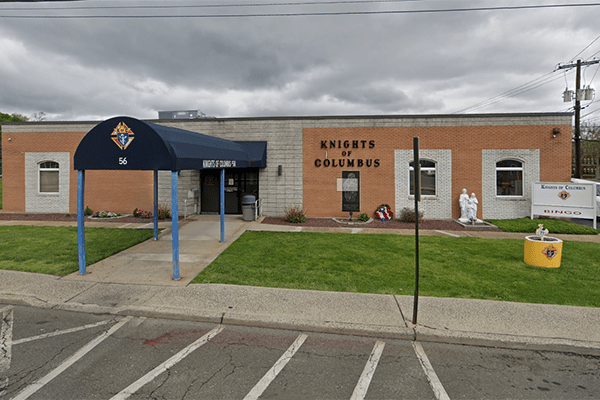
The lease, according to the AG, grants the Town “broad ‘at will’ use and operational control over those areas, while the Knights regain only limited, pre-scheduled reserved usage rights subordinate to the town’s primary occupancy and control.”
Langloir characterized the lease as a “space sharing situation,” with a $63,000 annual value to the Knights because the town would assume responsibility for all costs and obligations to run the building, as well as payment of real estate taxes, utilities, property and liability insurance.
In the leasing proposal, the Knights are restricted not only in the limited number of days permitted each month but by constrained and impractical hours. General use is limited to Mondays from 3 pm to 7 am and on Tuesday through Thursdays from 4 pm to 7 am. “The purported ‘reserved use’ largely consists of partial-day occupancy during evening, overnight and early-morning hours when meaningful charitable, fraternal, civic, or community programming would be realistically difficult to conduct,” the AG says.
The AG added, “petitioners actual annual occupancy equates to approximately 62 days per year – not the approximately 100 days represented in the Rental Analysis.” The lease put the town in control of scheduling and booking, requiring the Knights to reserve use of the premises in advance.
Most egregiously, the lease has no meaningful protection for the preservation of the property if the town fails to fulfill its obligations, and it grants the town a unilateral right to terminate the lease in the event of substantial casualty damage, while imposing the long-term ownership and restoration risk on the Knights.