










|
RCBJ-Audible (Listen For Free)
 |

Multi-Family Dwelling Community Floating Overlay Proposed For Light Industrial Zone In Orangetown
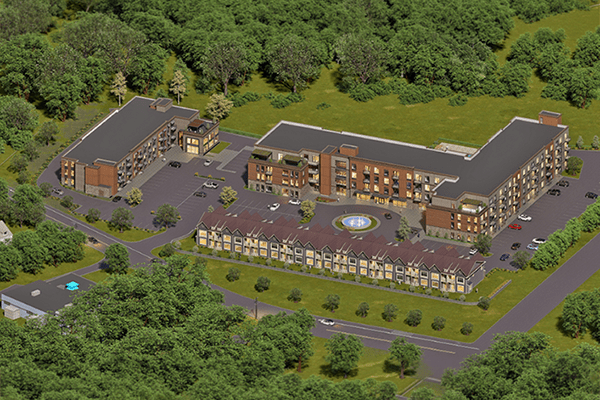
Development of a residential project on about 12 acres on South Greenbush Road in Blauvelt’s LI (Light Industrial) Zone would require the Orangetown Town Board to greenlight a newly proposed “Multi-Family Dwelling Community Floating Zone” overlay.
The proposal, by an affiliate of Gabe Alexander’s Alexander Properties, would establish the right to construct apartments among the warehouses, manufacturing facilities, and other commercial uses in proximity to Route 303 in Blauvelt and Orangeburg. Alexander is a developer and owner of commercial, residential and retail properties in Rockland County.
Alexander’s property at 155 South Greenbush Road fronts on the east side of South Greenbush Road and is bounded to the north by a single-family residential neighborhood, to the south by a commercial area including several warehouse buildings, to the west by an existing office building and light manufacturing facility , and to the east by Clausland Mountain County Park.
An 8,000 square foot warehouse building on the property was demolished and the land is currently used for school bus parking and storage but is otherwise unimproved. The original plan for the property was for an 87,000 square foot warehouse but the building was never constructed.
The residential proposal calls for two multi-family apartment buildings consisting of 138 one- and two-bedroom apartments with 220 parking spaces, and 15 townhouses, each with its own garage and parking space.
To be eligible to participate in the proposed Floating Zone, a parcel must be at least 10 acres and be situated in any of Orangetown’s LI districts. An analysis of available parcels reveals that only five parcels would be eligible: 125 and 155 South Greenbush Road (11.74 acres and 24.76 acres, respectively); 57 North Troop Road (14.31 acres); 5-7 Glenshaw Street (23.66 acres); and 375-377 Western Highway (11.72 acres). Developments must have 20 or more residential units, with a maximum of 15 dwelling units per acre. All of the properties, other than Alexander’s property, are already developed for commercial use.

According to the developer, the creation of the zone would facilitate the development of a range of housing types in the town, provide for a transitional use between existing industrial and residential areas, and permit appropriate redevelopment of eligible parcels.
The creation of the floating zone is a discretionary act for the Orangetown Town Board. It has no obligation to act on the proposal. At a recent town board meeting, residents on adjacent properties spoke out against the development, primarily citing traffic, safety, and preservation of their existing residential districts.
The proposal is pending before the Town Board, which could refer it to the Town Planning Board for its non-binding recommendations.
Pearl River Overlay Zone
Last month, a developer proposed the creation of a zoning overlay in proximity to the Metro North/New Jersey Transit line on Main Street in Pearl River that would allow the redevelopment of fallow commercial properties in the downtown area.
A proposal was made to the town board to create a “Development Enhancement (DE) Overlay Zone” to allow rental apartments on parcels of land at least one acre in size and within 1,000 feet of the train station.
The overlay would apply to CO (Commercial/Office) zoned land.
The developer, Jefferson Arms LLC, touted the benefits in creating housing opportunities for young professionals, commuters, downsizing seniors, and local workforce residents. Benefits also included additional foot traffic for downtown businesses, as well as enhancing the appearance of the area which is dotted with fallow and underutilized commercial lots.
In that presentation, the developer’s plans outlined a 4-story building with 109 apartment units and 132 parking spaces at 10 Jefferson Avenue. At the presentation, the developer said the plans were suggested, and that no formal application or petition was being submitted.

SEQRA Amendments Offer Exemptions From Environmental Review For Many Rockland Housing Developments
 The State Environmental Quality Review Act (SEQRA) has been both a safeguard against rampant environmental damage and a weapon used by opponents to development to reject, delay, or add cost to new real estate developments.
Recognizing the desperate shortage of housing in New York State, and the need for new construction, New York State amended SEQRA as related to new housing developments.
New York’s “Let Them Build” agenda makes the most consequential reforms to SEQRA since its passage in 1975. The law is designed to cut red tape and eliminate duplicative environmental reviews for housing and critical infrastructure projects across New York State, with the stated goal of making it easier and more affordable to build the housing and infrastructure that New Yorkers need.
There was opposition to the revisions at the municipal level, largely led by Riverkeeper, which said in a statement: “SEQRA is an essential planning tool that ensures development does not compromise clean water, air quality, or public safety. It provides transparency, coordinated review, and the ability to identify impacts early and require site-specific mitigation. We reject the false choice between housing and environmental protection.”
In a letter to Governor Hochul, signed by 70 municipal leaders, urging the governor to reconsider the amendments, Riverkeeper wrote, “Substantial changes to a landmark law like SEQRA should occur through the regular legislative or regulatory process, allowing for public input and expert testimony. Rushing these exemptions through the budget process risks permanent damage to New York’s natural resources.” The only Rockland County official to sign on the letter was Upper Nyack Village Mayor Karen Tarapata.
The changes, contained in the Fiscal Year 2027 New York State Budget will materially alter the landscape here in Rockland County, considered by the US Census Bureau as an “urbanized area.” The most significant change is the creation of a categorical exemption for residential developments of up to 300 residential units in urbanized areas, significantly reducing environmental review delays for qualifying housing projects on previously disturbed land.
Signed into law on May 27, 2026, the reforms are now in effect.
Exemptions apply at different thresholds depending on census classification. In New York City, the exemption applies to residential projects up to 250 units citywide; and up to 500 units within zoning districts where the standard maximum residential building height exceeds 45 feet, or where there is no maximum building height.
In urbanized areas outside New York City, including Rockland County, up to 300 units are exempt. In non-urbanized areas, up to 100 units are exempt. And in areas without zoning, up to 20 units are exempt.
To qualify for the exemption, the housing projects must be located on “previously disturbed” land and be connected upon occupancy to existing public water and sewer systems.
The project cannot be located in a FEMA-designated 100-year floodplain or special flood hazard area unless the municipality has adopted an ordinance requiring new construction to be elevated above the base flood elevation as defined by FEMA.
And, the project must not consist solely of construction of a single-family residence on parcels of or one or more acres.
“Previously disturbed” areas are defined as land that has been substantially altered by an occupied, formerly occupied, or demolished building or by another improvement or use at least two years prior to the application. The land must abut, adjoin, or be opposite from another parcel that is or has been occupied by a building or other improvement, as long as the abutting parcel is not occupied by an industrial or agricultural use.
In addition to the exemptions, the law establishes binding timelines for SEQRA review: 120-day determination on exemptions; one year limit on determinations of positive declarations requiring Environmental Impact Statements (EISs); and two years to complete an EIS.
SEQRA exemptions do not override local zoning. A project must still comply with all local zoning and other laws, but a project that seeks a zoning change, special permit or similar approval can still qualify for a SEQRA exemption.
Projects that do not qualify for exemption remain subject to full SEQRA review.

Clarkstown’s Proposed Real Estate Transfer Tax Awaits Governor’s Signature & Public Referendum
 Clarkstown, following on the heels of Orangetown, has secured legislation enabling it to establish a Community Preservation Fund and implement a real estate transfer tax of up to 0.75%. The bill, sponsored by Assembly Member Pat Carroll and State Senator Bill Weber still needs Governor Hochul’s signature to become law.
The legislation allows Clarkstown to levy a real estate transfer tax not to exceed 0.75% on homebuyers to fund open space and historic preservation. Before the tax can be collected, the town must hold a public hearing, pass a local law, and conduct a local town-wide referendum allowing town voters to decide it they want the tax imposed in the manner designed by the Town.
If passed, taxes collected for the Preservation Fund could not be transferred to any other town account, but they can be utilized to pay off existing town debt from previous acquisitions consistent with the town’s community preservation goals.
Preservation of community character includes the preservation of open space, agricultural land, land with scenic value, freshwater marshes or other wetlands and forests. The fund can also be used for the establishment of a wildlife refuge to protect native, rare, threatened or endangered species, or for the acquisition of recognized historic properties or the establishment or maintenance of a greenbelt.
Opponents of the transfer tax argue that the tax will raise the cost to homebuyers, and that even though the buyer would be required to pay the tax under the law, the tax would reduce the value of the sellers’ property by the amount of the tax, essentially converting a portion of the sellers’ equity into a town fund for discretionary or political use.
The tax, if signed off on by the Governor, is certain to be a political hot button during a future town-wide referendum. Orangetown is aiming to hold its referendum this November.