









|
RCBJ-Audible (Listen For Free)
 |

Westhab and Chair Factory Overcame the Obstacles
By Tina Traster
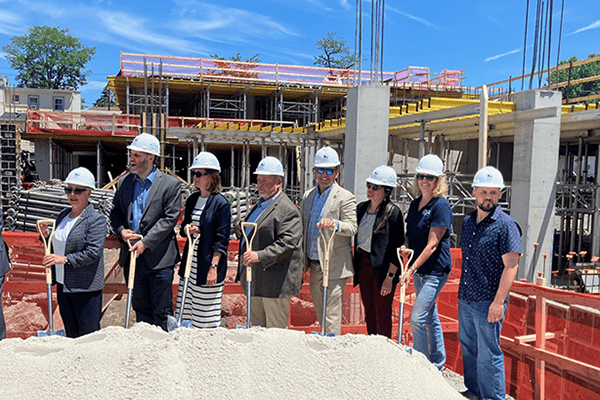
Developers of an affordable housing project in the Village of Haverstraw held a groundbreaking ceremony on Tuesday following years of fighting to secure a PILOT program with the Town of Haverstraw.
Westhab, Inc., a Westchester-based nonprofit housing developer, celebrated the partially-built edifice at 30 West Street, citing a host of governmental and financial supporters that came together to make the project a reality. The development, known as 30 West, is being built on a former Village-owned but under-utilized parking lot, though the project will include a two-story parking deck. The 81-unit four-story building, projected to be ready for occupancy in 2027, will include 81 affordable housing units, 61 of which will serve low-income tenants earning at or below 60 percent of Area Median Income (AMI) in Rockland County. The remaining 20 units will be used for supportive housing for formerly homeless residents.
Additional on-site amenities will include social services and programming, a children’s playroom, free resident parking and a landscaped rooftop balcony. The 80,000 square-foot building, which will have entrances on Maple and West streets, will include a partially-public parking garage with 136 spaces.
“This semi-groundbreaking is a momentous occasion,” said Richard Nightingale, president and CEO of Westhab. “This is where common sense meets common sense.”
Common sense, though, means different things to different people. He pointed out that in Rockland, 41 percent of the population is paying more than 30 percent of their income in housing costs, and among that group, more than half is paying 50 percent in housing costs. In the village, 52 percent of residents are spending more than 30 percent on their income for housing costs.”

Rockland County has a severe housing crisis, especially a dearth of affordable units, but Westhab spent at least two years battling with Town of Haverstraw Supervisor Howard Phillips over a proposed 30-year PILOT (payment in lieu of taxes), approved by the Rockland County IDA (Industrial Development Agency). Westhab found itself in similar company to the developers of the Chair Factory, which also needed PILOTs for the 450 units proposed for the waterfront development that includes workforce housing.
In the end, with the aid of “12 independent funding sources,” the project came together, according to Andrew Germansky, Chief Real Estate Officer with Westhab. Germansky said the project would have been impossible without strong advocacy from both governmental and financial partners.
Both Westhab and the Chair Factory development, which are underway, will add about 530 units to the Village.
“Affordable housing is desperately needed,” said Michael Mayor Kohut. “We had to do what we could do to make it happen. It took a lot of give and take. A lot of sacrifices. Without the partnership of the county, none of this works.”
Westhab originally sought a 30-year PILOT. The developer found cooperation from the Rockland County IDA, county, village, and school district officials but Phillips, who has railed against affordable housing in the Village, would not come to terms. He also undermined a third project proposed for affordable housing in 2024. The Knights of Columbus (Haverstraw Council) were on the cusp of selling their building at 56 West Broad Street for $2.4 million to Kings Katherine LLC, which planned to build 100 affordable housing units, a parking deck, and allocate space in the building for the Knights in perpetuity. Phillips, along with a quorum of town officials, held a private meeting at the 11th hour with a new Grand Knight where the parties hatched a deal for the Knights to forego the sale and donate the building to the Town of Haverstraw instead.
The scheme has turned into a protracted taxpayer-funded battle that pits the Knights and the Town against the Attorney General’s office, which opposes a scheme to allow the Knights to lease their building to the Town of Haverstraw. The fight is playing out in Rockland County Supreme Court.

WestHab ultimately settled for a 22-year PILOT, which was signed by the Village of Haverstraw, the North Rockland Central School District, and Rockland County. The Town of Haverstraw will not participate.
The project is supported by New York State Homes & Community Renewal’s Low-Income Housing Tax Credit (LIHTC) program which is expected to generate $21 million in equity, its State Low Income Housing Tax Credit Program which is expected to generate $2 million in equity, and $9.5 million from the Supportive Housing Opportunity Program. It also received $2.5 million from the Empire State Development’s Mid-Hudson Momentum Fund.
The Village of Haverstraw entered into a long-term ground lease with the developer for $1 per year. Construction costs for the building were estimated to be about $45 million, including infrastructure and soft costs, according to the developer’s application with the Rockland County Industrial Development Agency (IDA). The IDA authorized the developer to negotiate PILOT (payment in lieu of taxes) agreements with the relevant taxing jurisdictions.
The project is expected to open by the end of 2027.






Units at 30 West, which will be rented by way of a lottery in seven counties, will be leased at rents affordable to households earning up to 60 percent of the Area Median Income (AMI) – studios for $1,418 per month, one-bedrooms for $1,519 per month, two-bedrooms for $1,823, and three-bedroom units for $2,106.
Occupancy of the 20 units will be vetted through the county’s Department of Social Services and administered through Westhab’s housing division. Occupants will be expected to pay 30 percent of their income, but state grants will support the rents if an occupant loses his employment, according to Westhab. Occupancy is granted for a lifetime.
Chair Factory developers MPact Collective LLC, of Huntington Station, Long Island, with co-developer Pennrose NY LLC, were originally more dependent on the town’s support on a PILOT. But when it became clear Phillips was resisting, they found a way around the obstacle. Empire State Development (ESD), an economic development arm of New York State, in February acquired the nine-acre fallow waterfront property from the village and issued a ground lease to the development team.
The Chair Factory, like Westhab, has negotiated PILOTs with the North Rockland Central School District, the Village of Haverstraw and Rockland County.
“Phillips has been consistent in saying the town will not participate in affordable housing projects in the village, including WestHab and The Chair Factory,” said an inside source who asked not to be identified.

The PILOT agreement is a contract between the developer and the taxing authorities. The taxing authorities are guaranteed a steady flow of payments, and in return the developer waives its rights to challenge the PILOT payments. And, while the parties could renegotiate the payments during the life of the PILOT, a new schedule cannot be imposed on them without their consent.
Phillips has repeatedly argued that PILOTs for affordable housing impose a tax burden on residents. But both the Westhab and Chair Factory sites represent incremental new taxes that town would otherwise not have received because both projects are being built on vacant land.
“How many people fought for this — it puts the wind in our sail, this joint mission,” said Alexa Sewell, senior Vice president for Multifamily Finance and Development at New York State Homes and Community Renewal (HCR). “The average rent (for a one-bedroom) in Rockland is $3,000. This will be $1,400, with walking distance to amenities in the village.”
Several speakers remarked on how projects like Westhab bring dignity and foundation to communities.
They also praised the building’s eco-ethics, including all-electric building systems, low-flow fixtures and LED lighting, and a solar roof system that will offset about 30 percent of the building’s electrical usage.

Rockland has a deficit of 4,230 affordable units for those making under $60,000 annually, according to the Rockland County Housing Needs Assessment, prepared by Hudson Valley Pattern for Progress. The report says 57 percent of Rockland homes are single-family detached homes – unaffordable to the average resident. The single-family average sales price is $683,000. A median household income of nearly $100,000 can qualify for a $260,000 mortgage. And fewer than 2 percent of single-family homes sold are less than $300,000 according to the 2022 Multiple Listings Service.
The Chair Factory plan will transform the weed-choked rodent-infested site on the Hudson River into a 450-unit mixed-used development (70 percent of units will be affordable including set asides for veterans, seniors and those below an income threshold). The project includes commercial space and a bi-level structured parking garage for the town’s workforce, veterans, and seniors. The plan also calls for floodplain mitigation, and four acres of public parkland.
ESD can issue bonds, grant loans, and offer tax exemptions and abatements to finance the project, acting as a “one-stop shop” for development and funding. ESD centralizes control over the project’s development and environmental compliance, giving it maximum flexibility and minimal local regulatory interference.