









|
RCBJ-Audible (Listen For Free)
 |

Future Moratorium Would Not Impact DataBank Application, Town Supervisor Teresa Kenny Says
By Tina Traster
The Town of Orangetown on Tuesday unanimously passed a resolution to hire a consultant to study the logistics of placing a moratorium on data centers but stopped short of halting a controversial project seeking approvals from the Town Planning Board.
While a room filled with residents from both New York and New Jersey applauded the board’s efforts, dozens implored the town to include DataBank’s application in a moratorium, saying the addition of another data center will add pressure to the electrical grid, undermine water quality near the Tappan Reservoir, and elevate noise levels for neighbors living in the vicinity of Orangeburg’s five data centers.
“The moratorium has to include DataBank,” said Orangeburg resident Chris Kielbiowski. “Excluding it is clearly a carve-out. It protects the developer, not the community. This is managing the optics and is not protecting us.”
Data centers are the subject of national debate because they consume large amounts of electricity and water to power artificial intelligence and cloud computing. While tech companies promise jobs and revenue, communities like Orangetown and Bergen County are pushing back over skyrocketing utility bills, environmental degradation, noise pollution, and strained local infrastructure.
The demand for new data centers continues unabated, driven largely by Artificial Intelligence (AI) and the ongoing demand for data processing and storage. The hottest states for data centers include Virginia, California and Texas, Illinois, Georgia and Ohio, but New York is not far behind, and Rockland County hosts a number of large data centers (over 100,000 square feet) in and around Orangetown.

The New York State Legislature passed the Responsible Data Center Development Act, which institutes a one-year statewide moratorium on permits for new large-scale data centers. If signed into law by Governor Kathy Hochul, New York will be the first state in the nation to enact a statewide pause. The 12-month freeze applies to “large” data centers with a peak energy demand of 20 Megawatts (MW) or more.
“There is an unprecedented expansion of demand for electric power that could bankrupt our citizens, deplete their water supplies or subject them to large amounts of air and water pollution,” said Betsy Longendorfer. “Electric rates are the results of an auction. Energy is purchased until the demand is met. Huge increases in demand that aren’t matched with increases in supply drive up prices for everyone. This process explains why policy changes are needed.”
Along with the moratorium, the New York State bill requires comprehensive environmental impact assessments for facilities, establishes new rate classes for electricity and water usage, sets strict renewable energy benchmarks for future operations, and mandates prevailing wages and labor protections for construction workers.
When Bloomberg sited its data center in Orangeburg in 2009, the town was thrilled, Orangetown Supervisor Teresa Kenny said. “Fast forward, it’s time to take a step back and undertake a thorough evaluation.”

The Town voted to hire AKRF of White Plains, a planning consultant, to review and prepare “a proposed moratorium local law, an analysis and memorandum addressing land use and environmental concerns related to data centers, and preparation and implementation of zoning text and map amendments.” The study will cost $31,000.
The Planning Board previously hired AKRF to assist with New York State Environmental Quality Review Act (SEQRA) and to review the environmental assessment submissions by DataBank.
Kenny said DataBank’s application will not be impacted by a potential moratorium.
“We can’t interfere with the Planning Board,” she said. “Legally we’re not allowed to interfere. Still, we have faith in the Planning Board.”
“The Supervisor states the Town Board cannot intervene in the Planning Board’s review,” said David Rosen, an Old Tappan resident who spoke on behalf of the NY/NJ DataCenter Crisis Coalition. “But enacting zoning and land-use regulation is not interference – it it this Board’s exclusive statutory responsibility under New York Town Law. A moratorium is not overreach. It is leadership.”

Residents who’ve been packing Planning Board hearings for months were disappointed that a potential moratorium will not impact DataBank.
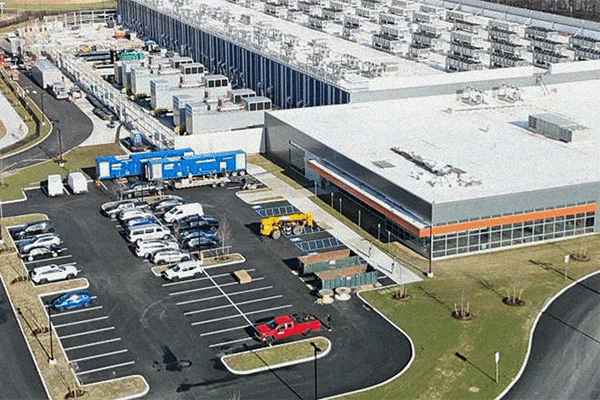
In March, representatives from DataBank presented plans for a scaled-down version of Phase II, originally designed as a mirror image of the newly constructed 145,000 square foot Phase I data center on Corporate Drive in Orangeburg. Phase II, according to Databank, will be significantly reduced from 145,000 square feet down to 77,862 square feet. The planned electrical substation has also been scrapped. DataBank represented that the existing substation on the property has adequate power to service both buildings.
Databank’s first phase, covering 145,000 square feet on the same parcel, had a ribbon cutting in May. The 20-megawatt (MW) facility is part of Databank’s three interconnected facilities in New York. Phase II, if approved, would be its fourth in New York State. According to its website Databank has more than 65 data centers in the United States.
Although Orangetown hosts several data centers in its LIO zone (Light Industrial-Office – a specific zoning district designed to accommodate a mix of industrial, warehousing, distribution, and office uses), the zoning for the LIO does not specifically permit data centers. In its most recent Comprehensive Plan, the addition of data centers as a conditional use was considered, but the Town Board has not yet taken action.

Residents who’ve been packing Planning Board meetings have been challenging the town’s position that a determination to allow data centers were permitted based on a building inspector’s determination 17 years ago.
“Where is that determination in writing?” Rosen said. “Zoning decisions in New York must be in writing. None has been produced.”
Local residents who oppose the project say there has not been an adequate environmental review under New York State Environmental Quality Review Act (SEQRA).
DataBank is scheduled to appear before the Planning Board on July 8 at 7:00 p.m. The applicant cancelled a May 27th hearing.