










|
RCBJ-Audible (Listen For Free)
 |

While Formal Cooperation Agreements Are Prohibited, Informal Coordination Remains An Option
By David Carlucci
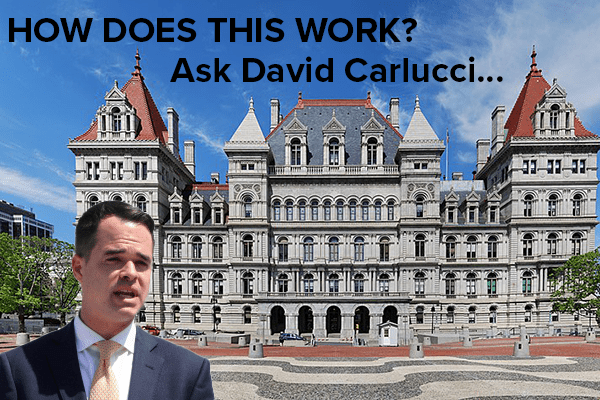
 New York State’s Fiscal Year 2027 budget, when finalized, will include a sweeping set of immigration enforcement restrictions that will reshape how local governments across the state interact with federal immigration authorities. For Rockland County residents, that development carries a particular resonance, because Rockland spent the better part of this winter trying to do something similar on its own.
Having spent years in Albany negotiating exactly these kinds of policy fights, I can tell you: what happened in Rockland this winter, and what will ultimately happen in the state budget, are two sides of the same story.
What the State Budget Does
The proposed budget will prohibit local law enforcement from being deputized by ICE for federal civil immigration enforcement, eliminate 287(g) agreements (formal partnerships between U.S. Immigration and Customs Enforcement (ICE) and state or local law enforcement agencies), bar state and local police from acting as civil immigration agents, and prohibit the use of taxpayer-funded resources or personnel to carry out federal civil immigration enforcement and detention. The budget also denies ICE permission to enter sensitive locations, including schools, libraries, health care facilities, polling locations, and private homes, without a judicial warrant, and establishes a state right to sue federal, state, and local officials, including ICE officers, for constitutional violations.
It is a significant package. However, it did not come easily, and it is not as far-reaching as some lawmakers wanted.
A provision that would have explicitly prevented local law enforcement from collaborating with ICE informally on civil matters was dropped from the final negotiations. Finding compromise language around that issue had been a major sticking point throughout the process. The budget closes the door on formal cooperation agreements, but leaves room for informal coordination to continue, a distinction that matters enormously on the ground.
The State Senate had pushed for something closer to the New York for All Act, which would have prohibited both formal and informal collaboration between local police and federal immigration enforcement. Senate Majority Leader Andrea Stewart-Cousins said she hoped to get “as close as possible” to that standard. The final deal will likely fall short of that goal.
The Rockland Story
Albany’s action did not happen in a vacuum. Part of the political pressure that moved the Governor and Legislature toward action came from communities like Rockland, where local officials were already trying to act, and where the debate exposed just how complicated this issue is at the local level.
In late January, County Legislator Beth Davidson introduced the Safety and Dignity for All Act, a bill modeled on Westchester County’s 2018 Immigration Protection Act. The proposed legislation would have prohibited county law enforcement and employees from honoring ICE detainers without judicial warrants, notifying ICE about the release of individuals from custody, or sharing immigration status information, except in cases involving criminal investigations.
Those are not radical provisions. They mirror what Westchester has had on the books for nearly a decade without incident. But building support for the bill required sustained grassroots effort. Advocates held public forums, engaged local civic and immigrant-led organizations, and turned out dozens of residents to county meetings to speak in favor of the legislation. Legislative sponsors continued outreach to colleagues, and community members signed letters to county leadership urging action.
However, the political environment in Rockland made even that a heavy lift. County Executive Ed Day, a retired NYPD commander, pledged to veto the bill, calling it “reckless” and arguing it had been “copied word for word from Westchester County by individuals who have never carried a badge or been responsible for public safety operations.”
That distinction, between legitimate law enforcement cooperation and unchecked civil immigration enforcement, is exactly the line the state budget is now trying to draw. It is a reasonable place to draw it.
Hundreds of Rockland County residents packed the county legislative building in New City for a public session on the bill, with public comment overwhelmingly in favor of moving forward. Sponsors continued to work to build support among their colleagues after that meeting. But the bill never got a vote. The item was removed from the agenda during the February 3rd legislative session after concerns were raised by the Rockland County District Attorney’s Office and the Rockland County Sheriff’s Office. Since the Legislature did not vote to approve a public hearing, the proposal did not advance further.
The Safety and Dignity for All Act remains under active consideration. Legislative sponsors have not given up, and advocates continue to engage the Legislature. Sponsors hope to achieve passage in the months ahead.
What It Means Now
The state budget will now set a floor for every county in New York, including Rockland. Regardless of what the local legislature did or did not do, law enforcement here, if the budget passes as expected will be prohibited from entering formal 287(g) agreements with ICE and cannot use county resources to carry out civil immigration enforcement. That protection exists whether or not the county legislature ever acts.
What the state law does not resolve are the questions Rockland residents were debating this winter. Informal cooperation between local officers and ICE on civil matters remains a gray area. The specific accountability mechanisms proposed for county agencies were never enacted locally. For a county that was at the center of this debate just a few months ago, the result is a measure of protection that came from Albany, not from New City. That is sometimes how it works. Local governments push. Albany watches. Eventually, Albany moves.
Whether Rockland’s legislature will revisit the Safety and Dignity for All Act now that the state is expected to act is an open question. The political dynamics have shifted. But the underlying concerns that filled that legislative chamber in February have not gone away. The families who showed up that night were not there for politics. They were there because they were scared. Albany did its part. Rockland sponsors hope to do theirs.
David Carlucci is a former New York State Senator and founder of Carlucci Consulting, a New York State government relations firm.