













|
RCBJ-Audible (Listen For Free)
 |

Editor’s Note: The arts are a significant thread in the fabric of Rockland County. They inspire, enrich, and chronicle our lives. They also play a role in our economic well-being; theater, writing, dance, crafts draw us to spaces. They invite strangers to share in our bounty. They are an indelible contribution. Welcome again, Christine Potter, a poet, to RCBJ.
SUNY Rockland’s Meghan Nolan: Personas are the Truth!
By Christine Potter
Happy late summer everybody! But let’s not talk back-to-school yet, for Heaven’s sake. The tomatoes are finally getting good and the local corn just came in! My old teacher’s soul automatically typed these waning-summer words only because we’ve had tons of poet-teachers here in Grist for the Mill. Alas, the first week of August can be an exercise in denial. Fools on the internet are talking about Halloween already! But there’s still time for poetry open mics and beach days—with many books.
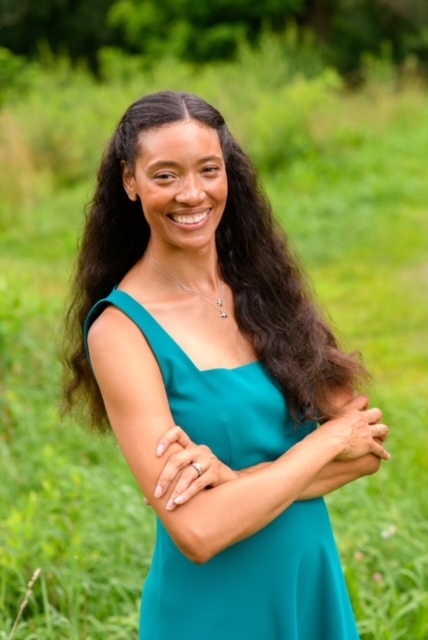 This month’s poet (poet-teacher, natch) is SUNY Rockland’s Meghan Nolan, who keeps the poetry program running there and teaches prose writing also. She’s a multi-genre writer herself, but she’s written a wealth of intriguing poems, three of which she’s sharing with us this month.
But before I get into that, some news: I get to read poems with Meghan, along with Rebecca Watkins, Monica Wendel, and our esteemed poet laureate Juan Mobili at Finkelstein Library in Spring Valley on the 25th of August at 7 PM. I’m looking forward to it. Rebecca and Monica have been in this column before, and Juan is everywhere poetry is in this county.
Meghan P. Nolan is a unique and deeply interesting poet. One of the many things I discovered as I interviewed her online was her admiration for the early 20th century Portuguese poet Fernando Pessoa, a master of persona poems. Pessoa is sometimes referred to as a poet’s poet. I had to spend some time reading him to catch up with what I need to say in this column. He wrote in one hundred and thirty-six different personas or voices (you read that right: 136). And his personas were whole people, developed characters with professions and personalities.
Except, of course, as his creations, the personas had to be at least partly himself, right? I mean, when they weren’t being Walt Whitman caught in a noisy factory. I’ve played with persona poems, and that’s my conclusion; trying to write as someone who is specifically not you enables deep truth that sometimes feels like a lie, much like good fiction does. I once wrote a poem called “I Want To Be The Winner of Fat Bear Week.” Perhaps it helped me face the grizzly within and celebrated my love of salmon—but it ended up being about aging.
Here’s a poem Meghan sent us:
Great White Hide
No machinery can or will rescue”
any of us from the law of being.
For centuries we have pretended that
by echoing those grey wings on the wind
grinding the black earth into our palms, and
dipping blue confections to our pink tongues,
we are truly living.
But, by proclaiming that
there can only be one of anything,
we are gradually tearing at the
seams of a sheath, well worn.
It would do us well to remember that
while the fringes may be tattered and torn
the main core is always serviceable.
Because while all our ancestors loom large
in the shadows of grief
Brown, Yellow, Red…
We must remember that
someone great was and is ever-present—
In the untouched landscape
In the interior web of oneness
In the infinite expanse beyond that
disposable jacket—
that great white hide.

So, wow. Who is the persona, here? The poem is in first person plural. In the wrong hands, that can sound puffed-up: what gives any one person the right to write as we? Well, conviction, for one thing, and this poem’s speaker has lots of it. First person plural is also the voice of Gwendolyn Brooks’ “We Real Cool,” as she speaks for bunch of doomed hooky-playing kids up late at the pool hall, and Paul Laurence Dunbar’s poem “We Wear The Mask,” about the hidden reality of the Black experience in this country.
Meghan’s poem is about the “law of being,”—who we really are—and I do think she’s talking about everybody, friends. I love the lines about how while there cannot be “only one of anything,” there is a “main core” that is always “serviceable.” That would be “an interior web of oneness.” And I love what I believe is a pun in her last line, “that disposable jacket—that great white hide.” Hide as in leather, or hide as in the verb?
The poem keeps fitting together and slipping away from me. Which is the magic of it! I’m hoping she’ll read it the night I get to share a reading with her.
Meghan says she doesn’t read a lot of contemporary poetry, but also admires Paul Blackburn, a poet-editor who supported the mid-century, Beat-adjacent Black Mountain Poets. They were very much free-versers, and buddies with some of the Deep Image folks (like my hero, Robert Bly). She admires Blackburn’s ability to get at what she calls “the beauty and grime” of places she loves. Yes. I know just what she’s talking about.
This poem of Nolan’s has beauty and grime both:
Urban Nocturne
You stop to discourse
about how the streets
are now… as they were then—
barren of equality
perpetually open.
But, we have been here before.
We heard those echoes
of constant maladies
bouncing back and forth.
Those distant souls that float
through the cold brick of youth.
But, we chose to ignore
this corner of the City,
although we visited
the remnants regularly
through memories and lore.
We have been here before.
When we pretended
that the fragility
of peace was distant—
that we had moved forward—
dismissing growing shadows.
But, it was an empty truth
that obscured that quiet
observer in the corner
and the perpetual ache
of urban nocturne.
For me, the heart of this poem is the fourth stanza. It’s ghostly: “Those distant souls that float through the cold brick of youth.” Grime and beauty, bricks…I see tenement buildings. An ignored/forgotten neighborhood, only seen in “remnants,” in “memories and lore.”
I also love where the poem closes, in “the perpetual ache/of urban nocturne.” It makes me remember riding the Hudson Division home from Manhattan when I was first out of college and living in Westchester—the yellow lights of old buildings at 125th St.
But while someone with my experiences might read it that way, there is nothing in this poem that is specifically Harlem or even New York. It’s a city, with a neighborhood that has changed—or the “you” in the poem thinks it has. Has it? Maybe. And again, first person plural. And now that I think of it, “you” can also be singular or plural. Huh. These lines are sharply focused without being hyper-specific. It’s a really good poem.
Meghan’s writing practice is unusual, too. She says, “I used to have to write for sustained periods of time (a full day or two) at a computer, and while that’s still my preference, everything changed after giving birth to two children! When my children were babies, I had to learn to write super late at night (even though I was dead tired) or during their naps or feedings, so I quickly learned to write on my phone!”
I’m impressed. I’ve tried to do that, but I find the word processing on my device (Pages) is better for revision than it is for composition. Now that her children are grade-school age, she has designated Thursday as a “sustained” writing day and composes at her desk with a computer.
She revises constantly, as she writes. And she knows a poem is done when she can read it “four or five times” without needing to change something. That makes me jealous. I can look at something that’s already in a journal and want to change it!
Speaking of jealous, my coveted line-of-the-month is the entire third stanza of this next poem.
Cultural Memory
Cultural memory is long—
when it wants to be.
Otherwise, we seem to
reminisce about things
steeped in “tradition.”
But, what about the tradition
of soul ravaging?
How often we forget
the essence of being
lies within us all.
Too often we forget that all
of our ancestors
have sizzled in that pan
of oppressive pressure—
a force born of ember.
Longer than we can remember
we have had to hold
our own feet to the fire,
because we are mortal.
It’s not a divine right.
And so, what is right?
Is it giving into
the desire to play God,
or growing into
the realization that we’re One?
Cultural memories trick one
into believing
this shadow of neon
spires is worth saving—
But, we’re no strangers
to resurrection.
We’ve done it before…
and, we’ll do it again.
Aho mitakuye oyasin.
“A force born of ember!” That could be Dickinson. I love “oppressive pressure” also. And that big old frying pan with all of our ancestors in it!
“Soul ravaging” is a tradition that doesn’t sound so worthy of honor. Human beings have to hold their own “feet to the fire,” says the first person plural narrator here.
And yes, first person plural again. The poem speaks for all of us.
And it ends with that mysterious (to non-indigenous people) last line. “Aho mitakuye oyasin” is a Lakota prayer about the interconnectedness of all people. Meghan’s poem seems to say that while our traditions can keep us from fully growing into the sacred within ourselves, “we’re no strangers/to resurrection.”
It’s fascinating stuff.
At SUNY Rockland, Meghan continues to run a program that dates back to her downtown days, ”an annual reading series called Word of Mouth where students can share their poetry and more. I started Word of Mouth on the Lower East Side of Manhattan 20 years ago, and I’ve just been bringing it with me wherever I go and modifying it to suit the poetic needs of those around me.” She says she loves performing her work. Can’t wait for that reading!
Considering the current news cycle, perhaps the poem I’ll close with this month is one I wrote during the pandemic. It originally ran in Mobius, A Journal for Social Change. It’s also in my book Why I Don’t Take Xanax. Thank you, Dr. Fauci, for helping keep me alive to write it.
What We Really Lost
Everything. At first, it didn’t seem real, as if the clouds in the sky
had suddenly become puppets. There weren’t even bombers,
but then a dozen nuns and priests at a gray stone convent across
the gray Hudson died. And after that, a woman who had taught
with my husband at the elementary school in our town, her
whole family, every one of them, all. By then there were barely
airplanes. The traffic on our street stopped. Birds called out
in the springtime heat and other birds answered them. Nightly,
the TV showed us pictures of the Empire State Building, tip
lit bloody red, like an ambulance, in tribute to the doctors
and nurses who had died. And also for those still at work, dull-
eyed, the skin on their faces mottled by their masks. Many
borders closed. No one was in charge. It was always 11 AM
or 3 PM and it didn’t matter. The names of the dead became
more and more familiar. Then we had to get tested ourselves
and somehow escaped. Everything was a heart that burst then,
but even this season’s funerals are mercy: a mother, a father.
For now we have permission to sing in public. But the sun’s
cheery sizzle, its long kite-string of joy—how uncertain that
all feels today! Patience. We are still learning what we can trust.