










|
RCBJ-Audible (Listen For Free)
 |

Complaint Says Use Of Public Funds To Benefit Incumbents, Private Businesses, And Influence Legislation Is Illegal
ANALYSIS
Towns and local municipal governments cannot finance Facebook ads or use public funds to promote political candidates, according to several legal sources.
In a Facebook post earlier this year Councilman Bob Axelrod stands in front of two flags, the Town of Clarkstown’s and the American flag. The post says: “Clarkstown Ward 4 Councilman Bob Axelrod is leading the effort to protect our neighborhoods from code violators,” and in that 46-second video post he talks about his role as lead sponsor for a resolution expanding the town attorney’s role in code enforcement.
The February 2026 post racked up 31,000 views, according to Facebook.
In another Facebook post in March, Councilman Jon Valentino stands in front of the same flags and talks about his role in cracking down on repeat code violators. The post says, “Clarkstown Ward 1 Councilman Jon Valentino is spearheading an effort to help protect our neighborhoods from chronic code enforcement violators.” The 24-second video post had more than 35,000 views.
And a few days later, Councilman Don Franchino’s touts his accomplishments in a 33-second video. The post says, “Councilman Don Franchino is working to expedite the hiring of code enforcement personnel.” The video garnered about 36,000 views.
These videos and posts may seem like the normal business of town government except that they were paid for by taxpayers. These are sponsored posts that are converted to advertisements, that can range in cost mostly from $400 to $500 each, but some campaigns ran between $1,500 and $2,000.
Towns and local municipal governments cannot finance Facebook ads or use public funds to promote political candidates, according to several legal sources. Local governments can communicate factual information about public policy or municipal services, but using official government channels or budgets for political purposes violates the principle that public entities cannot compel taxpayers to fund partisan political speech.

Further, funding the promotion of a candidate or incumbent falls under campaign finance regulations. Municipalities are not authorized political committees (PACs), and governmental contributions to candidates are banned. Using public funds to advocate for, promote, or oppose a specific political candidate constitutes an illegal gift or misuse of public resources under New York State law.
New York State’s Public Officers Law specifically prohibits advertisements by elected government officials and candidates made with public funds. The law includes counties, cities, towns, villages, and public authorities and prohibits elected officials and candidates from appearing in advertisements or promotions, including public or community service announcements if the ad is paid for or produced with public funds.
Under New York State precedent, if the Town of Clarkstown finances a Facebook ad or mass newsletter that features an incumbent running for reelection, it remains legal as long as it is strictly informational and avoids campaign rhetoric. The simple reference to the role of incumbent councilmen does not necessarily violate the law. But if the ad features prominent photos of a councilman, uses flashy graphics, or focuses heavily on his personal leadership rather than objective town data, it enters the gray area and may violate the law.
While explicit electioneering (e.g., “Vote for Councilman Franchino”) is strictly illegal using public funds, the issue is whether the town crossed into a legal gray area by running “informational” or “constituent outreach” ads that heavily feature incumbent officials.
The legality of these ads hinges on the distinction between legitimate government communication and “implied” campaign activity. Courts and ethics boards look at the tone and content of the ads. For example, if the town pays for an ad highlighting a new park and includes a quote from a councilman praising the project, it is technically an informational update, even though it provides the councilman with free, positive public exposure.
The issue becomes more timely as the November election nears. Each of the beneficiaries of the video ads is running for re-election in November’s contested races. The town’s Facebook page has 13,000 followers and 6,000 on Instagram. The sponsored ads were viewed thousands of times, with some reaching 30,000 views or more.
Incumbent officials in Clarkstown are also bound by the broader New York State Constitution (Article VIII, Section 1), which prohibits the “gift” of public funds for non-governmental, private, or political purposes.
In an ethics complaint filed by a New City resident with the Town of Clarkstown Ethics Board July 13, Amy Levitsky charges these ads and dozens more were “individually-branded, campaign-style videos,” benefitting incumbent councilmen on the taxpayer’s dime. The paid ads feature Town Supervisor George Hoehmann, a Republican, and each of the Republican town councilmen, as well as Republican Congressman Mike Lawler and Republican State Senator Bill Weber.
Levitsky cites 110 ads produced by and paid for with Clarkstown tax dollars that ran on Facebook and Instagram. She says at least 27 specific paid ads used taxpayer money to: (1) promote individual elected officials personally; (2) promote partisan state and federal politicians who have nothing to do with Town government; (3) advertise private businesses for their commercial benefit; and, (4) advocate political positions on pending state legislation.
The spending on the ads ranged from under $100 to about $600 each, and some of the ads she cited in her complaint are still running.
Many of the ads cited by Levitsky fall into a gray area because the town names a particular councilman in the paid ad and touts his role in what would otherwise be a public service announcement – the change in the role of the town attorney, the boost in code enforcement, the hiring of additional personnel.
For example, “Axelrod leads the effort…” “Valentino is spearheading the effort…,” “Franchino Is working to hire…” The video ads prominently feature the efforts of the incumbents, secondary to what the town is advancing. Each of the ads complained about, feature an incumbent councilman or the town supervisor (all running for re-election) taking individual credit for town activities.
Levitsky says this crosses the line.
Levitsky asked the Ethics Board to determine who authorized the paid advertisements and to determine who controls the town’s social media accounts. She also asked the board to review the town’s spending on paid ads, review the town’s social media policies, determine whether any official appearing in the ads has a financial relationship with any of the private businesses featured in the ads, and determine who controls and funds the “Hoehmtown Podcast” and why the town spends money to promote it.
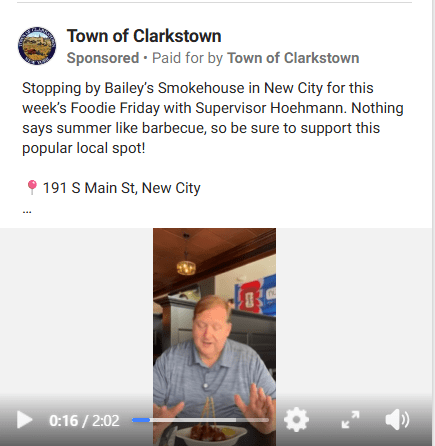
In a recent Facebook post, in a 2:02 minute video, Supervisor George Hoehmann is touting Bailey’s Smokehouse in New City, a private business, as the best barbeque in Rockland County. The ad was paid for by Clarkstown taxpayers, and placed after the town received the ethics complaint.
According to Levitsky’s research, Clarkstown’s paid promotion of a podcast named after the sitting Town Supervisor is a use of public funds directly benefitting the incumbent supervisor at taxpayer expense.
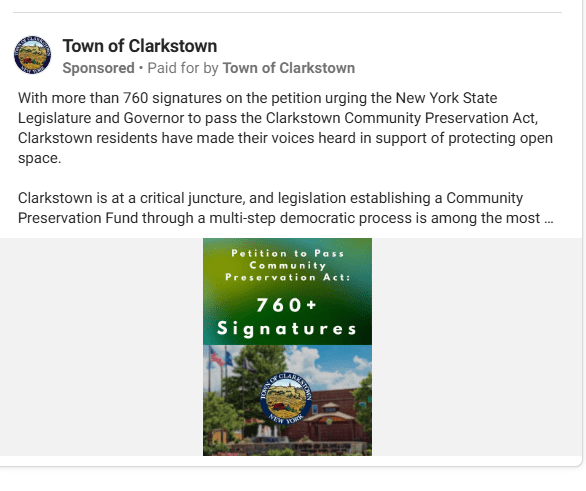
Levitsky also asks the Ethics Board to look into whether the town’s advertising for petition signatures supporting the Clarkstown Community Preservation Act and directly urging the Governor to sign the law is a legitimate use of taxpayer funds. On June 1, the town ran a paid advertising campaign urging the state legislature and governor to pass legislation the town board supported, using taxpayer money to directly influence the passage of legislation.
Whether town residents support the law will be the subject of a future mandatory town-wide referendum.
Levitsky refers to the section of the town’s ethics code that requires municipal resources — including Town money — be used only for “lawful municipal purposes” and bars their use for “personal or private purposes.” The code bars officials from using their position to secure a financial or material benefit for themselves or a private organization.
The complaint charges that “paid political-style ads for individual officials, advertising a podcast named after the Supervisor, advertising private businesses, and running paid advocacy for pending state legislation are not lawful municipal purposes” and violate the town’s ethics code.
RCBJ reached out to the Town Attorney for comment but did not get a response.