


|
RCBJ-Audible (Listen For Free)
 |

Ulster County & Bard College Partner To Add Seventeen Air Quality Monitoring Stations In Ulster County
 Ulster County has partnered with Bard College and its Hudson Valley Community Air Network (HVCAN) to install 17 new ground‑level air quality sensors at libraries, town halls, and community centers across the county. These sensors provide hyperlocal readings of PM2.5, sending residents real-time text alerts when the air quality becomes unhealthy and when it improves.
The monitoring initiative is designed to fill data gaps that traditional rooftop EPA monitors miss, giving neighborhood-level information rather than relying on broader regional data. The sensors are tied to the JustAir platform and regional map networks.
To access real-time data and register for local alerts, anyone can view the sensor network and sign up for text notifications on the Ulster County Department of Environment page. User can also track hyperlocal measurements in the area through the Hudson Valley Community Air Network portal.
Host sites include Elting Memorial Library, Esopus Library, Gardiner Library, Hurley Library, Marlboro Free Library, Olive Free Library, Phoenicia Library, Pine Hill Community Center, Plattekill Public Library, Rosendale Library, Saugerties Public Library, Town of Denning Town Hall, Town of Rochester Town Hall, Town of Wawarsing Town Hall, Town of Ulster Library, Wallkill Public Library, and Woodstock Library.
The City of Kingston is also a sponsor of the Hudson Valley Community Air Network, and hosts two sensors in Midtown Kingston through the Kingston Air Quality Initiative.
Although the specific cost of the 17 air quality sensors was not publicly revealed, the public libraries, town halls, and community centers are acting as “trusted community anchors,” providing the physical space and necessary connectivity for free.
Rockland County officially hosts one permanent continuous air quality monitoring station, which is located near South Mountain Road in the town of Clarkstown (near the Concklin Orchards). The station monitors regional pollution and is part of the broader New York State Department of Environmental Conservation (NYSDEC) monitoring network. Real-time data from this area can be tracked online.
Orange County, NY currently has one active, state-operated permanent air quality monitoring site managed by the NYS Department of Environmental Conservation (NYSDEC), located in Newburgh. A second station previously operating at Valley Central has been inactive or does not report live data.
In both Rockland and Orange County, real-time direct reading measurements include criteria pollutants (ozone (O3), sulfur dioxide (SO2), oxides of nitrogen (NOx), carbon monoxide (CO)), PM2.5 and PM10 (fine particulate with diameter less than 2.5 or 10 microns), black carbon, ultrafine particle (UFP) count, and meteorological data.
Filter-based PM2.5, PM10, lead, elements, acid and mercury deposition samples are collected manually and shipped to a laboratory for analysis.

Another Massive Redevelopment Plan Proposed For Former Grossinger’s Resort Site
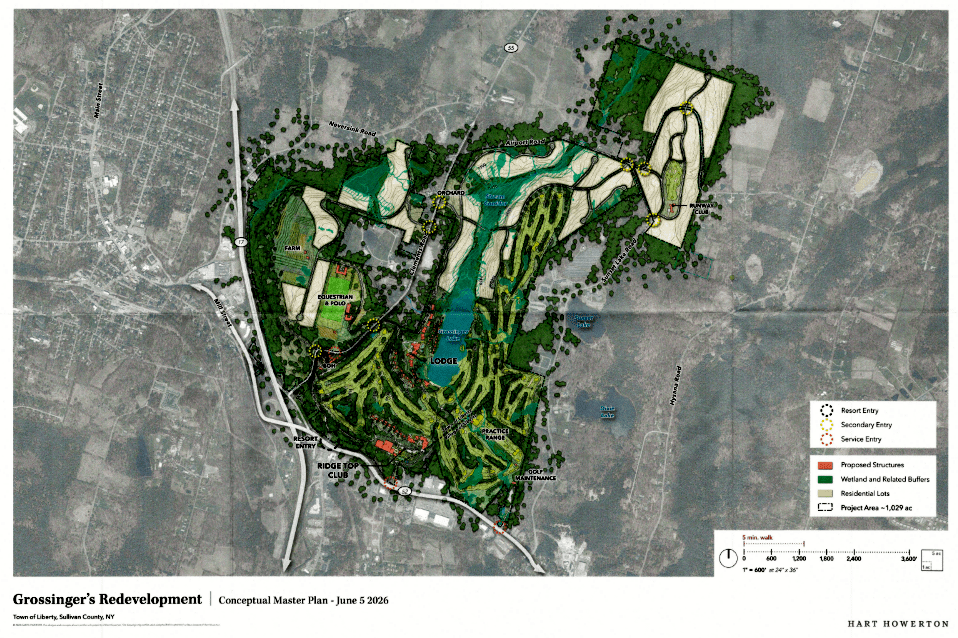
The former Grossinger’s Resort in Liberty, New York, is the subject of a redevelopment plan by PPG Development. The proposal describes a multi-faceted, year-round resort and residential development centered around two golf courses, a racquet and sport’s club, a resort lodge, single-family residences and an equestrian/polo center.
According to its website, PPG Development is a commercial and residential real estate investment and development firm based in Hallandale Beach, Florida. Founded in 2017 by real estate veteran Ari Pearl, the company specializes in high-end hospitality, luxury branded residential properties, and large-scale golf course redevelopments.
Pearl has managed more than $3 billion across diverse real estate transactions, and PPG has delivered over 5 million square feet of real estate, including 4,000+ hospitality and residential units.
The site totals more than 1,000 acres, primarily in the Town of Liberty, with a smaller portion in the Village of Liberty. Interior roadways and utility infrastructure would be provided by the developer.
The project spans both the former Grossinger’s site and the adjacent Muss property. The existing structures were demolished in 2018. What remained was lost to a fire in 2022.
The Project will be entirely built in the Town’ s Resort Hotel (“RH”) and Village of Liberty R-2 (“R-2”) zoning districts, and if approved will be constructed in four phases.
Phase 1 would include a 50-room resort hotel and lodge with 5,600 feet of beach amenities; 50 resort cottages; a golf/tennis/sporting club for homeowners and guests, an equestrian/polo center with stables, show rings and polo grounds; farming operations, a golf course, and about 80 additional residential units.
Later phases anticipate 145 additional residences and a second golf course.
Access would be off Route 52, near Route 17 at the location of the existing Grossinger’s driveway.
The developer says the project will result in substantial local benefits including building permit fees, construction and permanent employment, a significant increase in tax revenue, local procurement opportunities for small businesses, and ancillary economic activity from tourism.
Before PPG Development acquired the site, a string of aborted attempts, corporate bankruptcies, and collapsed financing deals left the Catskills resort to deteriorate.
Hotels International, which bought the property from the Grossinger family in 1985, planned to renovate the existing structure’s 585 rooms but abandoned its efforts. A year later, Servico acquired the property, and also abandoned its plans to re-open the facility. In the late 1980s, several investment groups floated plans to demolish the hotel and construct a smaller facility that never materialized.
In the 1990s, an investor group attempted to re-open part of the hotel with some amenities catering to golfers, but the effort ended in bankruptcy and an auction. In the early 2000s and 2010s, Louis Cappelli proposed several redevelopment plans for the property, including a casino and “Napa Valley-style” wellness spa. Then a fire in 2022 destroyed whatever was left of the resort, after which PPG Development stepped in.






Ulster County Seeks To Impose A Resident Income Tax Surcharge On Its High Income Earners
The Ulster County Legislature approved a resolution authorizing it to impose a resident income tax surcharge on higher-income residents. The “Fair Taxes Act” would impact about 1% of taxpayers, and would create a 18.75% surcharge on state income tax paid by county residents who earn more than $250,000 for individuals and $500,000 for joint filers.
The measure would require passage by the state legislature. The Ulster County legislature approved a home rule request, a prerequisite for the county to impose the tax. The resolution passed 15-8 with four Democrats dissenting.
State Sen. Michelle Hinchey and Assembly Member Sarahana Shrestha are sponsoring the measure at the state legislature.
The measure was prompted by cuts from the federal government’s share of funding to programs like SNAP and Medicaid, which tens of thousands of Ulster County residents rely on.
If approved by the state legislature, Ulster would be the first New York county to levy an income tax surcharge.
The surcharge would not apply to the portion of personal income taxed at the entity level for partnerships and S corporations electing to participate in New York State’s pass‑through entity tax (PTET).
The original thresholds would have imposed the surcharge on incomes over $200,000 for individuals and $400,000 for joint filers. Those thresholds were increased as the resolution was amended.
“These amendments reflect the input we’ve received from residents and local businesses, and would limit the surcharge to the top 1% wealthiest households while addressing the needs of small business owners,” said Ulster County Executive Jen Metzger. “The Fair Taxes Act will protect working families, seniors, farms, and local businesses from federal cost shifts driving up property and sales taxes.”
As amended, the proposed legislation is expected to generate between $9 million and $15 million annually. If the state enabling legislation is passed and signed into law in 2027, the County would have to adopt a local law to enact the legislation. The earliest the surcharge could take effect is January 2028.
Metzger is also working on a bill that would provide a 10% property tax exemption for year-round Ulster County residents by modestly increasing the tax rate on second homes and short-term rentals. Property tax exemptions do not raise tax revenue but instead affect how property tax costs are distributed.