









|
RCBJ-Audible (Listen For Free)
 |

Concerns About Electrical Usage, Noise, Light, Diesel Exhaust, And Potential Damage to Lake Tappan Trigger Mandatory Environmental Impact Statement
By Tina Traster
The developer of a proposed data center in Orangetown encountered a significant speed bump with its application on Wednesday after members of the town Planning Board voted unanimously to subject the project to a deeper environmental review.
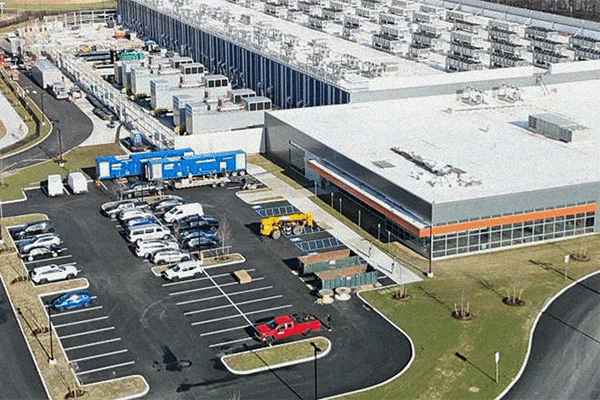
The board voted to give DataBank’s plans for a 77,862 data center expansion on Corporate Drive in Orangeburg a “Positive SEQRA Declaration,” after months of public outcry against the project.
Residents along with environmental groups that have held protests and filled planning board meetings to overflow capacity have raised issues concerning electrical usage, environmental pollution, noise, light, diesel exhaust, and potential damage to Lake Tappan reservoir.
The applicant, which had been hoping for the project to advance with preliminary site plan approval and a “Negative SEQRA Declaration” after appearing before the board for more than a year, argued that it had cut the size of the planned expansion of the facility in half, eliminated a proposed electrical substation, and did not need permits for watercourse diversion or wetland disturbance.
What appeared to ultimately sway the board to make a positive declaration were the findings offered by AKRF, an independent planning agency the town hired to evaluate the project. The planner said, “We are still concerned about energy use, air quality and noise.” She added that there may be outstanding issues concerning climate change and the possibility of nesting eagles near the site. The project’s proximity to “disadvantaged communities” as defined by the DEC was also an issue.

SEQRA requires all local, regional, and state government agencies to equally examine the environmental impacts along with the social and economic considerations for a certain project, or action, during their discretionary review. Under the State Environmental Quality Review Act (SEQRA), a positive declaration is a written notice issued by the lead agency (Orangetown Planning Board) stating that a proposed project may have at least one significant adverse environmental impact.
This formal determination mandates the preparation of a comprehensive Environmental Impact Statement (EIS). This means the applicant must make a more robust argument that its project will not have an adverse impact on air quality, water resources, or community character.
The unanimous vote taken to declare a positive SEQRA declaration led to a stunned gasp that rippled across the room, where every one of its 112 seats were taken. (The room’s total capacity is 295, but that’s only when the room is not filled with chairs, a police officer explained to this reporter.)
Seating in the packed house became an issue because more than 40 people were left standing/protesting outside. The town’s Fire Marshall manned the doors to prevent overcrowding, while many of those who came to offer public comment hooked up a bullhorn to a cell phone that was recording the proceedings.
“They don’t want public pressure,” said Melissa Hoffman, a leader of Food & Water Watch, an activist group that has been leading protests against the proposed data center. “Last time, the meeting was held in a small room with less capacity and overflowing crowds. They don’t want to face our anger.”
At one point, protesters, holding signs to the windows visible from the town hall chamber, repeatedly chanted “Vote Them Out, Vote Them Out.” While fire and police officials tried to subdue the loud protesting, Planning Board Chairman Thomas Warren derided the disruption, and said “We’re all trying to be civil, rational, I apologize for them outside.”
Data centers are the subject of national debate because they consume large amounts of electricity and water to power artificial intelligence and cloud computing. While tech companies promise jobs and revenue, communities like Orangetown and Bergen County are pushing back over skyrocketing utility bills, environmental degradation, noise pollution, and strained local infrastructure.
The demand for new data centers continues unabated, driven largely by Artificial Intelligence (AI) and the ongoing demand for data processing and storage. The hottest states for data centers include Virginia, California and Texas, Illinois, Georgia and Ohio, but New York is not far behind, and Rockland County hosts a number of large data centers (over 100,000 square feet) in and around Orangetown.






Last month, Orangetown’s Town Board unanimously passed a resolution to hire a consultant to study the logistics of placing a moratorium on new data centers but stopped short of halting the DataBank application, a controversial project seeking approvals from the Town Planning Board.
While a room filled with residents from both New York and New Jersey applauded the town board’s efforts, dozens implored the town to include DataBank’s application in a moratorium, saying the addition of another data center will add pressure to the electrical grid, undermine water quality near the Tappan Reservoir, and elevate noise levels for neighbors living in the vicinity of Orangeburg’s five data centers.
Fresh off her Democratic primary victory for New York’s Congressional District 17, Cait Conley posted on Facebook before the meeting: “Tonight, the Orangetown Planning Board is considering whether to approve another data center on the shores of Lake Tappan. I urge the Planning Board to reject this proposal until the proper assessments have been conducted to understand the impacts on our communities. We have to ensure data center companies pay their fair share, protect residents from rate hikes, ensure grid reliability, protect water resources and our environment, and protect nearby homes from excessive noise pollution, while making sure local residents’ voices are heard and listened to.”
DataBank’s opened its Phase I facility last year. The proposed expansion is a scaled-down version of Phase I, but was originally designed as a mirror image of the newly constructed 145,000 square foot Phase I data center on Corporate Drive in Orangeburg. DataBank represented that the existing substation on the property has adequate power to service both buildings, thereby eliminating the planned electrical substation.
Attorney Lino Sciaretta of Bleakley Platt has repeatedly argued that Orangetown hosts several data centers in its LIO zone (Light Industrial-Office – a specific zoning district designed to accommodate a mix of industrial, warehousing, distribution, and office uses) even though the zoning for the LIO does not specifically permit data centers. In its most recent Comprehensive Plan, the addition of data centers as a conditional use was contemplated, but the Town Board has yet to take action.
Sciaretta said misinformation about the data center project is “off the charts” on social media. That’s it’s “not reliable.”
“It’s your job to look at the facts,” he said. “This is not a popularity contest. This is not your first rodeo.”
The DataBank team emphasized that there are no stream or wetland impacts and they do not need permits from the Department of Environmental Conservation to build on the site. In a presentation, the company said the project will be sited 300 feet to the nearest residence and 250 feet from the lake, though one commenter disputed this math. It also said the project will have a 100-foot vegetated buffer to mitigate noise (there is also a planned 4,900 square foot office building proposed and a 22,000 square foot yard). The project leaves 57.5 percent of the site without development – or “pervious” to help with stormwater.
The applicant also said it would install yard lighting controls (and turn the lights off when not in use), “dark-sky-compliant” fixtures, landscaped berms and native plantings.

What remains more contentious is the project’s proposed use of electricity: the estimated annual electricity use is 214,445 MWh for Phase I and 107,222 MWh for Phase II. Opponents of the project said the data center’s power usage is the equivalent of usage for 35,000 households – more than exist in the town of Orangetown.
Generator hours were also an issue. Each of the 21 generators at the site could run up to 148 hours per year, with generators essentially running one at a time, one after the other, during testing hours, and all running during a power outage. The generators are diesel powered with diesel fuel stored on site.
“We have been unable to get a definite power usage number until DataBank’s revised filing on June 29,” said Betsy Longendorfer from Northvale, a retired electrical engineer. “The total of 40 MW for the completed and new data center represents about 34,000 homes. What is the extra rate that Orange & Rockland will charge us?”
Dave Rosen, an Old Tappan resident, said DataBank’s use of 21 generators for Phase II is unreasonable.
“You’ve heard tonight, with your own ears, what generator noise sounds like in a neighbor’s backyard. SEQRA requires weighing the cumulative impact of adding these diesel generators to a neighborhood already coping with unacceptable sound levels.”
Rosen pointed out that Rockland County Planning has declined the application, adding that the board will need a supermajority to approve the project.
Opponents have also expressed grave concerns about water usage and potential stormwater runoff in a major storm. DataBank says it plans to use a closed loop water system, adding that Veolia has said there is adequate supply for a buildout and that there will be no water draw from Lake Tappan.
There will be quite a bit of time before the board is tasked to vote on the project. With a positive declaration, the applicant must prepare an EIS. This process starts with “scoping,” which allows for public input and determines the specific environmental issues that must be studied and addressed in the Draft Environmental Impact Statement.
The issuance of a positive SEQRA declaration triggered the requirement for more public involvement going forward, formal public hearings, and the requirement for the project sponsor to explore alternatives and potential mitigation strategies to lessen the environmental harm.
No date has been set for the public scoping sessions.