


|
RCBJ-Audible (Listen For Free)
 |

Pole-Mounted Automatic License Plate Readers, Mobile Surveillance Units, And Roving AI Cameras On School Buses Record Vehicle Data Shared By Law Enforcement Agencies
Travel on a public roadway anywhere in the Hudson Valley and it is a near certainty that law enforcement agencies are tracking you.
Automatic License Plate Readers (ALPRs) are as prevalent as fast-food drive-thru restaurants, maybe even more so. Cameras on ALPRs, situated above or adjacent to public roadways, read and store license plate data. They read the make, model and the year of passing cars. Some read bumper stickers, vehicle damage, roof & bicycle racks, and driver and passenger images.
Plaintiffs claim the readers are deeply flawed, error-prone, and regularly misidentify license plates, vehicle types and other data.
Data from ALPRs are fed into AI databases, where the information is aggregated with other data points to create a dossier on virtually every vehicle captured on camera and its owner. Where have you traveled? When? How frequently? Did you visit a hospital, church or synagogue? Perhaps an abortion clinic? Or a meeting of a local civics organization opposing government policy?
A group of Westchester and Putnam residents filed a lawsuit in Westchester County Supreme Court this week and asked the court to put a stop to the practice in Westchester, claiming it violates their civil rights and makes them subject to illegal surveillance. The plaintiffs, who are seeking class action status, also fear that the dossiers which are accessible to outside law enforcement entities will be misused, and cite cases where out-of-state and federal law enforcement used ALPR data to investigate a woman who obtained an abortion, to surveil protesters, and to support the Trump administration’s mass deportation operations through ICE and the US Customs & Border Patrol (CBP).
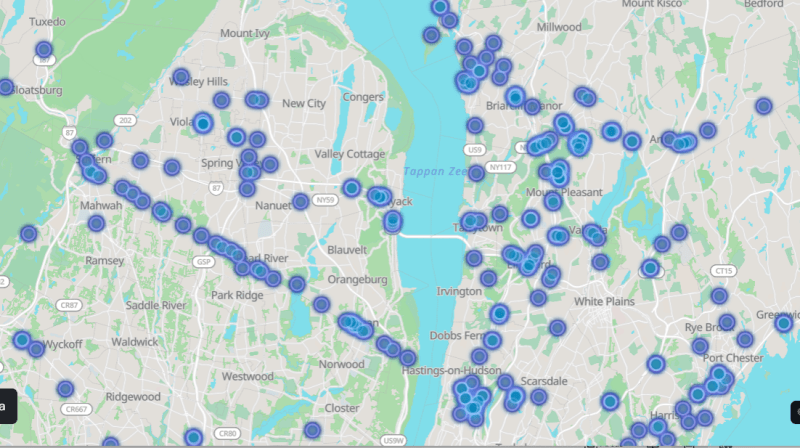
The use of ALPRs is not limited to Westchester County. Crowd-sourced map sites like De-Flock, show the locations of hundreds of Flock cameras dotting Rockland and Westchester County.
Flock Safety is one of the largest ALPR vendors in the United States. Their cameras are installed for police departments, businesses, shopping centers, and home owner associations. Captured vehicle data is uploaded to Flock’s cloud system, where participating agencies can search and share information across jurisdictions.
Though Flock may be the largest vendor of ALPRs, it is not the only vendor. Motorola, Genetec, Leonardo, Neology and Axon also sell ALPRs to state and federal law enforcement agencies. Funding comes from New York State and the federal government in technology grants which law enforcement uses to buy cameras and the technology supporting them.
In response to privacy concerns, many municipal governments around the state and country have started to “de-Flock” their communities and have either cancelled their ALPR contracts or are in the process of reconsidering their use, primarily prompted by complaints raised by local residents. In New York State, Tompkins County, Ithaca, Saranac Lake, and Scarsdale have canceled their contracts with ALPR vendors. In Scarsdale, more than 450 residents petitioned Village officials to cancel its contract with Flock. Troy, Trumansburg and Syracuse are considering restrictions and limitations on their use.
Unlike red-light cameras or speed cameras that are triggered by specific violations, these cameras photograph every vehicle that drives by and can use artificial intelligence to create a profile with identifying information that then gets stored in a massive database. Once that happens, officials can search the database for any vehicle they wish, all without a warrant. And departments around the country are automatically sharing data with each other, making it simple for police anywhere to track drivers’ movements.






Law enforcement can search broadly, for example, for every red Toyota or silver Honda CRV that traveled on Route 59 in 2025, or for every car carrying bicycles on the New York State Thruway last summer. Or, they can search for a specific license plate and every location its been captured for the past two years. AI creates virtually limitless search options.
BusPatrol, the vendor responsible for the installation of stop-arm cameras on school buses in Rockland County has expansion plans for the school bus mounted cameras. It has launched a pilot program to have its school bus cameras serve as mobile surveillance units, capturing license plate and other vehicle data, essentially functioning as a mobile ALPR. The systems are being designed to capture the license plate, location, and vehicle data of every car the buses drive past, with the collected data being instantly uploaded and made accessible to local law enforcement.
The Westchester County lawsuit focuses specifically on practices in Westchester, where plaintiffs claim the cameras are “heavily concentrated in non-white-majority neighborhoods near the Westchester-Bronx border, where residents are predominantly Black and Latino, resulting in disproportionate surveillance of all those who live, work, and commute throughout those areas.”
Plaintiffs claim that the focus on minority areas “perpetuates historical patterns of over policing and over-criminalization” and that the system operates without specific legislative authority and without clear limits on the use of the data.
The data collected by Westchester’s 575 cameras is shared with federal, state, and local law enforcement entities, including regional police departments in Putnam County and Rockland County, the New York City Police Department, the New York State Police, other state and local police departments across the country, and federal agencies like ICE, the Federal Bureau of Investigation (“FBI”), and the U.S. Drug Enforcement Administration (“DEA”).
Westchester also uses mobile ALPRs, mounted to police cars which serve as roving surveillance units, recording data on every vehicle they encounter. The roving vehicles also record video, which is uploaded instantly to AI servers.
Plaintiffs also claim that the readers are deeply flawed, error-prone, and regularly misidentify license plates, vehicle types and other data.
Plaintiffs say the use of the vehicle surveillance system violates the New York State Constitution’s prohibition on unlawful searches because it involves the warrantless and suspicion-less collection of personal information and location data, revealing the detailed daily routines and long-term travel patterns of countless innocent New Yorkers.
They also say that the system was created and is being used without legislative authority, and that public funds are being used without authorization. They ask the court to declare the system illegal, and enter an order prohibiting its continued use.
Plaintiffs are represented by the New York Civil Liberties Union (NYCLU), the Knight First Amendment Institute, the Policing Project at NYU, Freshfields US LLP.