








|
RCBJ-Audible (Listen For Free)
 |

Village of Chester Sends Letter To Homeland Security, While Township of Roxbury Passes Resolution Opposing Detention Center
By Tina Traster
Blindsided by the Trump administration’s plans to use empty warehouses to house “illegal” immigrants awaiting deportation, residents and activists have teed up protests, while public officials are mulling what can be done to seek more information, fight back, and in at least one New Jersey town, let the government know that their plans are unwanted.
In early January, the Washington Post reported the federal government is planning to purchase a vacant PepBoys distribution warehouse in the tiny Village of Chester in Orange County to convert to a processing facility for immigrants awaiting deportation.
Caught unaware, the Village’s attorney, on Jan. 9th sent a letter saying, “The Village has become aware, through media articles, of ICE potentially utilizing a warehouse in the Village of Chester (29 Elizabeth Drive, Chester NY) to temporarily house persons. No one from ICE has contacted the Village of Chester about this.”
As of last week, the Village has not received any correspondence from the Department of Homeland Security, which is planning to open seven large-scale warehouses holding 5,000 to 10,000 people in Stafford, VA, Hutchins TX, Hammond LA, Baytown, TX, Glendale, AZ, Social Circle, GA, and Kansas City, MO. And another 16 processing centers like the one planned for the Village of Chester, which are planned nationwide. The slated warehouse in the village is the only New York site on the reported list.
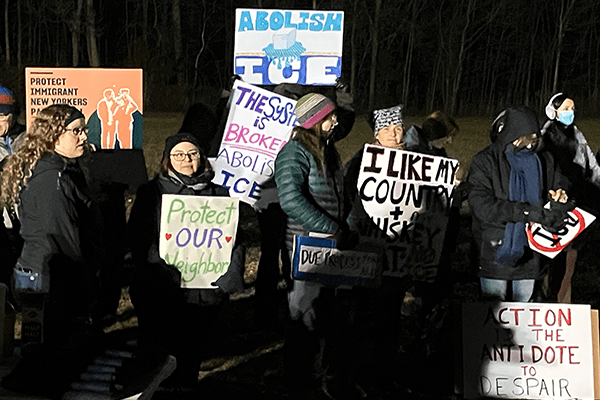
On Jan. 12, more than 400 people from the village, the surrounding Town of Chester, neighboring Orange County towns and cities, and from farther afield in the Hudson Valley flooded the standing-room-only Senior Center (Village Hall was too small for anticipated crowds) to implore elected officials to do whatever it takes to stave off the federal government’s attempts to site a detention center in the community.

Village of Chester Mayor John Bell said the village had not received any application or communication “concerning the potential use” of the warehouse. Neither he nor board members made public statements about the proposal.
After the town hall meeting, Village Attorney Brian Nugent said, “The village is not taking a position on underlying issues on ICE and immigration. Our only issue will be about zoning. We don’t want to take positions that may hurt the Village’s ability to review any potential applications.”
Meanwhile in the Township of Roxbury, New Jersey, town officials, who are also in the dark about the federal government’s plans, have taken a proactive step to keep the warehouse conversions at bay in response to the Washington Post’s reporting and subsequent protests.
The all-Republican Township Council on Jan. 13 voted unanimously to approve a resolution that opposes the placement of a federal immigration processing or detention facility inside warehouses within the town. As detailed in the resolution, the council “unequivocally opposes” the conversion of existing industrial warehouses within Roxbury for the creation of a U.S. Immigration and Customs Enforcement processing facility or “any other facility that disregards the Township’s land use and regulatory ordinances” and places “unanticipated burdens” on the town’s resources, infrastructure and services.

Roxbury’s resolution says its primary objective is to ensure the public safety and welfare of its residents, business community and visitors, and that the town is not an appropriate municipality for the placement of a detainee processing facility.”
In Chester’s letter to the Trump administration, the attorney wrote: “ICE should note that the Village has had a law in place for a couple of years regarding the housing of vulnerable persons which is a special permit/ public hearing process. A copy of the law can be found here: https://ecode360.com/44279793#44279793”
The law states that “No person, association, entity, or organization shall cause 10 or more vulnerable persons to be placed at any location or structure in the Village of Chester for the purpose of extended residency, which shall be defined to mean stays of up to 30 days, without a temporary residency of vulnerable persons license approved by the Village Board of the Village of Chester in accordance with this chapter. No such license shall be issued for stays of longer than 30 days.”
Examples of such persons include homeless persons, persons who suffer from mental disease or conditions that generally require supervision or assistance on an ongoing basis, persons who are physically disabled that require supervision or assistance on an ongoing basis, and persons who are not citizens of the United States that lawfully or unlawfully entered the United States within the previous nine months who do not currently have the means to support themselves with basic needs, including consistent supply of food, shelter and medical care and gainful employment.
In his letter, Nugent also wrote: “There may be additional use/zoning requirements applicable to the proposed use.”
Existing zoning allows “as-of -right” wholesale, storage and warehouse facilities, manufacturing, processing, producing and fabricating operations, research laboratories, business and industrial offices. The vast office park is not suitable for residential use, officials say. Additionally, Chester’s sewage system is a peak capacity, according to Town of Chester Supervisor Brandon Holdridge, adding “I will work with the Village of Chester and any other government entity/officials to keep any potential ICE facility out of Chester.”
In a letter dated Jan. 16, the Village wrote in a letter to the Trump administration: “Currently and for the foreseeable future, the Village of Chester currently does not have any sewer capacity available for any new development or expansion on an existing Project Site. The Village has been restricted from utilizing any additional sewer capacity for years. The Village is part of the Moodna sewer district, whose sewer capacity is governed by Orange County….”The Village has exceeded its 347,000 gallons per day (gpd) capacity and is not permitted to utilize any sewage capacity over its 347,000 gpd allocation.”
Futher, the letter said: “The ICE proposal would increase the number of people currently accommodated for sewer capacity at the Project Site from approximately 150 people to 1,500 people (a 1,000% increase).”
How much choice or power local officials will have may be a David and Goliath struggle because it is unclear how much sway local zoning rules will have when faced with the federal government’s decision to purchase and convert the former PepBoys warehouse distribution center. It is unclear whether the Village of Chester will be able to exert home rule or zoning laws to prevent the immigration processing center from opening in the jurisdiction.
Generally, property owned by the federal government, including its agencies like Homeland Security, are not subject to local zoning laws. While many federal agencies work with local governments to ensure federal land use is compatible with surrounding areas, local laws don’t bind them. Compliance is voluntary and discretionary.
If it came down to a legal fight, the federal government could invoke the Supremacy Clause (Article VI, Clause 2 of the U.S. Constitution), which establishes that the Constitution, federal laws, and treaties are the “supreme Law of the Land.” This means they take precedence over conflicting state laws, and state judges must uphold federal law. It underpins federal power, allowing the national government to enforce laws and treaties without state interference, forming the basis for federal preemption in areas of federal authority, while ensuring federal laws remain constitutional.
For this reason, a village or town that takes a “position” on a proposed center must tread carefully because the federal government can claim the opposition arises from more than just zoning issues. The use of empty warehouses nationwide puts any community with warehouses, especially those with a proliferation of warehouses, on notice.
The former 400,000 square-foot PepBoys Distribution Center targeted for the detention center has been shuttered since 2024. The facility is owned by IEP Chester LLC, which is an affiliate of Icahn Enterprises LLC. Carl Icahn is the founder and controlling shareholder of Icahn Enterprises, a public company and diversified conglomerate holding company based in Sunny Isles Beach, Florida. He was Special Advisor to President Trump on Regulatory Reform from Jan. to August 2017.
It may be difficult to fight the federal government if it owns the warehouse; however, if the warehouse is sold to the government but then leased to a private operator, that might give the village more control over its use.
The Village attorney’s letter also said, “We would appreciate someone from your agency contacting the Village as soon as possible so that the Village may address the significant public interest that has been generated by ICE’s proposed plans in the Village and to confirm whether or not this proposal is still on the table.”
The Trump administration has not responded to the email.