










|
RCBJ-Audible (Listen For Free)
 |

Public Hearing Enables Residents to Voice Concerns and Compels the Developer to Respond In Writing
On Wednesday evening, the Village of West Haverstraw’s Planning Board will hold a public hearing on the Draft Environmental Impact Statement (DEIS) for the proposed Grassy Point Bend Wholesale Storage and Warehousing Facility.
The hearing will give the public an opportunity to comment and question the details in the DEIS, how the developer plans to mitigate the significant environmental issues, and what alternatives it considered to its current proposal. Thereafter, the developer will be responsible to address every question raised by the public in writing.
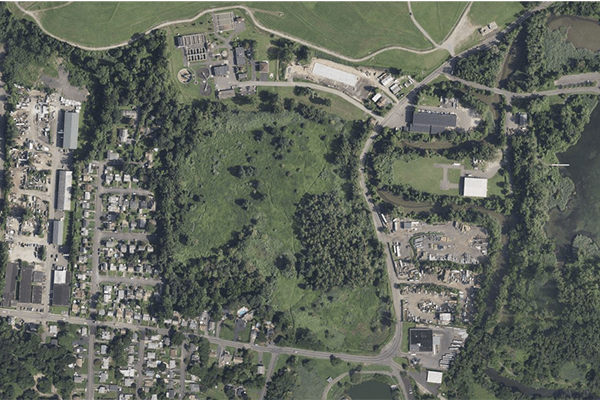
The proposal, which has met with opposition from homeowners in a residential neighborhood just to the west of the site, calls for the construction of a 454,000 square foot warehouse facility and accessory office space, with truck loading docks, trailer storage spaces, car parking spaces and related infrastructure and lighting. The site, a former construction and demolition debris landfill, has been closed for decades.
The proposed Grassy Point Bend warehouse project borders a residential neighborhood to the west, Minisceongo Creek to the east, and Rockland Green’s soon-to-open animal shelter to the north. The facility, with 76 truck bays will operate 24/7 though no tenant has yet been secured, according to the developer. The primary driveway for trucks entering the facility will be on Ecology Road, directly across from the planned animal shelter. The other will be on Grassy Point Road.
The 34-acre landfill site was never properly closed. The grassy hill is covered with two feet of topsoil and overgrown vegetation. The project sits in the Village’s PLI (Planned Light Industrial) zone which allows for warehouse uses as-of-right, but the developer is requesting two variances – for building height and reduced parking.
The DEIS addresses potential environmental impacts, proposed mitigation measures, and alternative plans.
Some of the issues that have raised concern among residents include the disturbance to soils at the existing landfill both during and after construction, how contaminated soils will be used, how groundwater will be affected at the site, and how runoff from rains and storms will be managed. Hundred-year storms have become a regular occurrence.
The developers have proposed keeping all of the C&D debris onsite and regrading it to bring the site level. According to the DEIS, clean fill will be brought on site for the landscaped areas. Clean soil will be taken from the existing landfill cap and temporarily stored, as well as bringing in additional fill material as needed to properly establish the subgrade. It says keeping C&D material onsite prevents the debris from becoming a part of another waste stream and reduces exposure to the material. Dynamic compaction and proper enhanced and re-capping of the C&D Landfill will take place before construction of the warehouse.
The management of stormwater both during and after construction and the protection of groundwater from infiltration of leachate are issues recognized early by the Planning Board and the developers. The DEIS focuses on the SWPPP (Stormwater Pollution Prevention Plan) and its comprehensive approach to stormwater management as mitigating the environmental impacts related to runoff.

Nearby residents have also expressed concerns about air quality from dust production during construction, as well as increased truck traffic and its impacts, including the idling of diesel trucks and operation of forklifts post-construction. Hours of operation have also been an issue as the proposed warehouse sits adjacent to an established residential neighborhood and the Rockland Green Animal Shelter.
Noise, odor, and light from the operation has been recognized as a significant environmental impact. To mitigate any potential noise impacts, the developer has proposed and is planning on constructing a sound wall on the west side of the property to prevent noise traveling to the residential area.
The DEIS says that the operation of the warehouse involves the movement and storage of goods inside the warehouse that will not cause any noise or exterior impacts. No exterior storage areas are proposed. And, to mitigate light impacts, the lighting sources for the site will be dark-sky compliant with downward directed fixtures.
In regard to the proposed Rockland Green Animal Shelter in the existing warehouse located at the northwest corner of Beach Road and Ecology Lane, there are mitigation efforts being implemented to prevent potential disturbances to the animals. According to the DEIS, minimizing nighttime truck activity on the northern portion of the project site and closing the Ecology Lane access point at a certain hour can prevent disturbance to the animal shelter. Limiting truck backup alarms could also prevent additional noise disturbances to the shelter. A potential sound wall with sound adsorption applied to the wall and building side facing the animal shelter could also reduce disturbances. It is unclear if any of these mitigation measures have taken into account the heightened sensitivity of the animals housed at the shelter.
The developer has prepared numerous simulations from various vantage points to address the impacts on aesthetic and visual resources, saying essentially that the residential neighborhood above the development will be minimally impacted by the warehouse.
The developer also asserts that the warehouse itself will mitigate the environmental issues related to the closed landfill. The project site is currently vacant and is covered with grass and low vegetation, dirt roads, two wooded areas, and two areas covered with gravel. There are currently ten landfill gas monitoring points and five groundwater monitoring wells on site.
The DEIS says the construction and active management of the site will ensure that the environmental harms that already exist will be monitored and mitigated.

As alternatives, the developer looked at a no-build scenario and a smaller warehouse. Its analysis says that the no-build leaves the landfill as a potential hazard itself, and that a smaller warehouse does nothing to further mitigate the steps already being contemplated on the larger project.
Written comments on the Draft EIS will be accepted until September 10, 2026. Residents will have the opportunity to comment on the DEIS and address their concerns directly to the Village Planning Board.
After the DEIS is accepted, the Planning Board as lead agency is responsible for gathering comments and preparing the Final EIS. It must adopt a formal, written set of findings, evidencing that the Board took a “hard look” at environmental consequences, balanced social and economic factors, and chose an action that minimizes environmental harm to the maximum extent practical.
Once findings are adopted, the Board can officially approve, deny, or place conditions on the project permits, concluding the SEQR review process.
The Draft EIS is available at 130 Samsondale Avenue, West Haverstraw and online at: https://www.westhaverstraw.org.