










|
RCBJ-Audible (Listen For Free)
 |

Nixon, Peabody Withdraws From County FOIL Case Following Charges of Conflict of Interest
ANALYSIS
Rockland County is doing everything it can to keep from public view the details of the contract it negotiated with BusPatrol on how revenue from the tens of thousands of tickets issued every year gets shared. Also, the county will not reveal what it has agreed to pay BusPatrol for the technical and administrative fees BusPatrol deducts from the county’s revenue share every month.
In 2023, Rockland County partnered with BusPatrol, a private company based in Lorton, Virginia, to equip school buses countywide with stop-arm cameras. The bulk of the collected revenue — 55 percent — goes to BusPatrol, with 45 percent to the county, according to a Rockland County spokesperson. The county covers costs incurred by the Rockland County Sheriff’s Office to review thousands of videos submitted to decide which ones to charge and pays for the costs of the County Attorney’s Office to cover hearings when drivers contest liability. From its share, it also covers a technology and administrative fee the county refuses to disclose. Every school district in Rockland County is participating in the program but none get any share of the revenue from the citations.
The county is currently litigating against a Brooklyn-based law firm challenging the secrecy with which the county guards the BusPatrol contract in a protracted and potentially expensive FOIL case in Rockland County Supreme Court.
But hold that thought for a moment. Let’s take a cold look at the numbers we can see and compare them to the limited data available from last year.
2025 Data Provided By BusPatrol
According to data provided by BusPatrol to the New York State Assembly (as per a legal requirement to share data with the state), BusPatrol reported that in 2025 it had cameras installed on 1,232 buses (across all school districts), an increase of almost 8 percent over the 1,143 school buses hosting BusPatrol cameras at year-end 2024.

During calendar year 2025, BusPatrol reported it collected $3,131,500 from 12,526 paid citations, at $250 per paid citation.
Of that $3,131,500, after deducting its share of the revenue, and deducting technical and administrative fees, BusPatrol remitted $450,528.52 to Rockland County – 14.4 percent of the revenue collected, far less than the 45 percent of the revenue the county represents it is entitled to. At 45 percent, the county would have collected $1,410,750 (before having to pay BusPatrol technical and administrative fees). BusPatrol did not provide any reconciliation or information regarding the county’s reduced share.
The camera recordings of vehicles allegedly passing stopped school buses with stop-arms out and lights flashing in Rockland County resulted in the issuance of 22,744 citations to owners of vehicles. According to the report, only 15,674 of the 22,744 were paid, with 7,070 unpaid, a 69 percent payment rate.
The 7,070 were broken down in the report as follows: 5,110 were “not paid and not contested”, 1,920 of them were “not paid, contested, and not heard”, and of the 1,920 that were contested, only 6 were found liable. And, 34 of the contested citations were dismissed.

In 2024, BusPatrol issued 24,036 citations, of which 8,122 were not paid – a 66 percent payment rate — roughly the same as 2025.
In 2024, BusPatrol reported that $3,073,000 was collected from paid tickets, and $1,996,218 was distributed to the county. Also in 2024, from the $1.9 million, BusPatrol deducted more than $1 million for technology and administration, netting the county $986,288 or about 32 percent of the collected revenue. This was roughly two times what the county took in on the program in 2025.
BusPatrol Hot Spots
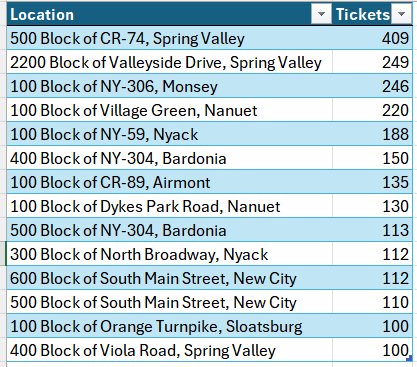
The data submitted by BusPatrol for 2025 shows a disproportionate number of tickets are concentrated at particular locations that have other endemic problems including higher speed limits and poor signage. The top 14 locations where citations were issued, based on data provided by BusPatrol to New York State, account for 2,374 citations, with many of the locations also being the same “hot spots” in last year’s report.
Critics of the program say the locations are effectively “traps” for motorists; charging revenue earned by the county creates a disincentive to slow speed limits, add warning signage, or re-route bus drop-offs to side streets to ensure student safety.
While keeping students safe is an obvious priority, many question whether the program is truly justified. The steep cost of the tickets comes at a time when many in the county are struggling financially.
And many note injuries and deaths from school bus accidents in Rockland County are the result of school bus-student interactions and not passing vehicles.






While exact yearly figures vary, recent data shows there are two to three student fatalities annually nationwide caused by vehicles illegally passing stopped school buses, according to the USDOT and state surveys, though total school bus-related deaths (including bus occupants) average over 100 yearly, with most coming from other vehicles or types of crashes. From 2000-2023, there were 61 fatalities nationwide from drivers illegally passing stopped school buses, averaging 2.5 deaths per year, with nearly half being children 18 and younger, according to Traffic Safety Marketing, based on data from the NHTSA’s National Center for Statistics and Analysis, an arm of the United States Department of Transportation.
FOIL Litigation
In March, Aron Law PLLC filed an Article 78 lawsuit in Rockland County Supreme Court after the county failed to comply with its FOIL (Freedom of Information Law) obligations by “unjustifiably withholding responsive records to Petitioner’s FOIL requests related to the County’s school-bus stop-arm camera enforcement program,” according to court documents.
The suit says programs like the one BusPatrol operates have been plagued by systemic issues, including reliability of camera footage, adequacy of notice and questions about motorist fault. RCBJ since December has published a series of stories that shed light on both the practical and economic efficacy of the BusPatrol program.
In an unusual move, instead of county lawyers or outside counsel defending the county, BusPatrol’s lawyers from Nixon Peabody represented the county (for free) in its opposition to revealing the county’s contract with BusPatrol.
Aron Law charged a conflict of interest – that the obligation of the County toward open government and disclosure of public contracts directly conflicted with BusPatrol’s interest in keeping the terms of its dealings with the county private. Aron Law moved to disqualify Nixon Peabody.
Instead of defending against the disqualification papers, the county sought consent to substitute Nixon Peabody with Tarrytown-based McGowan Harrington Parisi, and filed papers saying the motion for disqualification was moot.
Aron Law filed papers in opposition saying Nixon Peabody’s removal did not render the issue moot, as it was still unclear who was paying for replacement counsel. Aron is asking the Court to inquire as to the selection and funding of the McGowan firm, and whether the new counsel is pursing the same defenses Nixon Peabody had filed.

In a similar issue in Dutchess County, where BusPatrol’s lawyers at Nixon Peabody were representing Dutchess County (for free) in FOIL litigation to keep its contract secret, Aron Law sought disqualification of Nixon Peabody based in part on a conflict of interest. Last week Dutchess County, relented, substituting Nixon Peabody for local counsel.
Rockland County Traffic Camera Violation Bureau
Rockland County recently announced plans to create a Traffic Camera Violations Bureau, an administrative court structure to hear the county’s School Bus Stop-Arm camera citations. This program will need county legislative approval, but it is unclear who will pay for it, who will be appointed, where these tickets will be heard and whether additional costs will be added to the tickets to offset the costs related to the program.
Hearings for contested tickets would be routed to the County’s Traffic Camera Violations Bureau rather than traditional town and village courts, which according to one source have been reluctant to hear BusPatrol cases.
The 2026 New York State Budget authorized municipalities to establish Traffic Camera Violations Bureaus (TCVB) to handle school bus stop-arm camera violations.
New York City, Suffolk County, and the Town of Southampton already have administrative law courts to handle bus stop-arm camera cases.