













|
RCBJ-Audible (Listen For Free)
 |

Editor’s Note: The arts are a significant thread in the fabric of Rockland County. They inspire, enrich, and chronicle our lives. They also play a role in our economic well-being; theater, writing, dance, crafts draw us to spaces. They invite strangers to share in our bounty. They are an indelible contribution. Welcome again, Christine Potter, a poet, to RCBJ.
How Do We Do This? Marking America’s 250th With Local Poets
By Christine Potter
My dad worked for a while as an insurance underwriter and ended up worrying too much about safety. But he still let my sister and me play with sparklers on July Fourth. It was the early sixties. Susan and I knew sparklers were dangerous—and not even strictly legal in New York State then. They burned white-hot! We had a bucket of water to drop the spent ones into when we’d finished writing our names in white fire.
When they were little, I encouraged my godkids to do the same, and my husband made pan after pan of fried chicken for our patriotic July 4th dinners. We poured bright blue frozen margaritas for the grownups. I think it was on the Fourth that my older goddaughter discovered how delightful it is to munch a drumstick while reclining on a float in our swimming pool.
Independence Day used to be like that: sweet, a little wacky. Early summer, lawns and leaves incredibly green, parades…you didn’t have to buy presents or roast a turkey. Just sit outside while the fireflies blink on and listen to backyard firecrackers or the town’s display over the Hudson. Think about all that beautiful language in our Declaration of Independence.
But this year is that Declaration’s 250th anniversary, and I’m not feeling it. Neither are lots of us. ICE is still detaining law-abiding immigrants trying to make this country their home. The US is still mired in a pointless war of our own choosing that we can’t seem to settle. Vital social programs and even our basic rights are under attack—and the Reflecting Pool in DC looks like a broken hot tub in a half-built, abandoned development.
The only reasonable thing to do is to ask the local poets how to bear up. Fortunately, Rockland County is blessed with an excellent crop of them.
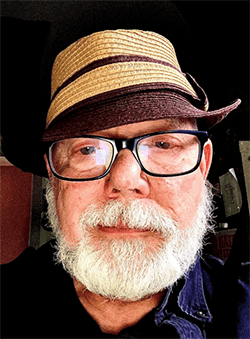
Pulitzer-award winning journalist-turned-poet Brian Kates, who appeared in this column last November, is simply furious. He’s mad at it all: the cage fight on the front lawn of the White House, the cruelty in the President’s speeches, what the ancient Roman poet Juvenal called “bread and circuses.” Trump, Kates says, “has figured out that he can dispense with the bread. All he seems to need are the circuses. So, like Juvenal, poets today must hold the emperor’s feet—and the people’s—to the fire, to open their eyes, their minds and their hearts.”
Brian Kates turned 80 around the same time The Donald did, and offers us this:
Thoughts on Turning Eighty
I turned 80 today and every little twitch and throb
hands me what looks like a passport to the hereafter.
Cancer has already taken a swipe at me and I know
it’s hiding, waiting. Will that be what gets me in the end?
Some of my friends now live in nursing homes.
They don’t recognize their children. Am I next?
A guy I used to hang with fell and broke his hip.
Dead three months later. Could have been me.
Yet here I am. My heartbeat is a metronome. My brain
can wrap itself around my thoughts. A kiss is still a kiss.
I’m able, too, to rise each day and read the morning’s news.
But, as Dylan said, you don’t need a weatherman.
Today, it’s raining bombs in a billion-dollar-a-day war
waged by a convicted felon and an indicted war criminal.
Epic Fury, War-a-Lago rules: 170 children killed
in their school. Shit happens. The corpses look like me.
Masked federales kidnap Americans off the streets, strip
children from mothers, murder folks who dare protest.
Our speech is censored, our history sanitized,
science mocked. And the tide keeps rising.
Oh, I’m alive, alright. In a billionaire’s kleptocracy,
artificial intelligence in service of natural stupidity.
So, yes, I think of how I’ll die and when. When they write
my obit let it read: He tried to live right and died of old rage.

Old rage! I have to love that. And I like that this poem reminds us how immediate it all is: censorship of history and news, ICE’s brutality last winter in the Twin Cities. The narrator here sees himself both in a friend who died after a fall and in Iranian schoolchildren dead after American bombs hit their classrooms. We are all, indeed, connected.
Brian Kates curates the ongoing poetry exhibition at the Hester Haring Cason Preserve, Riverhook, in Upper Nyack. With its views of the Hudson and its meadow well-mown by hungry goats from nearby Summit School, Riverhook is a lovely place to soothe the dystopia blues. If you’d like to submit a poem about the natural world to be part of an upcoming exhibition, email Brian here and he’ll put you on the mailing list for calls.
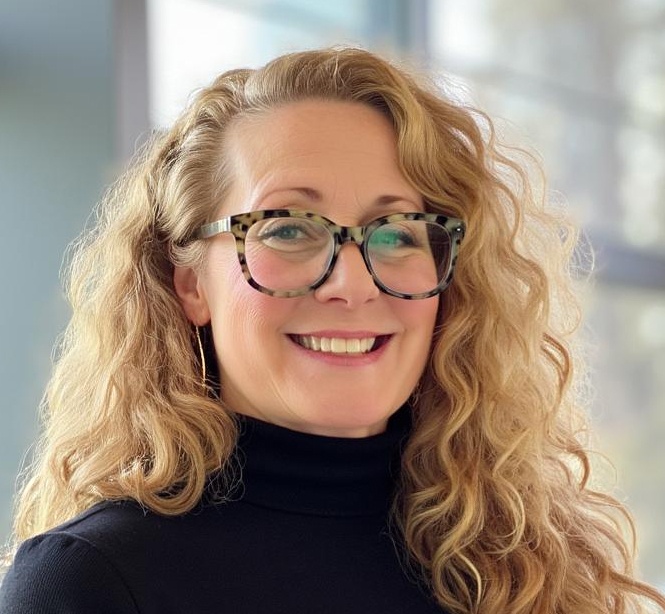
Poet Mary Lou Buschi was in this column last September. She’s having a rough time, too. And like Brian, she has a birthday mixed up in it: July 3rd. “I’ve always had a complicated relationship with my birthday,” she says. “It falls on the eve of July 4th, with its violent noise—fireworks that mimic war, parades, and flag-waving celebrations. This year, as I turn 60, the nation’s 250th anniversary feels especially charged.”
Here’s a poem from her with an unusual name: “&”
&
I just keep repeating I’m exhausted,
angry about knee pain—maybe arthritis—
and I want to cancel a haircut
because I’m too tired to have someone fiddle
with any part of me,
so I temper the scrolling,
temper conversations with my students
about ICE—I will protect you, I say—
as the Department of Education
becomes the next target, my sister loses
clients, working in social justice,
and H must get on a plane to calm
his friend in DC who’s losing his job,
and who cares about hair anyway?
What if Derick wants to talk about the state
of the world, how can I reply, Just a trim?
grateful his son won the wrestling finals—
we could talk about that or the snowstorm
or the new restaurants that have opened
and why the lights
are so f*****g bright,
twelve TVs behind every bar—
I just can’t take that much in—
It’s over, I pay him and then I’m alone
again in my car stretching my bum knee,
wondering who I thought I was kidding
in those high boots,
when I remember the Gaffers tape I saw
on a dog’s tail and burst into tears thinking of the pain
she must have endured
at the hand of the one who feeds her.
—first ran in Sixth Finch
Wonderful close! I’m teary over the dog, too. That last line gets into betrayal, which I’m certainly feeling from the country I love. Mary Lou is not without hope, though. For her, a member of the board at Arts Council of Rockland, it’s the creators who keep her going: “at our recent event honoring this year’s award winners, I was surrounded by people who, despite—or perhaps because of—the times we are living through, get up every day with the tenacity to create, inspire, and give voice to democratic ideals through music, writing, painting, and photography. As I listened to their speeches, I felt a renewed sense of pride and a bit of hope. Their work reminded me that creativity is not an escape but an act of courage.” Amen, sister, amen!
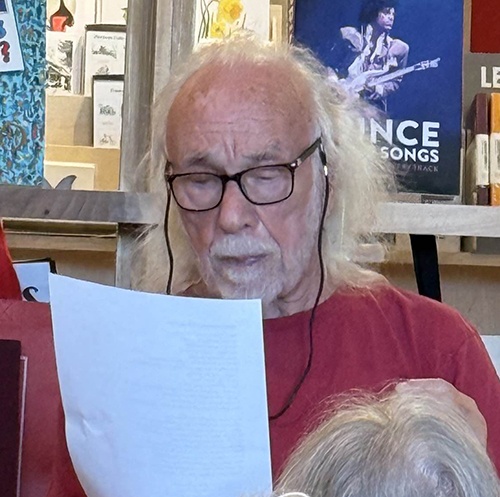
When Pomona’s Wally Glickman’s not waving a protest sign over at Four Corners Nanuet, he is writing poetry that encompasses grief, joy, love, and anger…and sometimes all of those things within two or three lines of each other. Wally practices what is really a very ancient form of poetry—one that encompasses performance, like the scops (medieval poet-entertainers who traveled to mead halls). Scops would be very much at home in the poetry slam scene. Here’s a poem Wally brought to life before a cheering, hooting, standing-room-only crowd at Nyack’s Big Red books last week.
Things About Kings
First of all, they lie.
Shamed-faced doesn’t say it, cause they lack shame.
Whatever doesn’t fly
they spin around to fling away the blame, find cover under flags flown high,
patriotic tunes, God’s name.
Then there’s the power.
They’ll do whatever it takes to keep the throne:
fortify their towers,
find some kind of conflict to condone,
let the rabble cower,
while they sit there sucking out the marrow, throwing you the bones,
eating your fruits, spitting out the stones
in your face. (That’s how seeds of tyranny get sown.)
Another thing is greed.
They sink their fangs in deep before they feed,
empty out your pockets while you bleed.
Oblivious to what people need, they give ’em booze and weed,
and circuses, so they’ll pay no heed
to the boot that’s comin’ down. Oh yes indeed,
there’s a boot that’s comin’ down. Forget about freedom.
Oh the kings will smile and tip their crowns,
send out the jugglers and the clowns,
then follow their foxes with their horses and hounds,
behind fine silk trappings and the sounds
of blaring trumpets. With soldiers all around
there’s no place to hide.
With trumped up enemies implied, lies get amplified
as they echo and resound through every hamlet, farm and town.
All dissent denied.
Dissidents they haven’t hung, bound
in dungeons – missing tongues – deep underground.
Transforming trumpets blast: Forsooth!
And soon it seems each blatant lie
has morphed into the Truth.
So forget the gilded scepter,
the embroidered brocade,
the courtiers they might have kept
in plumes and gold braid.
Think of the women who have wept over graves
where their sons were laid –
though it’s painful to remember, you kind of have to try.
Don’t ever let yourself forget that
first of all, they lie.
Reading this one silently seems wrong, but the cool thing about many of Wally’s poems is their jazzy, free-verse-y meter, punctuated by rhyme. It’s like rap—or early Dylan—and all in the bardic tradition. It makes your eyeballs dance—and makes its point! Kings may well lie—but Wally tells the truth.
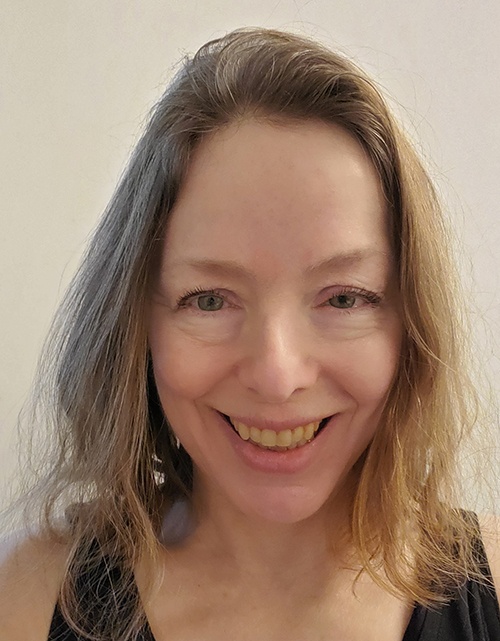
Therapist/tarot card artist/poet Alison Stone says she’s “trying to cultivate denial” about the big anniversary. Denial has its healthy uses. On the actual Fourth she says she might “ignore it as much as possible. Wear black. Hopefully go to a protest. If not, stay home and write postcards.” Sounds good to me—and very much in the American tradition; this country was born in protest. Here’s her poem, “Now.”
Now
Cards marked. Kings pulled out of pockets win.
Refugees hide. Masked agents close in.
Ashen with shock, our faces prohibit
pleasantries. Don’t ask How have you been?.
In Yiddish, “vance” means “bedbug.” Words twisted
like dishtowels, empathy is sin.
There’s enough suffering to go around.
Stop the Pain Olympics – class vs. skin.
My mother stays dead. My father rots in
his red hat. The cult owns half my kin.
The app to change him into kittens stops
working. Everywhere his vulpine grin.
Artemis is running out of arrows.
Women howl. Prayer? Lament? Tocsin?
Bali tiger gone. Cuban coney, plains
rat, sea mink, Yangtze River dolphin…
Stars blink on. Whales sleep vertically, holding
their breath. Voracious birds cry Ruin.
Doors lock. Neighbors avoid each other’s’ eyes.
Grudges wake and feast. New wars begin.
This ghazal-like poem says it all: the distrust bred by these hard times when “empathy is sin,” and “whales sleep vertically, holding/their breath.” That last image, by the way, is my envy-inducing line of the month. But I also love what “Vance” means in Yiddish! And she ends with those three matter-of-fact words: “new wars begin.” They are like the somber tolling of a bell.
Even after such an eloquent cry of pain, Alison also has hope. She sent me a list of reasons for it: “The polls (though I know they’ve been wrong before). The smaller elections where we’ve gained ground in places that creature won by double digits. The fact that cycles like this have happened before. The communities people are building.” Yes. Especially the communities!
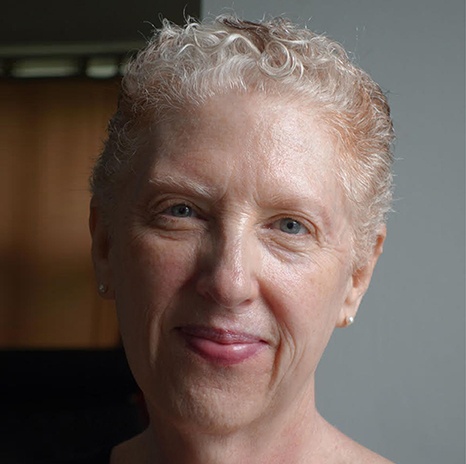
H.E. Fisher, co-editor of the forthcoming The Big Brutal Act poetry anthology and author of the collection Sterile Field, appeared in this column a few months ago. H.E. reminds us that two hundred and fifty years is not old for a country unless you’d been living here first, were displaced by colonization, and are still waiting for things to get better—and that the United States has “never fully loved all its people” because of capitalism’s greater love for the dollar. Yet, she, too, is heartened by many things: Minnesotans, wildflowers, poets and writers–and New York City. She gives us this poem about the Washington Monument in DC.
Obelisk
She is no longer the child posing on the Mall
for the Kodak in a red white blue shift,
her left-wing parents buoyed by patriotic pride.
There was a time she believed in symbols.
Or knew she was supposed to. The Stars
and Stripes a rose without scent.
A single tooth pulled from George
Washington’s pilfering mouth. Now
she lives in the historic Hudson River Valley
and wakes to percussive sounds from the quarry,
mass reduced to rubble. Marble, granite,
bluestone gneiss—chips of colonized earth.
The Commander-in-Chief did not want to be
called king. The Monument got built anyway.
–first ran in The Marbled Sigh: Political Poems Online Anthology
I love the flag as “a rose without scent.” And I identify with the “percussive sounds from the quarry,” which is near my house, too. “Colonized earth!!” Her last two lines really sum it all up. I wonder if Washington saw all this coming? I mean, he couldn’t have predicted the technology, but I bet he had an idea of the folly.
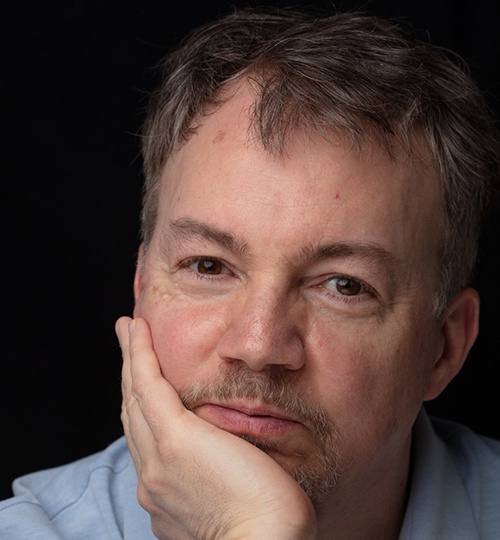
Piermont’s William Huhn, author of the collection Bachelor Holiday, sees light in the darkness. He takes the long view, pointing out our progress since this nation’s earlier days: “The American infant mortality rate in 1900: one in five babies died. I wouldn’t have wanted to need a cavity repaired in 1790. During what other era in history could we fly to Paris for the weekend?” You can’t argue with that. He cites the internet as the reason we are so aware of corruption and bad politics. I think he’s right—although I also blame the ‘net for being easily abused to pull the wool over people’s eyes.
William sent me the following comment and a “summer poem” to go with them. I love the poem, and even though I am a news junkie, I admire what he’s saying: “Frankly, as a poet I try to avoid the news of the day. I don’’t consider it my job. I’m after the truths of every age, the emotions all of us experience universally—the tears of a child when she knows she has to get a shot, a man whose wife died twenty years ago and her car’s still in their driveway. These are Americans, and we all owe our god a death. I don’t judge them for whom they voted for. That man was once a soldier, I’m glad he’s home now, and I’m glad the child gets a lollipop after her shot. I feel for them and celebrate them and our country and all the people in it, because they are our country, not our so-called leaders, they who often seem the most flawed and perverse amongst us.” Yes! Here’s William’s “Not A Through Street.”
Not A Through Street
Though others slept
she could not sleep
and went out walking
on not a through street
As white as stars
when winter blows
was night as dark
as a flock of crows
her sorrow cold
as summer’s heat
when she went walking
on not a through street
Children of candy
soldiers of home
she dreamt of not
being alone
but tried her heart
at least to keep
while walking along
on not a through street
No fireworks here—just a nocturne. And a sweet one at that. The long view again. Patience. Deep empathy. I can hear the solitary footsteps. And because William mentioned lollipops before, I’m thinking about them: the cellophane and bright cherry-red candy. This poem gets it also—and profoundly.
All I have to offer you is “Another Poem About The Fourth of July” from my book Why I Don’t Take Xanax. (I think there are a few copies in Big Red Books, Nyack, and Sparkle Bookstore in Sparkill.) It ran in Mobius first, and then in Autumn Sky Poetry Daily:
Another Poem about the Fourth of July
I don’t even know what I can say about it anymore, now
that I’ll never again drop a pack of lighted ladyfingers
down a Manhattan apartment building’s airshaft and
crazy-run to the elevator behind my screaming-laughing
college roommate. Lately, even polite fried chicken
and homemade peach pie seem like overkill. Truth is,
I’m usually away from home, the glittering fingers of
a local fireworks display surprising me after hamburgers
on a motel balcony, the antique fire trucks and Girl Scouts
having long since paraded, everything over by the time
I think to look. Abroad, it’s even stranger: two or three
distant skyrockets in Berlin, some fellow Yank shooting up
the sky over the Gulf of St. Lawrence near the national park
on Prince Edward Island. I remember the red streaks of
taillights on ring roads around Washington DC, the tooth-
pale Lincoln Memorial lights, on all night. Crowds scattering,
people walking back to their cars by themselves: a loneliness
that doesn’t even know how lonely it is. There’s patriotism
in that, but it’s not easy to celebrate because you have to love
something you can’t even name: a forgotten promise, a dense
July night, old houses lining American rivers. The gilded domes
of darkened civic buildings, the silence that divides our dreams.
Have the best Fourth you can, friends. It’s a toughie this year, but we are all Americans, as ugly as things have gotten lately. This 250th anniversary is no greedy autocrat’s holiday; it belongs to us all. Oh, and if you’re going to fry some chicken anyway, soak it overnight in buttermilk first. You can thank me later. See you in August.