










|
RCBJ-Audible (Listen For Free)
 |

A Plan Chosen For the Former IBM Center In Palisades By Orangetown Town Board Morphs From Updated Hotel, Conference Center, Spa & Biodynamic Farming To Luxury Townhouses & Condominiums
“It feels a bit like a bait and switch,” said Architect Rick Cook at the public presentation revealing plans for the former IBM/HNA center on Route 9W in Palisades.
Cook, who pitched a development for the site in 2021 when Orangetown was soliciting proposal for the property, added, “We were promised one thing, from one developer, then another thing from another developer.”
The bait in this case was a proposal chosen by the Town of Orangetown almost five years ago from a team that included brokers from Douglas Elliman, Sunia Homes, and New Valley Realty. Calling their plan “a haven for a generation of thinkers, creators, engineers and artists,” the team envisioned an updated hotel/conference center, world-class spa, a restaurant with biodynamic gardens, spaces for makers, 50,000-square feet of photo and film studios, test kitchens and co-working. The group emphasized an environmentally-driven project utilizing solar arrays, water reclamation, and biodynamic farming.
The plan, submitted by group known as REVEIL, included between 20 to 30 townhomes in the project’s first phase, and another similar amount for a second phase.
In 2024, REVEIL sold the campus to Atlantic Realty, a Woodbridge, NJ-based development company for $27 million.
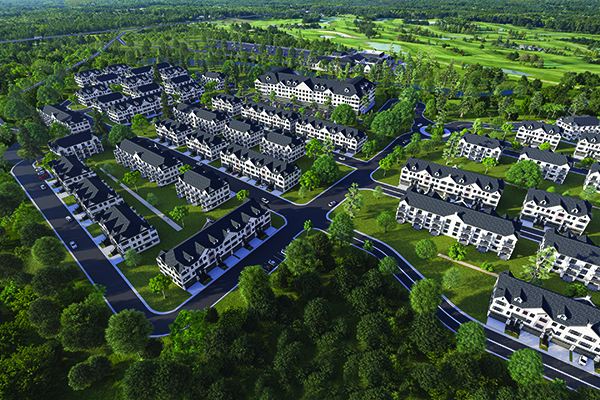
The “switch,” as many see it, involved both the selling of the property to Atlantic Realty and Crystal Plaza, and the latest proposal, which calls for demolishing the former IBM hotel and conference center and constructing 342 residential units (288 luxury, three-story, 3,300 square foot townhouses and 54 2-bedroom condominium flats). The plan also includes a newly built event space designed for between 600 (sit-down events) and 750 guests (cocktail parties), with valet parking and “after-parties” that could run until 2 am.

Some residents at last week’s town hall meeting voiced opposition to the plan for the 106-acre site in the Palisades hamlet.
The historic hamlet founded in the 17th century, as one resident pointed out, only has 513 homes.
If approved, the project would be a 66 percent increase in the number of residential units in Palisades.
Palisades resident Carol Baxter expressed concern, saying she was “told” by Atlantic Realty they were going to build 342 units. She said the plan before the town now “does not match with our community.”
Some say the prospect of adding school-age children and families to Orangetown could be a boon because the school district has been suffering from declining student enrollment for the past 12 years. Supervisor Teresa Kenny told the packed room that the Orangetown School Superintendent favored the project. She also spoke about the decline in tax revenue from the property’s current condition, saying tax revenue has declined by over $800,000 since HNA closed.
On nearby Oak Tree Road the Esplanade senior living facility has also proposed an expansion, with a proposal to build 53 one-story, two-bedroom, 1,200 square-foot senior housing units with garages on its 21.6 acre lot. That plan, accessible through Oak Tree Road, would require the town to rezone the parcel to MFR (multi-family residential).
The HNA would also require an amendment to the existing OP zone, which allows for hotels and conference centers, but does not permit residential use or multi-family development. The developers, represented by local land-use lawyer Ira Emanuel, are proposing an amendment to the OP zone on properties of more than 50 acres that would allow the town to consider individual building lots as a whole to be considered for density and FAR (floor area ratio) purposes. The amendment would only apply to lots in the OP zone that have at least 250 feet of frontage on a New York State highway.
As presented, the zoning amendment would apply solely to the former HNA property – some say a form of spot zoning to suit one particular project.
The residential units would be sold, not rented, and clustered in three- to six-unit attached buildings. The condominiums stand at four stories over a parking garage and house amenities for the residents.






Though no formal plan has been submitted to the town or its land-use boards to date, the developer asked that the project (rezoning, subdivision, and site plan approval) be considered a Type 1 action under SEQRA (State Environmental Quality Review Act) and that a positive declaration be issued requiring public scoping of environmental issues and the preparation of an Environmental Impact Statement.
Recent changes to SEQRA, that created residential exemptions for projects up to 300 housing units, would not apply to this project because of its size and the volume of land disturbance.
Jeremy Halpern, a principal of Atlantic Realty (the developer of the residential component) said he was not seeking public benefits from the Rockland County Industrial Development Authority (IDA). A previously filed application (and approval) from the IDA for a PILOT (payment in lieu of taxes) agreement, sales tax and mortgage tax exemptions was withdrawn, after a resident on the challenged the application due to the project’s lack of public benefits, Halpern said.
Whether the event space/catering hall proposed by Crystal Plaza will seek IDA and other tax benefits remains an open question.
Hunter Janoff, a principal of Crystal Palace gave a brief presentation but did not comment on IDA benefits or other tax breaks.
Residents were wary of the plan and reminded Town Board members they had previously rejected large housing proposals for the property.
In 2021, Piermont resident and property developer Billy Procida proposed re-purposing the hotel property and partnering with Toll Brothers adding 180 residential units. At the time, the town board rejected that proposal calling it “inappropriate” and “insulting.”
The town also rejected a plan by Cook Fox Architects and Atlas Capital called “Birch Brook Studios” to repurpose the existing facility and construct content creation studios of up to one million square feet. The Cook Fox plan also called for repurposing part of the hotel for apartments, with an alternative plan for additional housing.
Favoring the concept presented by REVEIL, the town signed an MOU outlining the terms of the town’s involvement in cooperating with necessary zoning and bulk table changes to facilitate the redevelopment plan.
The Town approved an amended Memorandum of Understanding in 2025 that accepted Orangetown Palisades Renewal Center JV, LLC as the “successor developer” to REVEIL, but restricted the developer from flipping the property to a “nonprofit” entity for two years after the submission of a completed redevelopment plan. The developer had also agreed to provide the Town of Orangetown with a right of first refusal for five years.
The original REVEIL plan that included refurbishing the 425,000 square-foot, 200-room hotel, restaurant, spa, wellness center, bar and lounge, collaborative workspaces, a coffee shop, gourmet market and “creative spaces”, as well as trails and walkways was scrapped by the new developers in favor of luxury residential units and a catering facility.
According to Halpern, the plan is not final. The developer says it is open to resident feedback.
In 2018, the 106-acre tract was rezoned from LO (Laboratory/Office) to OP (Office Park) – a zone that allows hotels — but at the time to secure the zone change allowing for a 100 room hotel expansion, HNA agreed to a restrictive covenant that capped building heights at 50 feet and banning any free-standing outside retail vendors. That new zoning and the restrictive covenant runs with the land in perpetuity.