












|
RCBJ-Audible (Listen For Free)
 |
The Glass On The Governor Mario M. Cuomo Bridge Is Designed To Reduce Bird Collisions
By Christine Toth
Looking out from the scenic overlooks along the Governor Mario M. Cuomo Bridge reveals breathtaking, sweeping views of the Hudson, with gentle waves rippling in the distance. Six glass-enclosed overlooks lie along the bridge’s 3.6-mile shared-use path. Although not obvious to the human eye, the glass is designed to reduce bird collisions.
Window collisions are one of the leading human-related causes of bird mortality, killing hundreds of millions of birds each year. On the overlooks, the glass incorporates GlasPro Bird Safe coating — a treatment designed to soften reflections and reduce collisions. To people, the effect is barely noticeable. But birds perceive parts of the visual spectrum differently than we do, making the glass surface appear much more visible. The manufacturer’s project page illustrates the “bird’s view” as contrasting vertical lines.
Along stretches leading up to the overlooks, the bridge also includes glass barriers with closely spaced horizontal stripes. These patterns were not described in project materials as a bird-safety feature, and may have been intended primarily to improve visibility for pedestrians and cyclists. However, their closely spaced horizontal lines fall within established bird-safe design guidance and may also help reduce collision risk.
But perhaps the bridge’s most important feature for wildlife is one that becomes noticeable at night time.
Because birds evolved over millions of years migrating in darker night skies, bright artificial light can disorient them. Too much nighttime lighting can also disrupt other ecological rhythms, including fish, other wildlife and even human sleep. By the mid-2010s, migration-season Lights Out efforts was already underway at some state and prominent New York City buildings including Rockefeller Center, Time Warner Center and the Chrysler Building. Applying a similar bird-friendly idea to a major bridge, however, was far less common.
That change on the Cuomo Bridge followed outreach from local environmental groups, including Rockland and Hudson River Audubon Societies, Sierra Club Atlantic Chapter, Riverkeeper, Scenic Hudson, Sustainable Hudson Valley, Friends of Rockland Lake & Hook Mountain, Rockland Astronomy Club, and Palisades Parks Conservancy. Commendably, the Thruway Authority agreed and worked collaboratively to reduce aesthetic, non-essential bridge lighting during migration — adapting the same general bird-friendly concept to a type of infrastructure not originally included in most Lights Out efforts.
As of 2025, the bridge’s spring (April 1 to May 31) and fall (August 15 to November 15) migration dimming schedule had become established. Each night at 11 p.m., the tower and cable lighting softens, and the Hudson takes back the night — an example of how collaboration can lead to real environmental progress. In a way, dimming improves the bridge aesthetically. Special lighting moments — deep red for the holidays, for example — feel even more meaningful when they are occasional, rather than set against a brighter bridge every night of the year.
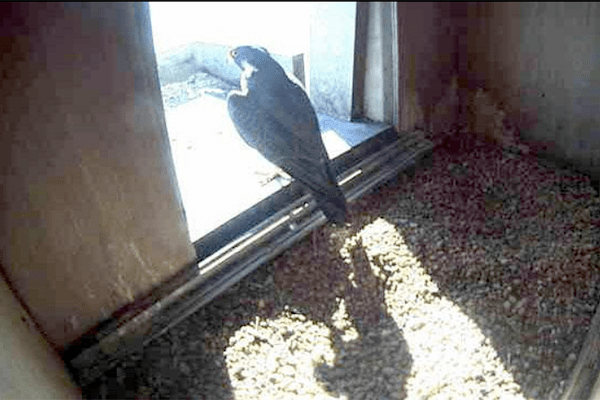
The bridge also has another kind of wildlife infrastructure: a nest box for Peregrine Falcons, a once-endangered species that historically nested on cliffs along the Hudson, from the Palisades to Hook Mountain and beyond. Primarily because of DDT and other pesticides, peregrine populations crashed after the 1940s and nearly vanished as an eastern nesting species by the early 1960s. Local accounts tell of additional challenges in the Hudson Valley, including disturbance at nesting cliffs and the taking of birds for falconry. So, it’s appropriate that one of our region’s great modern structures now supports one of its most iconic raptors. The Thruway Authority’s falcon webcam shows why the bridge towers work so well: high, protected nesting space with a great view of the river below.
Long before today’s focus on bird migration, early 1940s plans to bridge the Tappan Zee — one of the Hudson’s widest points — faced opposition from people afraid of losing the river’s broad, open character. Today, the overlooks on the Cuomo Bridge allow people to experience that very openness.
Just as the Cuomo Bridge connects Rockland and Westchester, migratory birds connect continents. Vast numbers of migrating birds travel along the Atlantic Flyway during their yearly migrations from locations as far away as the Caribbean and Central and South America. Their survival depends, partly, on lighting schedules, infrastructure design, governmental decisions, and local choices.
Christine Toth is the Conservation Chair for the Rockland Audubon Society