









|
RCBJ-Audible (Listen For Free)
 |
Home Values Have Risen Twice As Fast As New York City Medians Over Past Decade
REAL ESTATE
New Yorkers planning a move to the suburbs are in for sticker shock as they discover suburban home values have risen twice as fast as New York City medians over the past decade, according to Property Shark.
Over the past decade, New York City suburbs have undergone a fundamental repricing, moving dramatically upward: While the NYC median sale price rose 43 percent and the national median sale price jumped around 75 percent between 2016 and 2025, the suburbs topped that at an 86 percent incline during the same period.
Sales data for the 13-county New York City suburban region show housing prices in many suburban communities, including many in the Hudson Valley and in Rockland County, surpassed NYC neighborhoods in pricing.
- Westchester County’s higher pricing range, Rye’s median sale price now surpasses the median sale price of 237 NYC neighborhoods, including DUMBO and Flatiron District.
- Among the most dramatic pricing shifts, Spring Valley homeowners’ access surged from 47 NYC neighborhoods to 143 over the past decade.
- White Plains buyers now reach 168 NYC neighborhoods, up from 160 in 2016, gaining access to places like Yorkville and College Point.
- Even on the region’s lower pricing range buying power increased compared to the city: West Haverstraw residents’ buying power now reaches 29 NYC neighborhoods, compared to just nine in 2016.
- 100 suburban communities saw their median sale price at least double over the past decade, including nine Rockland County locations.
What was once a retreat for affordability, is no longer the same proposition. For decades, city folk fled to the burbs for a wide range of affordable price points. Now, the suburban market is dominated by mid- and high-priced suburban communities, which has mostly eliminated the traditional starter home markets. Only 31 enclaves sit below $500,000, representing just 8 percent of the 387 suburban markets in Property Shark’s study.

Suburban price growth has not only outpaced New York City gains in the last decade but also reshaped the region’s housing hierarchy in ways that directly affect city buyers. As prices climbed across nearly every suburban market, the advantage long held by city buyers — the ability to trade up for more space at lower cost — has narrowed significantly.
Rather than being limited to a handful of high-end towns, price increases spread across the suburban ring, pushing entire segments of the market into higher tiers. Accordingly, affordable NYC suburbs that once served as entry points for NYC buyers have steadily moved out of reach, forcing buyers from the city to adjust expectations or budgets.
43 percent of suburban markets are priced between $500,000 and $750,000 — double their share from a decade ago — while 49 percent of markets exceed $750,000. At the same time, the number of $1 million markets has surged to nearly 100 and sub-$250,000 have basically disappeared.
The suburbs have moved up the pricing ladder, removing many of the lower-cost options city buyers once relied upon. This trend accelerated sharply during the pandemic as lockdowns and widespread remote work motivated many would-be buyers to leave the city — raising prices far beyond the boundaries of the city. And, while price growth has slowed somewhat post-COVID, it remains ongoing with suburban home prices rising 5 percent in 2025.

In 2016, city buyers could access a wide range of entry-level suburban markets with 61 percent of towns priced below $500,000 and 12 percent below $250,000. Specifically, communities like Asbury Park and Carteret offered sub-$250,000 entry points, while places like Shelton and Ridgefield Park formed a broad middle tier.
By 2019, that structure had already begun to shift: The number of sub-$250,000 markets dropped from 48 to 13, reducing their share from 12 percent to 3 percent. Many of these towns moved into the $250,000 to $500,000 range, shrinking the lowest-cost segment that had anchored affordability for city buyers.
Markets that once defined the lower tier moved upward, further tightening the range of options available at entry-level price points. Suburbs that once provided a critical onramp for first-time buyers and middle-income households looking to move out of the city have become untouchable. Here’s how Rockland County locations fared:
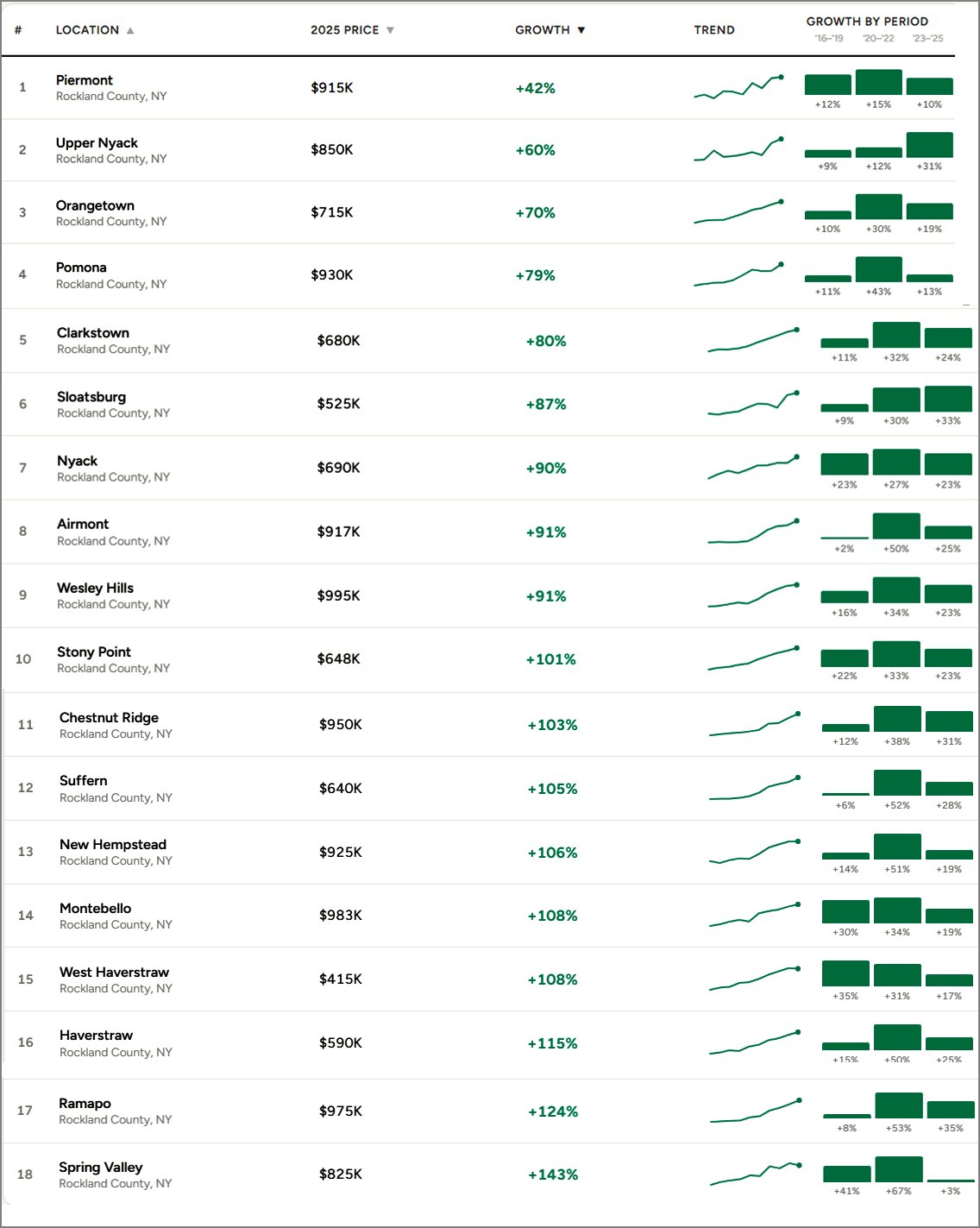
Even as this happened, the suburban market continued to function as a middle-tier environment with more than 79 percent of towns remaining between $250,000 and $750,000. But the direction of change was clear — fewer low-cost markets and increasing pressure on the lower end.
What’s more, these changes occurred even as prices contracted in a portion of suburban NYC, likely also influenced by the 2017 Tax Cuts and Jobs Act, which capped SALT deductions at $10,000 per household, according to Property Shark.
The collapse of the sub-$250,000 segment closed off the suburbs to buyers looking to move from the city’s lowest-priced neighborhoods to the suburbs. At the same time, the share of markets below $500,000 fell to 28 percent — less than half the share it represented just six years earlier — increasing suburban competition among middle-income city buyers.
Meanwhile, growth concentrated in higher price brackets. Suburbs in the $500,000-to-$750,000 tier expanded to include 38 percent of markets to become the largest segment, comprising 147 communities. The number of towns above $750,000 more than doubled compared to 2016 to include 131 communities, 62 of which had surpassed the million-dollar mark.
By 2025, the upward shift became more pronounced, leaving city buyers with fewer suburban markets at lower price points than there were a decade earlier. No suburban markets remained below $250,000 and only 31 towns — 8 percent of the region — were priced between $250,000 and $500,000.
Instead, the market concentrated at higher price levels: Communities in the $500,000-to-$750,000 range came to account for 43 percent of the options for city buyers, while 49 percent of markets exceeded $750,000. At the upper end, 98 of the most expensive NYC suburbs reached median sale prices above $1 million.
Key Takeaways:
- Suburban median sale price surges 86% between 2016 and 2025, double NYC’s gains
- Median sale prices doubled or more across 100 suburban communities since 2016
- Buyers from lower-priced neighborhoods can no longer afford most suburban markets: No markets left below $250,000, only 8% remain below $500,000
- 1 in 4 suburban markets now sit at $1 million and above, up from 1 in 10 a decade ago
- Top NYC budgets no longer cover the entire suburban ring: Manhattan’s buying power drops from 91% of suburbs to 78%, Brooklyn’s shrinks from 75% to 68%
- Staten Island buyers retained more suburban access than Queens: 46% versus 41%, compared to 53% a decade ago
- 14 Bronx and Queens NYC neighborhoods cost less than even the region’s cheapest suburb