









|
RCBJ-Audible (Listen For Free)
 |

Applicant Needs To Overcome Hurdle of Having Only One Ingress For Emergency Vehicles When the Village Code Calls For Two
By Tina Traster
You could feel the temperature rising during the Village of Upper Nyack Planning Board meeting last week as an applicant seeking a special permit for a yeshiva expressed frustration with the board, while at the same time board members conveyed impatience with an applicant they say continues to either shift positions or offer incomplete plans.
What makes the application thorny is that the proposed use of the property for a school of more than 400 boys calls for a second ingress and egress for emergency vehicles, but the property at 350 North Highland Avenue only has one way in and one way out.
To secure a Special Permit to operate a Jewish Day School at the former Alliance Theological Seminary on Route 9W in Upper Nyack, Congregation Ramapo Cheder must have a second egress from the property in the event of an emergency or convince the Village that a second access road is not feasible.
An irritated Joseph Churgin, the applicant’s attorney, said the hearing was the “eighth appearance” before the board, before explaining his client is working with the Nyack Joint Fire District (NYFD) to iron out concerns over the feasibility of the project. He told the board the fire district needs to visit the site with trucks to demonstrate how the turning grades work. But he acknowledged the fire district is still concerned about how the egress intersects with Route 9W.

On March 16, in a letter to the Planning Board, Jennifer Knecht, Chairperson of the NYFD wrote, “We have not seen any update or discussion about our most major concern, and that is the second egress road.” Knecht’s concerns included the proximity of the locations of the main and secondary access roads on the site, and the “criss-cross” patterns that the roads would have on the site.
In response, disputing the need for a secondary access road, the applicant’s expert from Civil Design Works wrote, “it remains our opinion that a secondary emergency access driveway located south of the main driveway is not a necessary or feasible option for this project.” According to its expert, the topography, steep slopes, and proximity to wetlands makes construction of a secondary emergency access road infeasible.
A second expert retained by the applicant from Bruce Bingham & Associates submitted a memo saying, “It is my opinion based upon 30 years of experience in the fire industry with 15 years exclusively inspecting private and public NYS schools that the compliance for two access points would impose a practical difficulty or unnecessary hardship on the school’s layout while providing no significant improvement in actual fire safety of students and staff in a single access configuration.”
Because Highland Avenue is a state road, any changes to the driveways and related curb cuts would have to be approved by the New York State Department of Transportation.

Churgin also said the plan had been updated to reflect “refuge areas” where children would be cordoned in case of an emergency, and walking paths that would lead them to Route 9W without interfering with fire trucks.
“It’s not perfect,” he said. “But it’s the best and safest” way to deal with the children in the event of a fire or another emergency. “There’s not going to be a bottleneck. People leaving the building will stay with the children.”
Churgin continued, “We know you want two independent roadways, but we can’t provide that. We have to work with what we have here. Everyone knows we can’t provide secondary access to the south.” He added, “the building is sprinklered.” And his client, Ramapo Cheder is willing to add a fire hydrant.
Alliance Theological Seminary operated for more than 50 years without a second egress for its much smaller student body, but changes to the Village Code in 2021 imposed the additional egress requirement on day schools, as well as houses of worship, and not-for-profit community centers.

For several months, planning board meetings held at the Nyack High School auditorium to accommodate large crowds have attracted many who oppose the project, saying the added bus and car traffic will have an adverse impact on nearby properties, including Nyack High School, which is situated to the north of the building, and Route 9W, which is a busy thoroughfare.
The existing ingress/egress at 350 North Highland Avenue sits about 130 yards from Nyack High School’s ingress/egress on Route 9W. The High School plans to relocate its entrance on 9W to the corner of Birchwood.
According to information provided by Colliers, the student body would require a maximum of 13 buses.
Ramapo Cheder proposed to accommodate 440 students but would not have any dormitories or residents on the campus. The report says 44 of the 440 students would attend a Pre-K program. 70 staff members would be on the campus during the school day, which would operate six days a week, including Sundays.
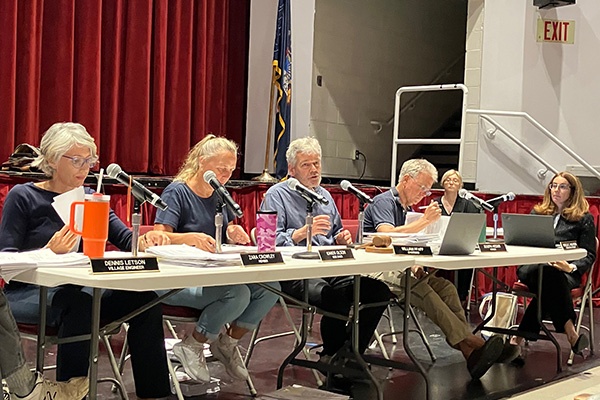
The March 17th Planning Board became tense when Village of Upper Nyack Engineer Dennis Letson said the application was “incomplete” and had “inconsistencies” and needed to be coordinated into a narrative summary.
“It’s difficult to make a decision,” he said, adding the applicant must get its issued resolved with the Fire District. “You’re wasting the board’s time and your time. Things can’t be acted on.”
Planning Board Chair Bill Pfaff echoed the sentiment. “Going forward, we need to know the fire department has no issues,” he said.
Pfaff told the applicant he wants the Ramapo Cheder, fire officials and village representative to meet on site with the fire district to demonstrate the emergency vehicles can safely maneuver the site.
“This board will do whatever it needs to do to facilitate, to work it out,” said Pfaff. “But have these meetings before you come back.”
Churgin agreed to the suggested meeting but said, several times, “We are not being treated fairly, for whatever reason.” He added he was “not going to say what that reason is,” but it seems likely he was referring to an alleged religious bias against his client.
Ultimately, the fire department is not the final arbiter of the application – that’s the board’s responsibility but Churgin wondered aloud if the board will reject the application if it doesn’t get “a letter (from the fire district) saying everything is wonderful.”






The property spans 36 acres, 15 of which are located in the Town of Clarkstown. In Upper Nyack, the property straddles two zoning districts, the OB (Office/business) and the R-80 (Conservation) zones.
In January, the Planning Board reconsidered an earlier determination that the application was a Type II action under SEQRA (State Environmental Quality Review Act), and is now viewing the action as “Unlisted.” Type II actions are those that do not mandate a formal environmental review. Unlisted actions are actions that fit somewhere between Type I (presumption of potential and significant adverse environmental impacts) and Type II actions. They are actions that could have significant environmental impacts but are not specifically designated under state law as those requiring extensive environmental review.
Both New York State and federal law (RLUIPA) requires municipalities to be flexible in the application of their zoning codes to educational and religious uses. These laws generally apply to Special Permits and variances.
Because part of the parcel sits in the Town of Clarkstown, it must also have an opportunity to review the application. And because of the project’s proximity to the Village of Nyack, it will also have an opportunity to weigh-in on the impacts to Nyack.
The Upper Nyack former seminary building has sat vacant since being acquired.