










|
RCBJ-Audible (Listen For Free)
 |

Planned Greenway Commission Needs State Approval; Voter Referendum
By Tina Traster
In 2017, a group of residents living on Mountainview Avenue in Valley Cottage fought to protect a 4.3-acre parcel of wooded land from development. (I was one of the founding members of the Mountainview Avenue Preservation Group that led the effort to fight a proposal by St. Peter’s Malankara Catholic Church to build the project, which would have encroached on existing wetlands.)
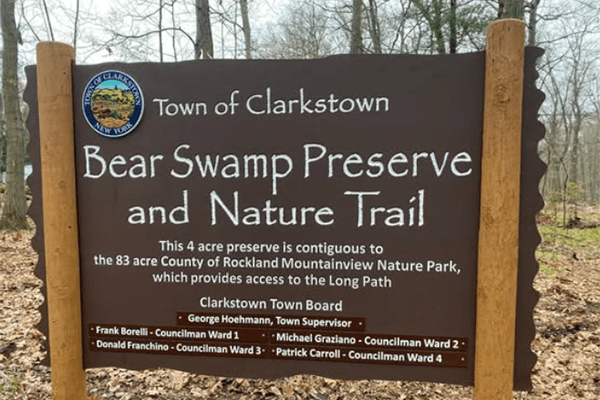
At the time, the landowner wanted to build a 10,925 square-foot structure and a parking lot for 55 spaces on sensitive land along Mountainview Avenue. Instead, in a move championed by Town Supervisor George Hoehmann, the town purchased the land for $235,000 to develop nature trails that connect to The Long Path and Mountainview Nature Park.
Over the years, Clarkstown has made several efforts to buy farmland and other parcels for open space, but without a dedicated fund to tap, the purchases have largely been paid for through municipal bonding.
Now, the town is hoping to establish a “Clarkstown Community Preservation Fund” and a “Purchase of Development Rights” program that can be used to conserve and protect open space, farmland, water sources, natural resources, historical landmarks, and more.
To create these programs, the Town recently passed a resolution calling for New York State to enact the “Clarkstown Community Preservation Act,” which is required because towns cannot impose real estate taxes without enabling legislation from the state. Once the legislation is passed by the State Legislature and signed into law by the governor, the program will still be subject to a town-wide public referendum.
New York State in late 2025 authorized The Orangetown Community Preservation Act, which enables the Town of Orangetown to establish a Community Preservation Fund (CPF) aimed at protecting open space, historic sites, and recreational areas. A voter referendum in Orangetown is planned for November 2026.
The Town of Orangetown was authorized by the state to implement a .75 percent real estate transfer tax on the purchase of property within the town to fund its community preservation program.
When Orangetown first sought to establish its fund, the New York State Association of Realtors issued a “memorandum in opposition,” writing that “New York is in the midst of a housing supply and affordability crisis. The state’s housing inventory continues to remain stagnant.” The organization says the legislation makes it “even harder to buy a home.”
New York State imposes a real estate transfer tax of $2 for every $500 (0.4 percent of value), plus a 1 percent “mansion tax” on residential properties on $1 million or more. The proposed Preservation Fund transfer tax is on top of the existing levy. If a buyer purchases a $750,000 non-exempt home, the transfer tax is $3,000; with the Preservation fund, the amount could rise up to $8,625.
The tax aims to protect open space and will expire Dec. 31, 2045.

Warwick in Orange County and Red Hook in Dutchess County have used it for decades and municipalities in Westchester, Putnam, Dutchess, and Ulster counties have received countywide authorization from state representatives to establish Community Preservation fund programs, according to Clarkstown.
“The Town Board is unified in calling for the state legislature to enact the Clarkstown Community Preservation Act,” said Hoehmann. “Community preservation funds would provide the strongest currently available tool to the town to conserve and protect open space, farmland, water sources, natural resources, historical landmarks, and more.”
Hoehmann estimates the town could raise up to $5 million annually to fund open space purchases. “Having a fund available would facilitate the purchase of sites when they become available.”
Last month, the town created a seven-member Town of Clarkstown Greenway Commission to assist and advise “on protecting and conserving land, open space, natural, historic, historic and recreational resources.” Five of the seven seats have been designated: Three to town employees Colin Schmitt, Director of Finance, Albert Moroni, Chief of Staff and newly appointed Deputy Town Supervisor, and Joe Simoes, the town’s principal planner. Also on the commission is Susan Farese, a founding member of the Nanuet Chamber, and Ed Mooney, a member of the Mountainview Avenue Preservation group who’s been calling on the town to preserve a large swath of nearly 200 acres of Tilcon-owned land that runs behind his home and along Route 303.
Hoehmann said he’s been working with Tilcon Mining Company to potentially donate or to grant the town a 99-year lease for $1 annually on the steep and wooded eastern flank of Route 303, where mining would be all but impossible.
“We are working to get that land preserved,” Hoehmann said.

The Supervisor said Greenway Commission meetings will be open to public participation.
In 2017, Clarkstown acquired thirty acres bordering Hook Mountain and overlooking the Hudson River in a $3.1 million agreement. The Trust for Public Land closed on the purchase of the property known as the Marydell Faith and Life Center at the north end of Midland Avenue. The New York State Office of Parks, Recreation and Historic Preservation contributed $2.1 million of the purchase price. Another $450,000 came from the state’s Mid-Hudson Regional Economic Development Council. The Village of Upper Nyack and the Durst Organization, which supports the Trust for Public Land, committed $100,000, Clarkstown, which includes the village, pledged up to $300,000.
In 2023, Clarkstown’s board members approved bonding to purchase property at 55 Waldron on an eleventh of an acre for $365,000. Subsequently, the town bought 49 Waldron Avenue for $720,000, to create a pocket park and playground.
Hoehmann also said the Greenway Commission will also play a crucial role in helping shape the future of the historic Storms Tavern in Valley Cottage.
After two decades of owning and renting out the historic house at 407 Storms Road in Valley Cottage, Tilcon Minerals Inc. donated the house to the Town of Clarkstown. The donation presents an opportunity to preserve an important pre-Revolutionary structure. It will take many tens of thousands of dollars to bring the house into repair, both inside and out.