









|
RCBJ-Audible (Listen For Free)
 |

Bowline, Unable To Meet DEC Standards For Protecting Aquatic Organisms, Seeks Loosening Of Its Permit Requirement
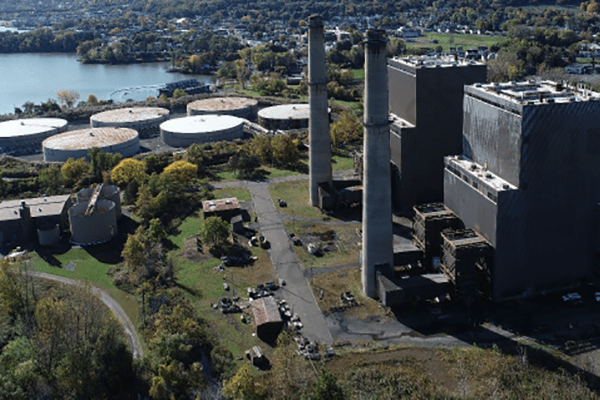
Bowline Generating Station in West Haverstraw is seeking modification to its existing SPDES (State Pollutant Discharge Elimination System) permit and is required to solicit public input as part of the process. Public input is required because the proposed modification has been determined by NYSDEC to potentially impact one or more potential environmental justice areas (PEJAs) abutting the plant.
Bowline, seeking to reduce a performance requirement in its SPDES permit, is asking to reduce the “required entrainment reduction value” from 80% down to 75% under Biological Requirement 5, part of the DEC’s biological monitoring requirements.
Entrainment values refer to the volume of small aquatic organisms—such as fish eggs, larvae, and tiny juvenile fish—into a facility’s cooling water system when water is withdrawn from the river. These early life‑stage organisms are too small to swim away from the intake flow or avoid passing through screens. The permit modification from 80% to 75% would mean that more organisms could be caught in Bowline’s water intake structure than currently permitted.
Species groups commonly affected by entrainment include: fish eggs; fish larvae; small juvenile fish; and drifting planktonic organisms. White Perch and Striped Bass, as well as river herring species, including Blueback Herring, Alewife, and American Shad, are commonly found in Bowline Pond and the surrounding area.
Other species in the Hudson River, including Shortnose Sturgeon and Atlantic Sturgeon, are listed in New York State as Endangered. These species spawn in the river, and their early life stages occur in the water column. Protecting these life stages is an important component of aquatic habitat protection in the region.
According to the DEC, Atlantic Sturgeon are one of the largest and longest-lived fish species in North America, growing up to 14 feet long and up to 800 pounds. Shortnose Sturgeon are generally less than 4 feet long and weigh less than 20 pounds.
In New York, adult Atlantic Sturgeon return to the Hudson River to spawn during May and June. After spawning, the adults migrate back to the Atlantic Ocean while juvenile sturgeon remain in the river for two to six years before moving to the ocean to mature. Shortnose sturgeon spend their entire lives in the Hudson River. Adults migrate upstream to spawn near Albany throughout the month of May. Adult and young sturgeon reside throughout the entirety of the Hudson River, occupying both fresh and brackish water throughout their life cycle.
Atlantic sturgeon overwinter in Haverstraw Bay.
“As a critical spawning, nursery, and wintering area for estuarine species, Haverstraw Bay is officially rated by the NY State Dept. of State as ‘Irreplaceable’ habitat,” said Peggy Kurtz, Co-Founder of the Rockland Water Coalition. “The Bay plays a critical role not only for the life of the river, but also for East Coast ocean fisheries. Despite years of work and great expense, the aquatic life of the river – including iconic species such as Shortnose and Atlantic Sturgeon, shad, striped bass, and American eels – is nonetheless at historically low levels. The DEC must reject this request for permit modification, that could potentially result in an increase to 25% permitted mortality of organisms in the highest rated ecosystem on the river. We cannot sacrifice the life of the river to the interests of the Bowline plant.”

Bowline’s permit requires an 80% entrainment reduction. It claims that after 4-1/2 years of operating under its current permit, it has been unable to obtain the required 80% reduction. It is asking the DEC to adjust the requirement to 75%. It says that despite utilizing the “best technology available” (BTA), it has only been able to achieve a 79% entrainment reduction.
Bowline says the change in the permit will not impact the level of protection for aquatic organisms, including the Atlantic and Shortnose Sturgeon.
Facilities must demonstrate that their cooling water intake structures represent the best technology available to minimize adverse environmental impacts, specifically regarding the mortality of fish and invertebrates.
Bowline argues that under DEC’s policies, it is entitled to a site-specific entrainment goal below the current requirement because it has been running at less than 15% of its capacity over the past five years. Under the DEC’s rules, the capacity threshold of less than 15% opens the door to Bowline to seek a reduction in its permit and entitles it to relief from the 80% entrainment reduction requirement.
The change in the permit would not involve any changes to facility structures or Bowline’s operations, only a change in the performance metric in its permit.
According to the DEC, Bowline is an electric generating power plant consisting of two multiple fuel-fired boilers and a 615 KW emergency generator on 50 acres in West Haverstraw. It is currently authorized to withdraw a supply of water up to 1,106,000,000 gallons per day (GPD) from the Hudson River for “once through cooling” and other processes related to electrical generation.
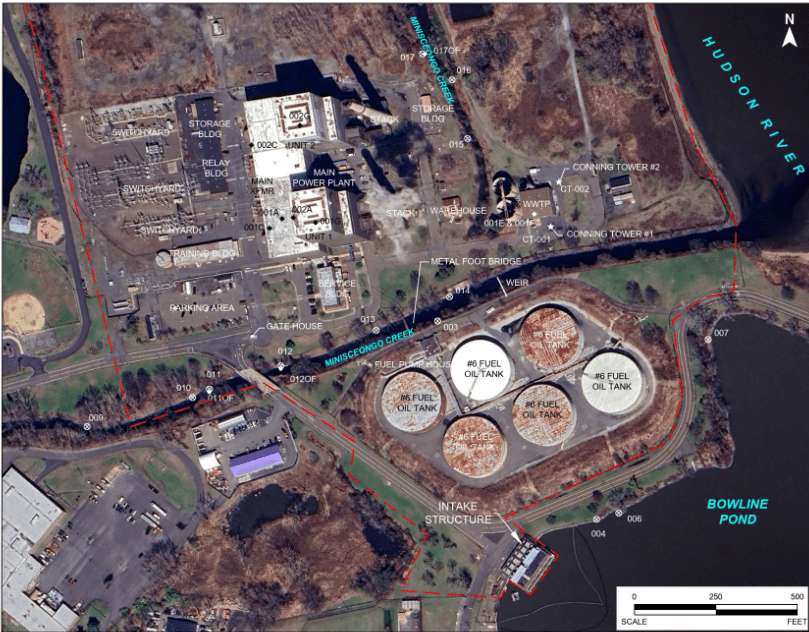
Once-through cooling is a process that withdraws water from a natural source (river, lake, or ocean), pumps it through industrial equipment or a power plant for cooling once, and then discharges it directly back to the source. It is generally characterized by high water volume usage and significant environmental impact, including thermal pollution – the warming of the receiving body.
Bowline does not utilize closed loop cooling, which would re-use the same water in a closed loop, rather than draw and release water into the Bowline Pond, which connects to the Hudson River.
The public comment period closes on March 13, 2026. Comments can be directed to Christine Croyle, Senior Environmental Engineer, by phone at: 845-786-8008, by email at: ccroyle@bowlinepower.com or in writing at: Bowline Generating Station, 140 Samsondale Ave, West Haverstraw NY 10993.