









|
RCBJ-Audible (Listen For Free)
 |

Public Officials Across Hudson Valley Unite In Opposition To ICE Detention Center In Village of Chester in Orange County
By Tina Traster
Now that the U.S. Immigration and Customs Enforcement (ICE) has confirmed its plans to transform a Chester warehouse into a “very well-structured” detention center, Orange County Executive Steve Neuhaus says he’s laying the groundwork to push back on the plan that he says: “nobody wants and nobody is happy about.”
“Once the deed is filed, that’s when we can start filing legal actions,” said Neuhaus, in a recorded statement on Friday.
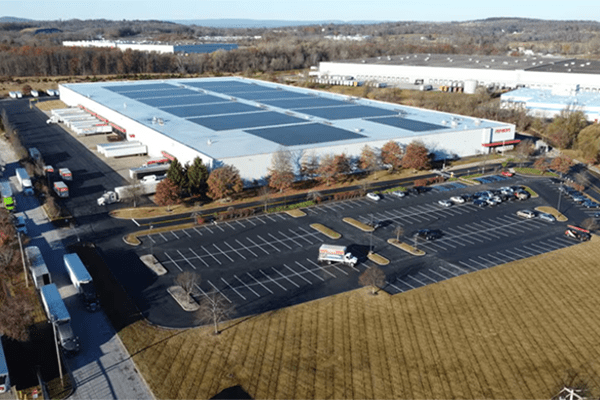
Neuhaus is responding to reports that ICE has moved ahead with its purchase of a former vacant 400,000 square foot PepBoys warehouse at 29 Elizabeth Drive in the Village of Chester that it plans to convert into a detention center. The Orange County Executive says he’s received “zero communication” from the federal government.
“We have a right,” he said on a Facebook recording. “We’re here. Everybody is concerned about it. We’ve filed objections but we can’t sue yet.” Neuhaus said his legal team is waiting for the property deed to be filed with the county. “But we’re on it.”
More than 53 Hudson Valley representatives have signed a letter sent to the Department of Homeland Security opposing the plan, which came to light in mid-January when Homeland Security filed a “Notice of Activity in a 100-Year Floodplain in Chester, NY,” citing its intentions: “ICE is proposing to purchase, occupy and rehabilitate a warehouse property at 29 Elizabeth Drive on nearly 36 acres in the Village of Chester in Orange County.”

The Trump administration plans to acquire and renovate eight large-scale detention centers and 16 processing sites to hold more than 92,600 immigrant detainees at a time, though pushback on some of the projects have curtailed and deep-sixed ICE’s plans. The Chester warehouse is one of the 16 processing sites.
The agency has already made moves to acquire buildings to serve as detention centers in at least eight states, with three properties purchased just last month: one for $102 million in Maryland, another for $84 million in Pennsylvania, and a third for $70 million in Arizona.
But the Administration’s aggressive and violent immigration crackdown, including the deaths of two American citizens, Renee Good and Alex Pretti, has stimulated widespread backlash and scrutiny against plans to expand a detention network nationwide.
ICE plans to spend $38.3 billion on new detention facilities to meet the demand for bedspace and to streamline the removal process for people allegedly living in the country illegally. Newly arrested detainees would be booked into processing sites like the one proposed in the Village of Chester for a few weeks before being funneled into one of seven large-scale warehouses holding 5,000 to 10,000 people each, where they would be staged for deportation. The seven slated facilities are in Stafford, VA, Hutchins TX, Hammond LA, Baytown, TX, Glendale, AZ, Social Circle, GA, and Kansas City, MO.
Public officials responding to local protests are pushing back on ICE’s plans in Oklahoma City, Salt Lake City, Kansas City, Ashland, VA, and Elkridge, MD.

Platform Ventures, the development company that owns a south Kansas City warehouse that federal agents had targeted for one of the large-scale immigrant detention centers, backed out of its plans to sell the facility to the federal government last week.
“While typically we do not comment on potential transactions, baseless speculation, inaccurate narratives, and serious threats toward our leadership, our employees and our families have prompted us to issue this statement” the company said in a statement.
In January, the Kansas City Council passed a ban on any permits or approvals for nonmunicipal detention facilities. The ban is in effect until Jan. 15, 2031, though it’s not clear if such a rule would stop the federal government.
In Oklahoma City, the Department of Homeland Security outlined plans to convert a warehouse located near the largely Hispanic Western Heights School District into a detention center. After weeks of opposition from locals and city council members, the company that owns the warehouse broke off talks with the agency and said it wouldn’t be selling.
The former 400,000 square-foot PepBoys Distribution Center in Chester has been shuttered since 2024. The facility is owned by IEP Chester LLC, which is an affiliate of Icahn Enterprises LLC. Carl Icahn is the founder and controlling shareholder of Icahn Enterprises, a public company and diversified conglomerate holding company based in Sunny Isles Beach, Florida. He was Special Advisor to President Trump on Regulatory Reform from Jan. to August 2017.
Other communities continue to resist ICE’s plans.
Salt Lake City Mayor Erin Mendenhall last month sent a letter to the owner of a warehouse on the city’s west side stating that if the facility were to be used as a detention center it would be in violation of city code, according to the Salt Lake Tribune. Public officials have warned ICE a detention center will “have an enormous impact” on the area’s water supply and sewage system.
Similarly, Orange County officials at local and county levels have let ICE know that a proposed detention facility in the Village of Chester will present a raft of safety and environmental issues. Neuhaus said the business park is home to a commuter lot. Additionally, a proposed detention center will draw scores of protesters, which puts a strain on the town and county’s police force.
“I have asked (the Governor) to have the New York State Police to help my local village, town, city and sheriff’s office, all that law enforcement that’s going to be taxed with responding to large crowds – protestors, counter-protestors – and I have asked her to have the New York State Police give us all the resources available to augment the law enforcement stream. It’s going to cost thousands of dollars. I have also asked for the National Guard to be on standby,” he said.
The vast office park is not suitable for residential use, officials say. Additionally, Chester’s sewage system is a peak capacity. Existing zoning allows “as-of -right” wholesale, storage and warehouse facilities, manufacturing, processing, producing and fabricating operations, research laboratories, business and industrial offices.
The site is also home to federal wetlands and is designated as a FEMA Flood Plain.

In a letter Chester sent to the Trump administration last month, Village Attorney Brian Nugent wrote: “ICE should note that the Village has had a law in place for a couple of years regarding the housing of vulnerable persons which is a special permit/ public hearing process. A copy of the law can be found here: https://ecode360.com/44279793#44279793”
The law states that “No person, association, entity, or organization shall cause 10 or more vulnerable persons to be placed at any location or structure in the Village of Chester for the purpose of extended residency, which shall be defined to mean stays of up to 30 days, without a temporary residency of vulnerable persons license approved by the Village Board of the Village of Chester in accordance with this chapter. No such license shall be issued for stays of longer than 30 days.”
How much choice or power local officials will have may be a David and Goliath struggle because it is unclear how much sway local zoning rules will have when faced with the federal government’s decision to purchase and convert the former PepBoys warehouse distribution center. It is unclear whether the Village of Chester will be able to exert home rule or zoning laws to prevent the immigration processing center from opening in the jurisdiction.
Generally, property owned by the federal government, including its agencies like Homeland Security, are not subject to local zoning laws. While many federal agencies work with local governments to ensure federal land use is compatible with surrounding areas, local laws don’t bind them. Compliance is voluntary and discretionary.
If it came down to a legal fight, the federal government could invoke the Supremacy Clause (Article VI, Clause 2 of the U.S. Constitution), which establishes that the Constitution, federal laws, and treaties are the “supreme Law of the Land.” This means they take precedence over conflicting state laws, and state judges must uphold federal law. It underpins federal power, allowing the national government to enforce laws and treaties without state interference, forming the basis for federal preemption in areas of federal authority, while ensuring federal laws remain constitutional.