










|
RCBJ-Audible (Listen For Free)
 |

Presumption That SEQRA Didn’t Require Environmental Review Of Conversion Of Alliance Theological Seminary To A Boys Yeshiva Derailed By New “Unlisted” Designation
Advocates for a comprehensive environmental review of a proposal to convert the former Alliance Theological Seminary on Route 9W in Upper Nyack into a yeshiva for 440 boys scored a victory last week when the Upper Nyack Planning Board classified the application as “Unlisted” for the purposes of SEQRA (New York State Environmental Quality Review Act).
The planning board had been previously operating under the assumption that the application was a Type II action – one requiring no formal environmental review under SEQRA. Unlisted actions are actions that fit somewhere between Type I (presumption of potential and significant adverse environmental impacts) and Type II actions. They are actions that could have significant environmental impacts but are not specifically designated under state law as those requiring environmental review.
Though no formal SEQRA determination had previously been made (or published with the New York State Department of Environmental Conservation), the planning board had been conducting its review of the project as a Type II, noting that many of the environmental impacts would have been studied as part of the Special Permit the yeshiva needed from the Village. There is nothing in the state law that allows a municipality to bypass SEQRA and conduct an alternative (even if similar) review.
Ramapo Cheder is proposing to convert a long-vacant office building that formerly housed the Alliance Theological Seminary into a yeshiva for pre-K through 8th grade students.
It plans to use the building, with interior and exterior modifications, for 440 boys and 90 staff members. The building’s footprint would remain unchanged, but the interior would be reconfigured for the new use, and the façade would be updated. Day schools are allowed by Special Permit in the OB zone, where the property is located.

The determination of the application as Unlisted changes the nature of the review.
The planning board has to send out a notice to various governmental and quasi-governmental organizations indicating the SEQRA designation and allowing interested entities 30 days to weigh in on the application with comments.
Depending on the comments received and the review of Environmental Assessment Forms prepared by the applicant (and reviewed by the Village), the planning board will have to make a positive declaration (triggering the need for a full Environmental Impact Statement with public participation), a Negative Declaration (cutting off further environmental review), or a Conditional Negative Declaration (imposing mitigation and other conditions as part of the approval process). The Declaration decision could take many months while the potential environmental impacts are studied by the planning board and its experts.
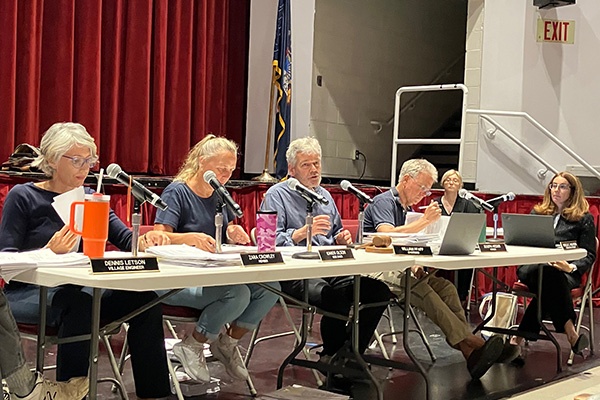
The planning board held the meeting last Wednesday at Nyack Center to accommodate local residents wanting to be heard of the application.
A group of over 100 neighbors living in close proximity to the proposed yeshiva formed High Plains Management, LLC, (HPM) and raised over $20,000 in a GoFundMe campaign to contest the approval. The group retained White Plains-based Marks DiPalermo & Wilson to represent its interests and to steer the planning board toward the designation of the application as unlisted.
Other issues raised at the meeting included the possible retention of an independent planning consultant to assist the board in reviewing the application, the level of site disturbance, additional stormwater review, fire safety and emergency access options, and adherence to updated building code requirements.

Concerns were also raised about the impact of the project on Mountainview Avenue in Valley Cottage, where a proposal is pending before the Clarkstown Planning Board to expand the Islamic Center of Rockland’s facility with a 30,000 square foot addition. Requests were made to expand the traffic impact study to include Mountainview Avenue to determine the cumulative impacts of the two projects on traffic and safety.
More recent changes to the plan include changes to the grounds, including reconfiguration of the parking lot, internal drives, and the addition of a second access road for emergency vehicles. Grading and steep slope issues limit the options for where secondary access can be located.
Plans have also been submitted by the applicant’s traffic engineers to the New York State Department of Transportation to modify Route 9W with turn lanes going up to the yeshiva, as well as adding a turn lane onto Riverton Drive.
Consideration must also be given to approved plans for Nyack High School to modify its Route 9W access by creating a four-way signalized intersection across from Birchwood Avenue with a left-turn lane into the high school from Route 9W. This scenario would create two left turn lanes (one for each school) along northbound Route 9W.
Route 9W is already clogged with school bus traffic and serves as the primary access to Nyack Hospital’s emergency room on North Midland Avenue.