







|
RCBJ-Audible (Listen For Free)
 |

Clarkstown Officials Say They Cannot Prove A Suburban House Is Being Used For Prayer
By Tina Traster
Neighbors on Pleasant Hill Drive in New City have long enjoyed gracious houses, manicured lawns, and a quiet leafy suburban idyll. But anger and hopelessness have been escalating as long-time homeowners say the town has been indifferent to their complaints about a home they say is being used as a house of worship.
At issue is whether the Town of Clarkstown intends to adhere to a law passed in 2016 that prohibits houses of worship on town roads. The local law says non-residential uses in residential zones, including houses of worship, must be located on a state or county road, and not on town-owned secondary, or collector roads. The law was designed to restrict non-residential, high-traffic developments, such as schools and religious institutions, from being placed in residential areas. The law also requires at least 100 feet of frontage, and sets minimum parking requirements.
To date, the law has not been tested, though New York courts have consistently ruled that churches and other houses of worship cannot be entirely excluded from residential zones. This aligns with federal protections under the Religious Land Use and Institutionalized Persons Act (RLUIPA), which prohibits local rules that substantially burden religious uses unless there’s a compelling interest and no less restrictive alternative.

Clarkstown and Rockland County at large are groaning under the strain of illegal housing, zoning code violations, and lack of enforcement. In recent months, Clarkstown officials have publicly touted targeted efforts to fight illegal housing, including hiring more building inspectors and code enforcement officers. The Supervisor and town council members are seen on Facebook pages and in email blasts promoting efforts to crack down on illegal conversions, making it a key campaign issue for the Nov. election. They have used texts and video on the Town’s social media to promote their efforts.
“We have noticed all the declarations (by the Town saying it will crack down), but we have not had any relief in a year,” said one of the neighbors. “The town has turned a deaf ear.”
The town says it has investigated and there’s nothing more to be done.
“The Town conducted an extensive code enforcement investigation and made multiple appearances before Judge Leslie Kahn to secure a search warrant,” said Town Supervisor George Hoehmann. “We executed the search warrant, and the investigation found no town code violations. While one neighbor might dislike the outcome, the Town utilized its full code enforcement resources and found no violations on this property.”
According to local residents, more than “one neighbor” is impacted.
For more than a year, Pleasant Hill Drive residents have written to and called town officials, called the police with complaints about off-street parking, attended coffee meet-and-greets with Hoehmann, and submitted a petition objecting to what they observe as a single-family house being used as a synagogue. They say the town is unwilling to substantiate that the house is being used this way nearly every day, particularly because building inspectors are not there in the early morning or early evening.
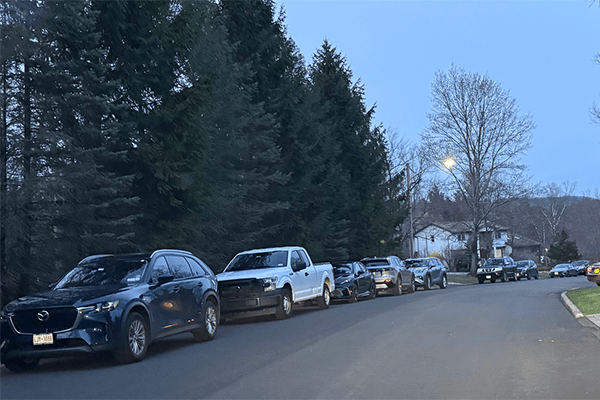
On a recent spring morning, RCBJ met with neighbors who requested anonymity but talked about the disruptions caused by the activity at 391 Pleasant Hill Drive. They shared emails exchanged between themselves and town officials. They say groups of religious Jewish men carrying prayer books enter the house every morning around 7 am and leave around 9:30. A second visitation takes place in the early evening. They have seen between 20 and 30 cars parked overnight on Fridays, when observant Jews do not drive.
“They walk ten abreast,” said one neighbor. “The kids are running around. I’m afraid I’m going to hit a child with my car.”
On July 5th, a neighbor wrote to town officials, “There are 17 cars parked overnight at 391 and they will remain there until sundown tonight. That means besides the rabbi’s family at least 17 men are sleeping in that house and probably more…violating the code on allowable numbers to sleep in that house on a regular schedule.”

Another resident, with three children, said congregants double-park on the edge of turns. “It’s a concern,” she said. “I have children. They’re teenagers who are learning to drive and when they come out of the driveway, it’s hard to see ongoing traffic.” The neighbor said she’s also concerned because the cars often park in front of the school bus stop.
There is a provision of the town code that requires houses of worship to provide one off-street parking space for every 200 square feet of floor area. If the entire structure were used as a synagogue, the owner would have to provide 18 off-street parking spaces.
Since April 2025, neighbors who’ve been told to contact the Clarkstown building department have received a runaround. They’ve provided photos and video evidence to document what appears to be illegal use of a single-family home, but they said the town has not sent the inspectors at the times when prayer services are held. After months of pleading for help, Lawrence Kay, the town’s chief building inspector, wrote, “I’m sorry and I agree with you but there is not enough evidence to take this problem to court.”
Kay went on to say that annual inspections are not required for single-family dwellings and that the town cannot prove this is a house of worship. He also told the neighbors: “illegal parking and traffic violations can be enforced by the police department.”

It is unclear what’s required for proving that a house is being used for worship, but neighbors say they’ve spoken to young men leaving the house after prayers who’ve characterized the dwelling as “a house of worship.”
On Sep 11, 2025, a neighbor wrote to town officials and the police department about “30 cars parked at 391. Double parked and in front of neighbors’ houses since the previous night.” In response, Al Moroni, who has recently been elevated from Hoehmann’s Chief of Staff to Deputy Town Supervisor wrote: “I have discussed this matter with our Town Attorney, who has opined on numerous occasions that the gatherings are legal and hence there is nothing that can be done to prevent these gatherings.”
In a letter to Town Attorney Kevin Conway last September, neighbors wrote “We fully support the right to worship – but only in legally permitted, properly managed spaces. The current use of the property appears to be a clear violation of Town zoning regulations and poses a growing public safety risk.”
Homeowners using a residence as a synagogue on a local road could face enforcement actions including citations, orders to cease activities, or legal action if compliance is not met.
The law is rooted in land-use control – not in the number of attendees to the house of worship. A private home being used regularly as a synagogue, with daily services, is potentially a non-conforming use, especially if it’s on a town road – which the zoning code expressly excludes. Variances could be available from the Zoning Board of Appeals, but would be difficult to secure.
The five-bedroom 3,817 square-foot house on 1.42 acres at 391 Pleasant Hill Drive was purchased for $1,375,000 on Dec. 18, 2024 by Brooklyn-based Y&RB LLC. The LLC was established in 2018, with a corporate headquarters listed at 1428 East 9th Street in Brooklyn. Annual property taxes are nearly $27,000.
On a recent day, RCBJ knocked on the door of the house. The man who opened the door said he was the owner but did not give his name. When asked if the house was a synagogue, he said, “No, it’s a house. The neighbors come to pray.”
Neighbors say they’ve met the 42-year-old Rabbi Yochanan Cohen, who is listed as a one of the principals of the LLC. He lives with his family in the house and leads the Chazon Nuchim Shadik congregation. According to Oraysa, a Torah learning organization, Cohen’s house at 391 Pleasant Hill Drive is listed as a location for Torah study.






A Facebook video posting from Feb. 13 2025 says Tu B’Shvat Tish at Chazon Nuchem Shadik, a newly established Bais Medrash in New City, was led by Morah D’asra Rav Yochanan Cohen. The video shows about a dozen men and boys praying and singing around a long dining room table. Chazon Nuchem Shadik is a tax-exempt 501(c) (3) religious organization that was registered in Toms River, NJ in May 2022.
Another neighbor said, “We are not antisemitic,” adding that the neighborhood is comprised of people of all faiths and ethnicities. “But it’s not fair. Our quality of life has changed. We’re not comfortable driving. Congregants park in the street. The headlights flash into our houses. It’s invasive.”