








|
RCBJ-Audible (Listen For Free)
 |

Clarkstown Planning Board Asked To Consider Environmental Damage From A Former Dry Cleaning Operation As Part of SEQRA & Site Plan Review
The Clarkstown Planning Board is reviewing an application for the redevelopment of the Shoprite Plaza in New City that could be complicated by the need to further evaluate the potential risk of onsite contamination left by a dry cleaner that shuttered its doors two decades ago.
Attorney Robert Zitt, who is representing Ricardo and Celia Fijor, of 11 East Evergreen Road, wants the town to undertake a more rigorous environmental review and coordinate with the Department of Environmental Conservation (DEC) to determine whether the site is suitable for residential development.
In a March 8 letter to the Planning Board, he wrote: “I want to bring to the town’s attention certain environmental conditions and regulatory controls currently affecting the property. These conditions should be relevant to the Planning Board’s consideration of any pending or future land use approvals affecting the site.”
Zitt is calling on the board to take a deeper dive into ongoing environmental impact of contaminants left behind by a shuttered dry cleaner, even though the site was remediated back in December of 2015. He’s concerned that the contaminants, including tetrachloroethene (PCE), and to a lesser extent, PCE breakdown products, may still be traveling underground in the groundwater, outside the area of the original contamination.
The owners of the site are required to submit an annual Periodic Review Report and EC Inspection Report. According to the DEC, the owners of Shoprite Plaza, K/BTF New City, LLC of Ridgefield Park, New Jersey, are up to date with their filings.
Further, the DEC, in a letter to the Town of Clarkstown wrote on Tuesday, “The DEC understands that, aside from upgrades to the stormwater management infrastructure, the proposed redevelopment will mostly occur outside of the BCP (Brownfield Cleanup Program) Site boundary.
An Environmental Easement limits the use of the areas in the BCP boundaries to “commercial” and “industrial” uses as defined by the DEC. It does not allow for “residential” use. Clarkstown’s rezoning of the Hamlet areas to allow residential development on the site does not impact the limitations in the existing easement or otherwise expand the permitted uses covered by the easement.
The residential component of the proposed redevelopment project lies outside the BCP easement limits.

The DEC letter says, “The DEC further understands that the proposed mixed-use, multi-unit residential building is located outside of the BCP Site. The Environmental Easement recorded for the BCP Site prohibits residential use of the BCP Site, but the areas of the redevelopment project are not subject to the Environmental Easement. Based on the proximity of the proposed mixed-use building to the BCP Site, the DEC recommends evaluating the potential for vapor intrusion for this building, and any potential impacts that are identified must be monitored or mitigated.”
Both the DEC and the New York Department of Health also recommend “a vapor intrusion evaluation be completed prior to any building occupancy following this redevelopment outside of the BCP boundary due to remaining groundwater contamination.”
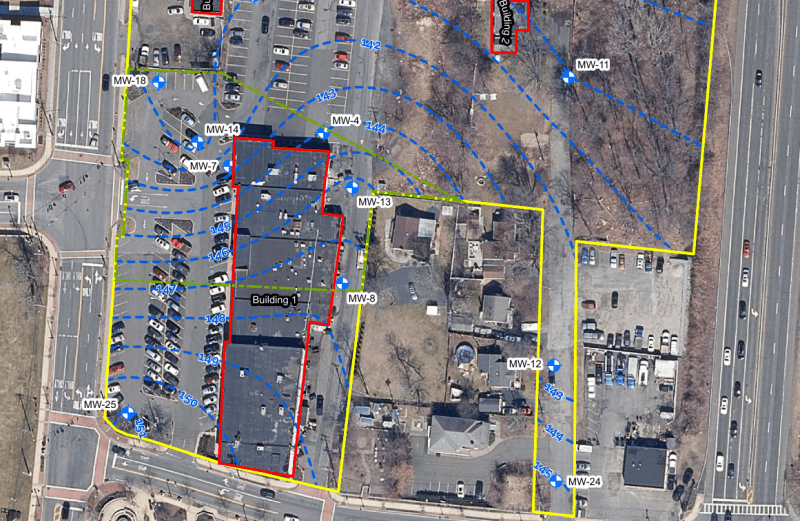
Zitt is asking the Planning Board to take a harder look at an environmental easement that was placed on a portion of the property and monitoring wells outside the BCP boundary — even though neither the proposed residential building nor his client’s house is located within the easement. Rather, his concern is that monitoring wells the DEC required post-cleanup show underground contamination that could be migrating in the groundwater beyond the parameters of the environmental easement.
In a March 8 letter sent to the board, Zitt said the Planning Board is not taking the necessary “hard look” at environmental impacts as required by SEQRA, and that it has not been creating a detailed record of the steps the town has taken to study and review the environmental issues.
Zitt also takes issue with the disclosures made on the Environmental Assessment Form (EAF) submitted by the developer. He says the EAF refers to the BCP (Brownfield Cleanup Program) site generally. However, the EAF also includes a specific question asking whether the project site is subject to a ‘institutional control limiting property uses (e.g. deed restriction or easement).’” Zitt says the EAF form submitted by the developer “appears to have been answered in the negative.”

The attorney also says, “the Planning Board should consider requesting confirmation from DEC that the proposed development plans, including any excavation, subsurface construction, soil intrusions, utility work, grading, or building modifications, have been reviewed for consistency with the Environmental Easement and the SMP and will not interfere with the existing remedial systems or monitoring infrastructure that remain in place at the site.”
Lino Sciarretta, the attorney representing K/BTF, said, “Ownership meets all the annual testing and reporting requirements for New York State and DEC.”
A Site Management Plan (SMP) was implemented to monitor the site, primarily through periodic testing, including evaluation of monitoring wells in and around the impacted areas. As part of the clean-up, the DEC recorded an “Environmental Easement” for the 1.1387 acres, and mandated extensive monitoring wells outside the affected area and periodic testing and reporting. A revision of the SMP to reduce the number of wells being monitored was approved by NYSDEC on June 27th, 2023. The most recent testing report available on the DEC website is dated November of 2024.
The residential, mixed-use building planned for New City Center sits just to the east and north of the easement area and does not have any use restrictions from the DEC or the SMP, but a series of monitoring wells sit outside the 1.1347 acre easement, including at least one in close proximity to the site where the residential building is planned, according to maps available on the DEC site.
The owners of New City Center, also known as the Shoprite Plaza, on North Main Street in New City have a redevelopment plan calling for new retail buildings, a shopping center re-design and the addition of a five-story, mixed-use structure with 103 residential units, a swimming pool, and enclosed ground floor parking. The new structure would include 8,733 square feet of ground floor retail and about 95,000 square feet of residential space between West Evergreen and Route 304. The plan calls for merging nine lots, with eight mostly adjacent to the existing Shoprite Plaza.
The redevelopment and inclusion of a residential component is permitted since the Town of Clarkstown in 2023 amended its zoning code to create the New City Hamlet District. The new zoning was part of the implementation of Clarkstown’s Comprehensive Plan. The main zoning change was in the H4 district, which encompasses the shopping center properties between Main Street (North and South) and Route 304. The town sought to encourage denser development by allowing residential and mixed-use projects to supplement or replace existing shopping plazas.
Nearly all of the discussion about New City Center at recent Clarkstown Planning Board meetings have focused on traffic volume and flow and pedestrian safety.
The Shoprite Plaza covers more than 14 acres, but the contamination from the dry-cleaning operation affected only 1.14 acres of the site, primarily around the buildings housing retail on the southern portion of the site, and fanning out toward North Main Street and encompassing West Evergreen. The shopping center is part of the New York State Department of Environmental Conservation’s (DEC) Brownfield Cleanup Program (BCP) stemming from a dry cleaning operation by Robbie J Cleaners that operated on the site dating back more than 20 years. An eight-year clean-up was completed in March 2015. The cleanup showed that the soil, groundwater, and soil vapor were contaminated with tetrachloroethene (PCE), and to a lesser extent, PCE breakdown products. The contaminants have been contained but the state requires the property owner to monitor the property and file reports.
A presentation by the developer scheduled for the March 11 Planning Board meeting was pulled from the agenda just before the meeting. A new date has not yet been set.