









|
RCBJ-Audible (Listen For Free)
 |
Chair Factory Moving Along; Developer Expects To Break Ground in June
By Tina Traster
The North Rockland Central School District joined the Village of Haverstraw and Rockland County in signing onto a PILOT (payment in lieu of taxes) plan that pushes the Chair Factory project one more step ahead, while the Town of Haverstraw left the payments behind.
Haverstraw (Town) is the only entitled jurisdiction that declined to sign on, which comes as little surprise given that Town Supervisor Howard Phillips expressed ardent opposition over the plan, which the developers of the Chair Factory maintained they needed to build affordable housing on the fallow 14-acre waterfront site in the Village of Haverstraw.
It was Phillips’ opposition to the proposal of a PILOT that delayed the affordable housing project for more than two years. Then, in a stunning turnaround, developers MPact Collective LLC, of Huntington Station, Long Island, with co-developer Pennrose NY LLC, found a way around the obstacle. Empire State Development (ESD), an economic development arm of New York State, will acquire the fallow property from the village and issue a ground lease to the development team.
The developer has paid $4 million for the portion of the site where they plan to build affordable housing. ESD stepped in because Gov. Kathy Hochul has made the critical need for affordable housing a keystone issue.

The Chair Factory plan will transform the weed-choked rodent-infested site on the Hudson River into a 450-unit mixed-used development (70 percent of units will be affordable including set asides for veterans, seniors and those below an income threshold ). The project includes commercial space and a bi-level structured parking garage for the town’s workforce, veterans, and seniors. The plan also calls for floodplain mitigation, and four acres of public parkland.
ESD can issue bonds, grant loans, and offer tax exemptions and abatements to finance the project, acting as a “one-stop shop” for development and funding. ESD centralizes control over the project’s development and environmental compliance, giving it maximum flexibility and minimal local regulatory interference.
The PILOT agreement is a contract between the developer and the taxing authorities. The taxing authorities are guaranteed a steady flow of payments, and in return the developer waives its rights to challenge the PILOT payments. And, while the parties could renegotiate the payments during the life of the PILOT, a new schedule cannot be imposed on them without their consent.
Last January, the Rockland County Industrial Development Agency (IDA) authorized a raft of benefits for the $340 million project, including $1.65 million exemption from mortgage tax recording, an $18.5 million exemption from sales tax, and the approval to participate in a PILOT program. PILOTs schedule payments to taxing jurisdictions over a long term. They provide certainty of revenue for the county, town, village, and school district, though the amounts are typically lower than assessments based on fair market value. The incentive is necessary to make a project financially feasible for project lenders, not to enhance the profitability to the developer.

The PILOT between the Chair Factory partners and the three municipal bodies runs for 24 years. From 2026 to 2028, the developer will be on the hook for relatively small payments during construction and lease-up. Payments increase once the project is completed and occupied. For example, payments to the county are just over $1,000 annually; payments to the Village of Haverstraw are just over $7,000 annually. And, with no students anticipated to live at the Chair Factory until 2029, payments to the North Rockland School District are around $24,000 annually.
The Town of Haverstraw, having declined to participate, gets no payments, either in the early years, or through the 20-year life of the PILOT. Two sources said it’s too late for the Town of Haverstraw to change course on the PILOT
Once occupied, payments to the village, county and school district ramp up dramatically, though the lion’s share of the payments going to the School District. Over the 24-year PILOT, the village will collect $851,370, the county, $121,625. Payments to the North Rockland School District will increase significantly over the life of the PILOT agreement, with the school district receiving a total of $14,144,347 over the lifetime of the project.
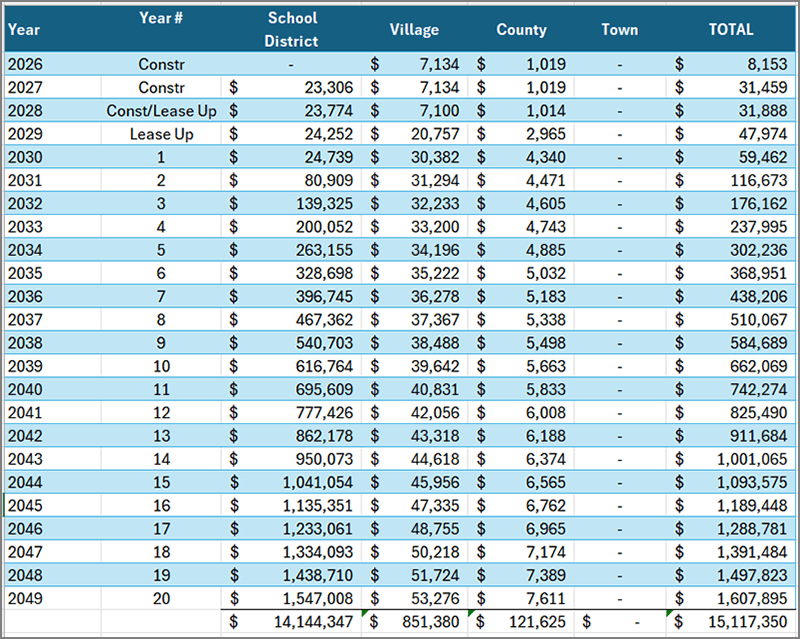
Last year, the North Rockland School District retained Storrs Associates to advise it on the PILOTs proposed by the developer. The amounts agreed upon are based upon a report by Storrs Associates from July 25, 2025.
RCBJ requested a copy of that report, but the School District refused to provide it in response to a FOIL request.
Several aspects of the project are moving ahead or are completed, with major planning, environmental review and design work completed. The developers say they expect to break ground in June.
“Over the coming months, the team expects to begin demolition of existing structures on the site, clearing the way for full redevelopment,” said Ryan Porter, a principal with MPact. “At the same time, work is underway to finalize infrastructure solutions, including utilities, shoreline improvements, and roadway connections that will support the project and the surrounding downtown.”
The development team is completing the remaining county approvals, including health department signoffs and subdivision approvals, while continuing to coordinate with village officials and partner agencies, the developer said.
Village of Haverstraw Mayor Michael Kohut said the project is moving along but there “are still issues they have to address, particularly with sanitary sewage conveyance. There are problems that exist in transporting sewage to the Joint Regional Sewer plant.” He added, “pipes for transporting sewage are too small for the anticipated increased capacity. It is incumbent for the developer to pay the cost for upgraded infrastructure. but we expect that will be worked through.”
Rockland County is in dire need of affordable housing. There is a deficit of 4,230 affordable units for those making under $60,000 annually, according to the Rockland County Housing Needs Assessment, prepared by Hudson Valley Pattern for Progress. The report says 57 percent of Rockland homes are single-family detached homes – unaffordable to the average resident. The single-family average sales price is $683,000. A median household income of nearly $100,000 can qualify for a $260,000 mortgage. And fewer than 2 percent of single-family homes sold are less than $300,000 according to the 2022 Multiple Listings Service.