







|
RCBJ-Audible (Listen For Free)
 |

Village Outside Counsel Recommends Planning Board Limit Environmental Review Of Controversial Yeshiva Project On Route 9W
Residents in Upper Nyack have banded together in opposition to a proposal before the Village Planning Board to convert a long-vacant office building that formerly housed the Alliance Theological Seminary into a yeshiva for pre-K through 8th grade students.
There is nothing in SEQRA that enables a municipality to bypass SEQRA and conduct an alternative (even if similar) review.
Congregation Ramapo Cheder plans to lease the building at 350 North Highland Avenue (Route 9W) from Nyack Building LLC, an entity that purchased the property from Yeshiva Viznitz Dkhal Torath Chaim after Viznitz acquired the Nyack College properties in 2020.
Ramapo Cheder plans to use the building, with interior and exterior modifications, for 440 boys and 90 staff members. The building’s footprint would remain unchanged, but the interior would be reconfigured for the new use, and the façade would be updated. Day schools are allowed by Special Permit in the OB zone, where the property is located.
A group of over 100 neighbors living in close proximity to the proposed yeshiva formed High Plains Management, LLC, (HPM) according to its attorneys at White Plains-based Marks DiPalermo & Wilson. Neighbors’ concerns range from traffic to safety to runoff to loss of habitat, but before any of those issues are examined or resolved, HPM is contesting the manner in which the environmental review should be conducted under New York’s State Environmental Quality Review Act (SEQRA). The group has raised over $20,000 in a GoFundMe campaign to fight the approval.

Before any approvals are granted, the preliminary issue of how the environmental impacts of the project should be reviewed has to be decided. Every proposed project impacting land use is subject to the State Environmental Quality Review Act (SEQRA), a law that determines the depth of environmental review undertaken depending on the potential adverse impacts of the project.
After a town or village receives a land use application, a determination must be made as to who will serve as “lead agency” for purposes of environmental review. In this case, Upper Nyack’s Planning Board designated itself as lead agency.
The next step is for the Planning Board to make a decision about the scope of environmental review based on the type of application submitted. The Planning Board has three choices: a Type I action (one that presumably will have significant environmental impacts that must be studied); a Type II action (one that is presumed not to have significant environmental impacts); or an Unlisted Action (one that falls in the middle and may have environmental impacts, has no statutory exemptions from environmental review, and does not fit neatly into a Type I action).
The designation is critical, as each carries with it a different level of environmental review, with a Type II action being more or less exempt from intensive environmental review. Type II actions also deny the public the right to participate in determining the scope of environmental review, if any, and preclude the preparation of a detailed Environmental Impact Statement (EIS).
In a November 14 memo, Upper Nyack’s outside counsel, Hocherman Tortorella & Wekstein, LLP, recommended that the Planning Board consider the proposal as a Type II Action under SEQRA. The decision was largely based on a statutory exemption for the “reuse of residential or commercial structures.” The exemption likely exists because of a presumption that environmental impacts, if any, are already existing or have already been adequately examined or mitigated. The memo also contemplated that an environmental review would be adequately addressed as part of the application for a “special permit.”

The neighbors strongly disagree with that opinion and is urging the Planning Board to reject it. HPM argues that the project is much larger than simply the reuse of the former Alliance Seminary building as the proposal includes modifications to the building, the grounds, the addition of a secondary access road and necessary off-site modifications to Route 9W under the New York State Department of Transportation’s supervision. It also argues that the project is not a residential of commercial structure, and should not be treated as one, under a narrow reading of the Type II statutory exemptions.
Counsel for the Nyack School District agrees, and in a separate memorandum submitted in November at the close of a public meeting, urged the planning board to reject the advice of its counsel and declare the action as Unlisted. Nyack School District attorneys say the “reuse” exemption only applies to residential or commercial uses, not institutional, community, or educational uses. The school district attorney urged the Planning Board to reject the recommendation of its outside counsel,.
The difference in categorization is significant as related to environmental review. Both Type I and Unlisted Actions are subject to meaningful environmental review, and the Planning Board would also have to decide whether to give the application a “positive’ or a “negative” declaration under SEQRA. A positive declaration would require an extensive environmental review with public participation and consideration of both mitigation of environmental impacts and alternative uses for the property. A negative declaration would mean that the potential environmental impacts were studied through a series of submissions by the applicant and that the Planning Board was satisfied that no further study was necessary and that all impacts will be mitigated as part of the approval process. (There is a middle ground, a Conditional Negative Declaration which would attach contingencies to site plan approval and require the applicant to take affirmative mitigating steps as part of its approval.)
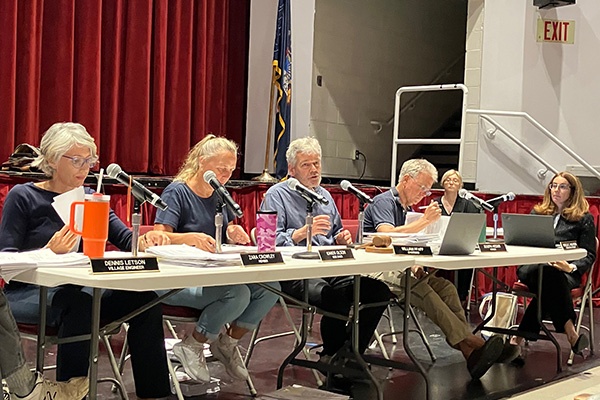
If the Upper Nyack Planning Board accepts the recommendation of its counsel, then it need not conduct a formal environmental review of the project under SEQRA. Opposition to the project has filled the auditorium at Nyack High School over a series of meetings in the last few months. Neighbors have expressed deep concern about the safety of the road and neighborhood, as well as safety to pedestrians and cyclists, and are skeptical about the introduction of turning lanes, saying they would lead to longer delays as cars and school buses backed up waiting to enter and exit the yeshiva.
The Planning Board has been treating the application as a Type II action (one that does not warrant further review under SEQRA), partly on the assumption that the Village would conduct an in-depth review as consideration for issuing the “Special Permit” that the project needs. Although the issues reviewed may be similar, there is nothing in SEQRA that enables a municipality to bypass SEQRA and conduct an alternative (even if similar) review.
A memorandum on the Village website dated December 5, 2025 provides” “Due to changes in the proposed plan and comments received from members of the public the Planning Board will review the SEQRA classification of this action. It is anticipated that this will occur at the Planning Board’s January 21, 2026 meeting.”
The Planning Board could defer to counsel and maintain the Type II (no review) designation or consider the action as a Type I or Unlisted and conduct further review under SEQRA. It is feasible that the Planning Board could declare the action as Type I or Unlisted and still provide a “negative declaration” — meaning that it acknowledges some impacts, but either finds them not significantly adverse or that they would be sufficiently mitigated by the applicant.
More recent changes to the plan include changes to the grounds, including reconfiguration of the parking lot, internal drives, and the addition of a second access road for emergency vehicles.
Plans have also been submitted by the applicant’s traffic engineers to the New York State Department of Transportation to modify Route 9W with turn lanes going up to the yeshiva, as well as adding a turn lane onto Riverton Drive.

Consideration must also be given to approved plans for Nyack High School to modify its Route 9W access by creating a four-way signalized intersection across from Birchwood Avenue with a left-turn lane into the high school from Route 9W. This scenario would create two left turn lanes (one for each school) along northbound Route 9W.
Route 9W is already clogged with school bus traffic and serves as the primary access to Nyack Hospital’s emergency room on North Midland Avenue.