








|
RCBJ-Audible (Listen For Free)
 |

The Plan May Hinge On Clarkstown’s Consent To Cluster Large Homes On Small Lots In New City
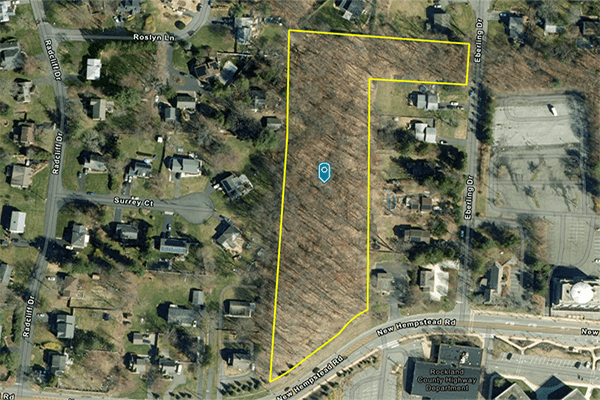
Clarkstown’s Town Board last month deferred a decision on allowing a planned subdivision off New Hempstead Road and Eberling Drive to cluster homes on one of the last wooded residential parcels in that section of New City. The applicant, Rockland Housing Action Committee (RHAC), a nonprofit HUD-approved agency dedicated to preserving and creating affordable housing for low to moderate income individuals and families, needs approval from the town to cluster housing; a non-clustered plan, which would be spread out on the 4.22-acre parcel, has been given preliminary approval by the town’s Planning Board.
The seven home development is slated to be built across the street from the Rockland County government complex on New Hempstead Road. The empty tract also sits to the west of the county-owned Sain Building redevelopment site. Rockland County has solicited proposals to redevelop the long-vacant Sain Building to affordable rental housing where at least 75 percent of units will be set aside for workforce and middle-income earners.
This proposed project, known as the Eberling Homes Subdivision, is sui generis because the proposal offers luxury housing at deep discounts to a small group of people.
The seven single-family homes conform to an “as-of-right” use in the zoning district, which means no variances are required. The homes would be built on a 4.22 acre parcel in the town’s R-15 zone (single family residences on a minimum of 15,000 square feet lots).

The homes are large – 2,200 square feet, with three-bedrooms, two bathrooms, eat-in kitchens, living rooms, dining rooms, and one car garages, each with its own EV charging station adjacent to a paved driveway. The developer estimates the homes would sell on the open market for about $768,000. But these homes, which would be marketed as “affordable” under Rockland Housing Action Committee, will sell for about $350,000.
The seven purchasers must be first-time homebuyers earning 80 percent of the 2024 Rockland County HUD median income of $133,400. A family of four can earn up to $124,240 to be eligible. The applicant needs to cluster the homes to reduce infrastructure costs, including sewers, water, and other utilities, as well as mitigate disruption to steep slopes on the lot.
Construction costs for the seven homes is estimated at $5,385,690 (about $450,000 per home), according to RHAC.
The RHAC partnered with Rockland County, which will provide a grant of $1,450,000 ($207,143 per home) from the county’s unused American Rescue Plan Act (ARPA) funds. New York State Housing and Community Renewal (NYSHCR) would provide $1.4 million ($200,000 per home) and the Federal Home Loan Bank would provide $385,000 ($55,000 per home).
Unspent ARPA funds can be used for affordable housing development. But while the United States Treasury guidance encourages using funds for affordable housing, projects must meet criteria like creating new units or preserving existing ones, and funds must be fully spent December 31, 2026.
Home buyers would also receive property tax breaks based on the reduced purchase prices of the homes. The developer is seeking a waiver of having to pay $73,850 to Clarkstown, a standard money-in-lieu-of land (MILL) fee paid by other developers creating subdivisions.
To keep the houses affordable and to prevent flipping of the homes after purchase, deed restrictions of 30-years are proposed to limit the resale value of the homes for the first 30 years of occupancy. The details of the deed restrictions were not disclosed, but Town Supervisor George Hoehmann requested the restrictions be in perpetuity, instead of limited to 30 years, based on the amount and use of public money that would make this project feasible.

The project (without clustering the homes) has preliminary approval from the Clarkstown Planning Board, but the developers say that clustering the homes will help preserve some of the steep slopes existing on the land and preserve some of the trees slated for removal.
Under Clarkstown’s code, the town board can approve clustering, but only after the planning board approves a project as-of-right on the site. The cluster plan would eliminate the need to access the subdivision via New Hempstead Road and would cluster the seven homes on smaller sites on the north end of the property.
Under the submitted Tree Preservation Plan, a significant number of trees will be removed to facilitate the construction of the proposed homes. Trees to be removed include about 175 mature maple, cherry, walnut, oak, beech, mulberry, catalpa, and hickory trees. The County Planning Department, in its review, expressed concern over the loss of such a large number of trees.
Residents on and near Eberling Road spoke at the public hearing last week, opposing the concentration of houses the cluster plan would permit and the disruptions the seven homes bundled on small lots would create. Others decried the overdevelopment along North Main Street and the failure of the town and planning boards to take a comprehensive and holistic look at the impacts of so much concentrated development.
Amy Levitsky of Verdin Drive referred to the “failure of planning that is creating a public safety crisis on North Main Street,” noting “at least four major projects along this corridor—Eberling Homes, new senior housing, a shopping center, and a large school.” She said, “the piecemeal review, which ignores the combined traffic nightmare these projects will create, is an abdication of the Town’s duty under state environmental law.”
The town deferred a decision to a later date, and asked the developer to return with specific answers as to whether the project would be built if the town denied the clustering, and for an update on how the deed restrictions would work.
Earlier this year, a plan by the RHAC to construct and cluster 17 duplex-style affordable homes at 55 Schriever Lane in New City was scrapped. That project also relied on $462,143 of subsidies per home, enabling the purchase price of the $768,000 homes to be sold for $306,241 to low-income buyers earning up to 80 percent of Rockland County median.