




The Study Details Economic Benefits Far Beyond Its Direct Spending On Operations, Capital Improvements, and Employment
Let’s face it. Electric and gas utility companies are under enormous pressure from local residents to keep rates down. The proliferation of proposed and existing data centers in Rockland County breeds fear into the hearts of Orange & Rockland Utilities (O&R) ratepayers who may be forced to subsidize the infrastructure investments needed to provide service to these new power-hungry industries. New York’s legal “duty to serve” requires the utilities to provide the power to run these facilities, making both data centers and utility companies ever less popular with the populace.
To meet its obligations, O&R makes extensive investments in the local grid every year, maintains and improves the existing infrastructure, and upgrades service to secure a reliable, uninterrupted power supply to residents and businesses alike.
O&R powers our local economy and its impacts are felt way beyond its direct spending.
According to a report compiled for the company by HR&A Advisors, an economic development consulting firm, O&R generated $2.4 billion in total economic output in 2025 in its six-county service area in New York and New Jersey, which includes Rockland County. The bulk of the economic output, $2 billion, was in New York, according to the report.
To calculate its economic output, the “Orange & Rockland 2025 Impact Study” tracked direct spending by O&R, as well as the value of both indirect output and induced output stemming from its contracts, employment, and participation in the local economy.
Direct spending in New York, according to the report, totaled $1.3 billion in 2025, supporting indirect output of $394 million, and induced output of $302 million.
While direct spending (spending on operations and capital improvements) is quantifiable, indirect and induced spending are “spinoff” activities, calculated through multipliers. A multiplier effect occurs when an initial investment leads to a greater overall increase in economic activity, amplifying (or multiplying) the original expenditure.
Here in Rockland County, recent infrastructure investments (though not necessarily all in 2025) include a $24-million replacement of two transformers at the Corporate Drive substation in Orangetown, a $4.8-million project that upgraded a transformer at the Monsey substation, and a $57.8-million project in Clarkstown to install new underground transmission lines from the Burns substation to the West Nyack substation.
“Indirect output,” according to the report, represents the money spent by the businesses that do business with O&R stemming from O&R’s direct spending. The report provides an example where O&R hires a law firm to provide legal services. The law firm’s spending attributable to O&R would constitute an “indirect economic output.” Another example is where a local tree trimmer buys new equipment to provide services under an O&R maintenance contract.
“Induced output” represents the economic impacts stimulated by additional household spending due to wages from both the direct and indirect activity, including, for example, spending at restaurants within the region by both O& R employees and by employees of businesses that do business with O&R. — the legal staff and tree trimmer.








The 2025 Impact Report uses a similar spinoff and multiplier analysis to gauge its impact on local employment.
O&R employs 1,200 people in New York State and the report details generation of an additional 2,170 jobs – 800 “indirect” and 1,370 “induced” jobs.
In other words, the spending and employment have an impact beyond O&R and generate what it refers to as “spinoff” employment and economic benefits.
The report also touts spending of $70 million on contracts with small businesses, $23 million invested in clean energy and electric-infrastructure improvements directly benefiting disadvantaged communities, and $23 million provided to reduce the bills of 17,000 low-income customers through the Energy Affordability Program (EAP).
“This report shows that our commitment to powering the region goes beyond the grid—it’s an investment in people, jobs, and shared prosperity,” said Michele O’Connell, O&R president and CEO. “We are also investing equitably in local infrastructure and creating stable, long-term careers for the New Yorkers and New Jerseyans we are proud to serve every day. We know that our success is entirely built on working hand-in-hand with the families, businesses, and communities we are privileged to serve every day.”
In 2025, O&R spent $23 million on reliability and clean energy investments benefitting customers in Disadvantaged Communities (DACs). DACs are specific census tracts identified by the state as bearing a disproportionate burden of environmental pollution, climate change impacts, and socioeconomic challenges, according to the report.
The report also describes $60 million in local property taxes paid in Rockland County, $37 million in Orange County, and $1.8 million in Sullivan County.
O&R provides delivery services according to an approved three-year rate plan that is set to expire in December of 2027.
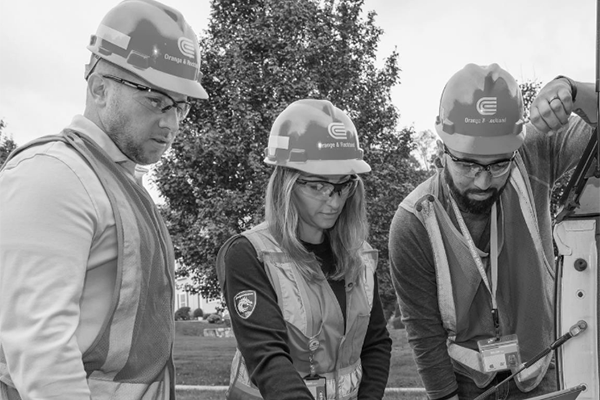
Featured image from O&R 2025 Impact Study